
Augusto Latorre, Mesa County gleaning and food systems coordinator for UpRoot Colorado, joins Lisa to talk about the important role that gleaning plays in our food systems. UpRoot’s mission is to increase the nutrition security of Coloradans by harvesting and redistributing surplus, nutrient-dense foods while supporting the resilience of farmers. Learn all about it and what drew Augusto to this organization on today’s Postcard From Palisade.
Subscribe:


Transcript:
Lisa: How did the glean go this morning?
Augusto: It went really well. So it was officially my first glean since I started.
LM: Hold on, what’s a glean? What exactly are we talking about on this podcast today? Augusto Latorre joins me to talk about the important role that gleaning plays in our food systems. Augusto is with UpRoot Colorado, a 501(c)(3) nonprofit with locations across the state. Augusto is the new Mesa County gleaning and food systems coordinator for UpRoot.
The central idea of gleaning is that it’s a process to get food that would otherwise be wasted to people who otherwise wouldn’t have enough. Augusto goes into all the details, including the historical origins of this practice, how gleaning works, how it benefits farmers, the community, and the environment, and what drew him to this organization.
And then I join in and share my experience of being a farm worker for a day. Or, OK, for two hours. Keep listening for all that and more, on today’s Postcard From Palisade!
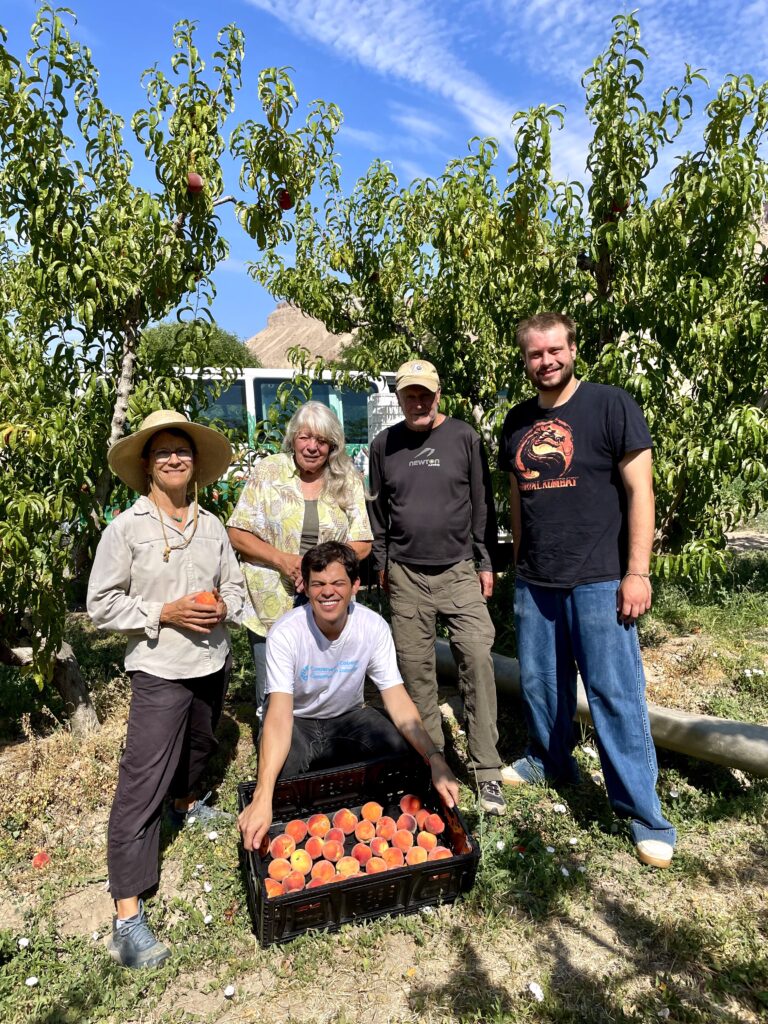
Augusto: So it was officially my first glean since I started. We have done a couple harvests, but this one was officially the first glean with Just Peachy. Just a couple, like a mile that way. Yeah. And it went great. Just Peachy had connected with us during Palisade Farm Festival. We had a booth with UpRoot. And he connected with us and we stayed connected. And he has had summer squashes that he picked and he was not able to sell that he connected with us to have us pick it up and take it to the food pantries and so on. And this time on Monday, I came to pick up some summer squashes. And he’s like, hey, do you have time to go check out some peaches? And I’m like, sure, let’s. Let’s go. And he’s like, we’re a little concerned that the heat from Monday to Wednesday would over-ripen them. But, they were okay. And we had six volunteers.
Lisa: That’s awesome.
Augusto: Come out. And we collected close to, I think, 400 pounds of peaches. Yeah. Yes. It was nice. So excited for my first glean. And those have already been distributed, so it’s easy to find home for delicious peaches.
Lisa: That’s awesome.
Augusto: Yeah.
Lisa: All right, before we get too far, you should introduce yourself.
Augusto: Yeah. okay. So, my name is Augusto Latorre. I am originally from Venezuela, but I’ve lived in the US for 20 years. My 20th year anniversary would be at the end of this month. But I, in the West Slope, I’ve been for just under two years. And before that I lived in Texas and in Massachusetts. Yeah. And I work as Mesa County, gleaning and food systems coordinator. I started on this role a couple of months ago. Yeah, happy to be in the area, exploring. It’s just been a couple years, and now in this new role, trying to, you know, find, my way and support my community as, best as I can.
Lisa: So I first met you when you were the community engagement coordinator at La Plaza, and so you’ve since moved over to this other role, which seems really cool and excited for you. But when you were kind of telling me about it, what I thought was so interesting. Well, I think the whole thing’s really interesting, but, the concept of gleaning wasn’t something I had come across before, so I got really excited about it and learning more about it and kind of sharing it with everybody. So, like, first of all, I think the word gleaning is really cool. So can you just talk a little bit about, like, what does that even mean and where did it come from and why is that kind of what the focus is for this organization?
Augusto: Yes, so gleaning, it has deep roots. It comes up in the Old Testament and the Torah. It was a practice that landowners used to do, where they would leave excess or just crops in the fields for people who didn’t have the means to buy them through other avenues, so that they could go to the fields and collect it. Collect those themselves. So practicing food equity, in that way.
UpRoot has been around in Colorado. it’s the only gleaning organization in the state of Colorado, since 2017. It arose when the founder, at that time, David, in 2016, he had an event with volunteers where they collected surplus crops as well. If I’m not mistaken, that might. If I’m not mistaken. Yeah, it was kind of like they were doing a gleaning one-off, and they realized, whoa, this is not a thing elsewhere in Colorado. And that was in 2016. And in 2017, they decided to start the project, to launch it as UpRoot. And it’s been around since.
They did some research before that. So they did some research, like, why would Colorado benefit from a gleaning organization? And how could it be tailored to the needs of Colorado? And so, yeah, it’s been around since then. It’s in seven regions in the state, and in Mesa County, it’s been since, this would be our third season in the area. Before me, my predecessor was Marina, and she was here for a couple seasons.
Lisa: Okay. Tell me about how gleaning works. Like, how does, how does the whole process work? How do you all know, like, where do I glean? What do I glean? When? (such an eloquently stated question, right?)
Augusto: So gleaning, and like you said, I also found about gleaning when I first heard about UpRoot, about a year ago, when I was, like, in the nonprofit world. And so across. It’s been around for thousands of years. Across time, it’s taken different shapes and forms. Today, it looks like going to commercial farmers or producers, and first you would establish a connection with them, presumably. And then whenever they have an excess, then they would contact, in this case, us, UpRoot Colorado or a different gleaning organization and let them know, like, hey, we have peaches in excess that we cannot harvest or market or they’re not cosmetically adequate for the market. They don’t meet the standards.
Lisa: They’re ugly.
Augusto: They look ugly, but they taste just the same.
Lisa: Yes, exactly.
Augusto: And so then they contact us and we go out with them. Hopefully. This is usually how it would play out, check out the site, kind of go over a few logistical components, like how many people do you want in the field? Do you want kids here? Where are the bathrooms, all that. Where can people park? So a lot of those logistical aspects are sorted beforehand with the farmer. And determining how many volunteers he wants. Also scoping out the fruit.
Part of the practice of gleaning, it’s also bringing food that is dignifying. It’s a dignified experience for those who are receiving it. And so we as UpRoot coordinators also have that responsibility of like, okay, is this fruit okay? And that would be kind of like the first steps of coordinating a glean. And then finding a date, sending a glean alert, as we call them, to our list of volunteers. And we have them kind of segregated by areas. And then the volunteers would just sign up and we take it from there.
Coordinators would then, okay, we have the volunteers we need. If we don’t have the volunteers we need, we still do it. And we harvest. We do the glean, I should say, onsite, usually in the mornings, because the heat is brutal. And we pack. Usually, volunteers would support with the part of sorting and packing. Like this morning we had set up the packing operation of the glean out, like by where we were gleaning. So we put everything in boxes, we weighed it, and then volunteers get to take some home as well.
So like with peaches and with many crops, there is first, seconds, and thirds. We reserve the firsts for the hunger relief partners and the seconds volunteers can take, they’re up for grabs. And from there, it’s a distribution part, taking it to the different relief partners, food pantries in the area. Sometimes there is transport volunteers that may be willing to take them themselves. Or sometimes it’s just the coordinators. Sometimes when it’s large harvest or gleans, then we need to coordinate pickup and we do that as well.
Lisa: And then so then the farmer would get some sort of things to say, like.
Augusto: That part, yeah, that’s an important part. As UpRoot, part of the mission is to increase the nutritional security of Coloradoans. To support the resiliency of farmers and to reduce food waste. The farmers benefit. You would hear most farmers don’t want food waste. They hate to see their food going to waste. And sometimes that is a situation that may seem unavoidable because there’s no value for them to harvest it. Like the cost of harvesting offsets the cost of selling it. Or maybe they just have, they don’t have market for it. So it’s always great to see that we can support the farmers in that way.
And then at the end of the year we what we weighed, we assign the value to, just the market value, if it’s peaches, market value for the peaches and they receive a tax donation receipt, which they can then use as a tax deduction. The way it works. So in 2015 actually Congress passed a bill in which this type of donations are enhanced. And it gets a little like nuanced and I don’t understand it all the way but they, it’s enhanced so that the farmer gets an enhanced kind of like tax incentive. And it also expanded the time for which the tax donation receipt is eligible to up to five years. So if the farmer doesn’t have any profit to report, then it wouldn’t necessarily make sense for them to submit the receipt. So they maybe decide to wait until next year, save that receipt, and submit it then.
Lisa: Interesting. Okay. And you mentioned too that you are, you have insurance so that the people who come out and glean, volunteers and coordinators and everybody, is insured. So farmers don’t have to worry about that either.
Augusto: Yeah, there wouldn’t be any liability to the farmer. That’s something that we try to emphasize to the farmers. Like, we’re bringing volunteers onto your farm. Sometimes we’ll be climbing ladders and that’s obviously scary. So we do carry liability insurance for our volunteers.
Lisa: Yeah, makes sense. So there’s farmers obviously. That all seems pretty straightforward and really cool. But then you also have an aspect where there is just say like if I, well I used to have two peach trees. They are no more. But when I did, you know, they would produce a ton of fruit and it was like, you know, I loved picking it. And then you just message everybody and say come get some peaches. But you know, if that weren’t the case or somebody maybe grows like an excess of zucchini or something like that. You work with just regular people too, right?
Augusto: Yeah. Fruit stewards or backyard fruit. Or veggies as well.
Lisa: Oh, okay.
Augusto: Yeah. The term in UpRoot just for communication sakes, it’s fruit stewards. But it’s also tree stewards or. Yeah, it can be just stewards, backyard stewards you can call them as well. But those are not commercial partners that maybe have a few trees, maybe just one in their backyard and they want to find a way to distribute like what they can not eat themselves or consume themselves. So that’s also a part of UpRoot’s gleaning program. And yeah, it’s great. We had someone last month, with an apricot tree and we connected with her and it’s like I’ve seen so many here around Palisade. And so we’ve also been doing outreach there to try to connect with some people that maybe would be interested.
Lisa: Yeah, especially this year I noticed there are a lot of apricot trees and they just would ripen and fall and like, that really is painful to see that. So I think that’s such a cool aspect too. And one of the things I think is, I mean one of the many things I think is great about the organization is like how many different ways there are for people to get involved, depending on what they have or what they can do. So you know, not only is the farmers, and you said the backyard stores, and then people can volunteer to participate in the gleans. People can always donate. What’s the best way for people to get involved for each of those things? Like how do somebody hears this and they’re like, oh, I want to do that. Like, what is the pathway?
Augusto: Yes. So going to UpRootcolorado.org you will see options to kind of learn about all these different opportunities and to be a fruit tree steward. You would just go to the section that it says get involved and then you can sign up there as a fruit tree steward. We would receive an email and then we would get in touch with you as a potential fruit tree steward, or backyard steward. And.
Lisa: Steward, you said, okay. I thought you said store!
Augusto: Yes, steward.
Lisa: Okay, steward. Okay, gotcha.
Augusto: Yeah. And as a farmer there is also a section you can go online and then you would fill out a short form that would give us a bit of information about you. And then we would get back in contact with you to sort of like get that conversation going, get more information, and see where the partnership could lead to. As a volunteer, you would also go to that get involved section in our website UpRoot. And you sign up, you sign up first to like our mailing list and then we would sign you up to receive those emails. And once you first, like after you start receiving those gleaning alerts or those notifications for gleans in the area, then when you sign up for that, for one of those you would create a profile which then you just create it once and then you have your profile. You can just go back and register for any volunteering opportunities.
Lisa: Okay.
Augusto: And as hunger relief partners, if you’re a hunger relief partner and you want to get in touch with us, you can also do that through our website. There isn’t necessarily one dedicated section for hunger relief partners in our website. But there is a section to get in contact with us and we would get those emails as well as we would get the other ones.
Lisa: Okay.
Augusto: Yeah. I can also mention like for those who are getting involved, especially the volunteers, part of our mission. Our vision as well is to bring like the experiential learning experience. It’s a little redundant, but hoping that this will connect the volunteers and just the community in general with our foodshed and where our food is coming from, with the farmers, with the labor of farming and what it all means. And hopefully that kind of stewarding our food systems as an organization as well from that angle, as well as the angle of reducing food waste and bringing it to those who may not have access to fresh and local produce.
Lisa: Sure. I noticed on the website too, which I’m just looking at as we’re talking, that there’s an impact section and it’s really impressive. I mean this is for the state of all of Colorado. But I think the latest report on there is from 2024 and you know, 150,000 pounds of surplus fruit and veggies harvested and redistributed is like amazing. It says 1.9 million servings. And you know, I’m sure that it looks like in the past it’s just continued to grow. For that again, that’s for the state as a whole. But still, if you think about where you’re focused, we do have a lot of farms and everything here. Be interesting to know how much came from Mesa County. But yeah, I mean that’s just so impactful to see that number because it’s like that would have otherwise gone to waste. Most likely, you know, it would have gone or, or maybe it would feed pigs or chickens or something, but, or goats, but, you know, it’s feeding humans. And that’s really cool to see that number.
Augusto: Yeah, that’s, It’s. It’s like, like you said, it’s, it’s like inspiring, encouraging to see that. At the end it’s important also to kind of like see the impact, data has. Has its usefulness, for sure. And yeah, those numbers from 2024, from 2025, like an updated count is close to 500,000 pounds of food harvested.
Lisa: So that’s like a huge. Oh, like wait. Sorry to interrupt you.
Augusto: No, it’s okay.
Lisa: Let me just let you finish.
Augusto: No, go ahead. Yeah, it’s an increase because that number, well, in 2024. I’m not sure from what time period it is. This one is as of April 2025. So more than a year ago, it was 460,000 pounds of harvested and gleaned produce crops. And that amounted to around 5 million servings. And those are in seven regions. So as I mentioned, we have a presence in seven regions. It’s Larimer county and Fort Collins area, Boulder area, metro Denver, and Pueblo and Ontario counties, and Roaring Fork Valley and Garfield County, North Fork Valley, and Delta County, and then Mesa County, which I think is one of the younger or the areas where we have been in the least amount of time.
Lisa: Okay.
Augusto: But yeah, so.
Lisa: Seems like there’s a huge opportunity here.
Augusto: Yes, I mean there is from my research, and don’t quote me on this, there is more than a thousand farms in the Palisade/Grand Junction/Fruita area. And I think it’s actually, that’s an underestimate. And not that all of them are producing or anything, but there is a big potential here. We think so as well. It’s also part of the work that I do as a coordinator. It’s doing outreach, getting the name out and seeing if there’s interest.
Just kind of some numbers that have been helpful for me as I started my role here is, in Mesa County the latest numbers on nutritional and food insecurity, put Mesa County at 13% of its population being food insecure. Which means that at least in one occasion throughout the year a family might forego food or their food budget to pay rent or pay electricity. So they have to choose between paying rent which is usually a fixed value and forego food. That’s around the same amount, the same percentage as the rest of the United States. Colorado is a little lower. Colorado is closer to 12%. So that’s the population that we are kind of, we just try to harvest excess and bring it to the community to kind of bridge that gap in general. And what’s interesting as I was learning as well is like out of those 13%, 35% of them wouldn’t really qualify for SNAP either. Which is an interesting indicator. I was trying to think is that because of inflation where food is a lot more expensive or you know.
Lisa: Yeah broken programs, systems.
Augusto: And yeah part of like this data sometimes we’ll have like mini lessons during the gleans and so we’ll put them a little more structured and then bring it to volunteers. Because the experiential learning along with the mini lesson as we call them I think would complement themselves very well and it kind of plants the seed or kind of pollinates the community to be food stewards themselves and it’s slow and important work. I think that’s something that as a coordinator and in my role previously as community engagement coordinator, I’ve noticed that working with the community takes a lot of patience and trusting in what you’re doing. I have more statistics about farmers that I can share that is like quite impressive.
Lisa: Yeah, that’d be awesome.
Augusto: It’s impressive. It’s a little tough and hard to hear but that’s also kind of why UpRoot has been since this year, it’s my understanding, kind of meet the farmers from a different angle. The North Fork area after the freeze in early April or mid April this year they lost everything, like 100% crop loss across the board. And UpRoot understands that these extreme climate events are becoming more prevalent and recurring. So it’s exploring as an organization ways to support farmers other than just doing gleans or supporting with harvest of excess.
We are hopeful that we can come up with other ways that we can support farmers. Farmers, like 21% of crop workers had families incomes below the poverty line. So we understand the difficulty that farmers face and part of that I mentioned. Bringing this experiential learning to the community members that maybe have no experience with agriculture before is in the hopes that they understand that farmers, which are pivotal for any community and any society, deserve better conditions and more support and more recognition. I think with the awareness that will probably and hopefully it start to change. Yeah, because of all these pressures that farmers are under, there are also statistics pointing that they’re 3.5 times at higher risk of committing suicide and attempting suicide. And it’s combined with like the intersection of many things. Right. It’s rural and more isolated. But also the conditions of the circumstances of working in a food system that is not necessarily very supported. Very, very supportive of them. So we will hopefully have more news and information on what ways we are looking at and exploring to support farmers in more than just harvesting and helping them with the excess crops.
Also, reducing food waste has another angle that it’s beneficial. And that’s the environmental perspective. So and there is an upstream benefit or I should say it depends on how you look at it. If you look at the resources and that are placed in order to, are placed and invested to grow the fruit and the crops, then you would assume or you would expect that that’s not going to waste, that that’s going to be going to someone’s table. But that’s not the case. We know that 31% of the food produced in the US between 30 and 40% is going to waste. That’s around 20% or a little less than 20% from the farms. Like it goes bad at the farms. And then the rest, which is the majority of the food waste, is happening at the households themselves.
So by reducing food waste, you are making sure that those resources that were invested to grow the food are not going to waste. And then the other aspect is that after that, food goes to waste it will go to landfills. And in landfills it undergoes an anaerobic decomposition which emits a lot of greenhouse gases. So if all the food that was wasted in the US were to be kind of calculated as a country, it would rank third in terms of gas emissions, greenhouse gas emissions, after the US and China, which would be first and second. But it produces a lot of methane gas. And methane gas is remarkable for being one of the worst greenhouse gases. It just holds a lot of heat.
Lisa: Yeah, that’s a really interesting point that even think about the end of the life cycle. And I didn’t think about that either. That’s fascinating. I’m curious, since you started, so it’s only been a couple of months, but have you personally like, has there been anything in your experience where like you’ve done a glean, you’ve done some harvests and things like that, is there anything you’ve already come across or learned that you didn’t know before that surprised you?
Augusto: Yes, and I think more so like, it was surprising indeed. It’s like when doing outreach, a lot of the farmers in this. One thing that I learned is like this peak of the season, like starting May through August, it’s not the best time to do outreach and just learning how farmers are so busy, so they need to wake up really early at sunrise because like afternoon, then it gets too hot for them to be out in the fields. And then they even work sometimes in the evenings when the heat goes down a little bit. So that’s been really surprising. And I had an idea of that. Just being in the area, but witnessing it, like seeing the farmers day in, day out, you know, do this labor has been inspiring, but also sort of like a wake up call of like, okay, how can we do more to support the farmers?
It’s been also surprising to see how many small farmers and young farmers are out there and trying to start their own farms. And that’s really inspiring because so many times you hear it’s a difficult field to get into. And so as one farmer told me, it’s not for everyone. And so I see why he mentions that. Another farmer, like doing outreach as well, he kind of looked at me and he was not disrespectful at all, but he was kind of like, he thought he was a little cute, I think where I was coming from, he was like, well dude, we don’t really need help with the harvesting. That’s the easy part. So thank you. But once you are able to help me with everything else, like watering, weeding, please come back. And I’m like, okay. So that feedback is always better. Like, we also, appreciate it. Like, it was short. And like I mentioned, he wasn’t rude. He was just like, okay, thank you, but I really appreciate it. Some other farmers are like, they’ll take your flier and be like, okay, thank you, bye.
Lisa: Like, you want to hear what would be helpful, right? You want that feedback?
Augusto: Right. Even if it’s, like a little hard to hear it. Another thing that was surprising is that, I should mention too, our biggest partner here in Mesa County and they’re partners in other regions that we’re in as an organization is CSU here. And they have the CSU research research station in Orchard Mesa, where they have a lot of crops. And those crops are for research purposes, so they’re not commercial. Amanda McQuaid, who is a coordinator, the food systems coordinator there, she had her own crew of volunteers, who would, since the station, has been there, it’s my understanding since 2018, they would go out and harvest all the crops. And those wouldn’t be gleans, because you’re harvesting.
Lisa: Right.
Augusto: The glean happens after you go through the orchard one time and harvest what you’re gonna sell. But in this case, because they have no commercial purpose in their practice, then everything is just harvested. And what’s not harvested is just for them to do research. So. But this past Thursday, we did our harvest at the station and we harvested five pallets of peaches. So that was like close to 3,500 pounds of peaches, with close to 30 volunteers. And that was like, super. That was very inspiring and encouraging to see that many, that amount of volunteers showing up at, you know, 8:00am in the morning, and donating their time to harvest peaches. And they get to take some home, which is awesome. But the majority is going to hunger relief partners. And yeah, it’s really eye opening to see, from different angles, since I’ve been here for a couple years, how the community comes together and is supportive of each other. It’s a contrast from what you many times see in social media or in the news. So I’m really grateful for the community I’m a part of. Obviously, you know, it’s not perfect but it’s been great.
Lisa: Well, I think I’m excited to have an opportunity to do it because I really liked picking peaches from my two little peach trees. Like, it was really fun. Other than the bugs, which were not great.
Augusto: Have you heard of the insectary?
Lisa: Oh, yeah, yeah.
Augusto: That’s also a place that, as UpRoot coordinator, I’ve learned. And I think I’ve bugged them so many times with like, my colleagues, when they come, he’s like, we need to do a tour.
Lisa: Yeah. Have you gone?
Augusto: Yeah, like four times.
Lisa: Oh, nice. Those are good bugs. I mean, so, yeah, we didn’t spray our tree or anything, so it would just be like earwigs. You know, you pull it. Oh, gosh.
Augusto: Yeah.
Lisa: So I think other people use pesticides or organic products to not have those.
Augusto: Yeah. And, but it’s hard, especially with the heat and the early onset of peaches ripening, which I think it’s across the board. I think it’s increasing pest pressure. That’s what I’ve been hearing anyway. Like, a lot of farmers and even at the research station, it’s like they have more pests, more earwigs and other pests. And more split pits, which is when the peach grows. Like, the pit doesn’t completely kind of develop. And so there is a gap in the middle where the stem goes and then the earwigs make a home inside.
Lisa: Yes.
Augusto: And usually once that happens, the fruit is not edible. But the insectary is an awesome place that I try, I always try to tell people about it because it’s just so cool what they do. And, yeah, those are cool projects. I know that the research station also had a cool project where they were doing research on cherries and they were spraying them with. This is just like, kind of like a fun little thing that I learned. They were spraying the cherry trees with grape Kool-Aid because they’re. I know. And it’s like. Well, it makes the bird’s tummy hurt.
Lisa: Oh.
Augusto: So then they won’t eat the cherries.
Lisa: And humans also! Oh, that’s interesting.
Augusto: Yeah. But it’s organic because it’s not like.
Lisa: Yeah.
Augusto: So I thought that was really cool.
Lisa: I guess it’s like an acid, right? If you don’t put sugar in it, it’s basically like.
Augusto: Yeah. And I would imagine they don’t put sugar. I don’t know. Because then you have ants, but, it’s like, don’t pick these trees because they’re have, they’re research trees and they have grape Kool-Aid and so.
Lisa: That’s awesome. Yeah, and everybody who works at. I haven’t been to the research station but I’m sure it’s similar to like everybody who works at the insectary is just so like, so into what they’re doing and so passionate about it and they’re just fun people to talk to. It’s like a whole little world. I love it.
Augusto: It really is. I really appreciate the opportunity that they have to the community to kind of like can I just see what you’re doing?
Lisa: I know, anybody can just go in. It’s pretty great. It’s wild. So clearly you’re really passionate about this stuff. Like, tell me why?
Augusto: Well so I started, my background is in working in biology labs. So I worked in that for about five years. And then doing research and later on in biotech, less so doing research and working in molecular biology with a startup. So it was a for-profit entity. So yeah, I’ve always had like a deep appreciation for like biology and life and how intricate, interesting, and complex it is, but also in how much it has to teach us as humans.
And so after a while in Massachusetts I was looking at opportunities of joining the AmeriCorps. At that time the Inflation Reduction Act had passed and with that came the creation of the American Conservation Corps I believe it was, which would kind of create a workforce to support conservation, climate change, and educational AmeriCorps terms of service for the community. Community members who wanted to take these opportunities. So the AmeriCorps has like a two-part intention of like capacity-building for the people who are enrolling and also filling in gaps in the community.
So a great example that I like to use is Teach for America, which is also part of the AmeriCorps, where they find early graduates and they connect them with schools in rural areas so that they can go and get their experience there. In areas where there is a high demand for teachers. So in this case, I started looking when that came about, the new corps that was created by the Inflation Reduction Act. I was like okay, this is a great opportunity for me to learn about how I can use my background in biology to approach the different efforts to combat climate change and support the environment, which we are a part of as humans, we’re animals as well, and we’re a part of the larger ecosystem.
But then as a result of that, I ended up accepting a position in the City of Grand Junction in their Housing Division, as housing and outreach specialist. And that was for nine months. And during that time, the new administration came in and they did away with the Inflation Reduction Act. They also cut the AmeriCorps programs quite a bit. And so that kind of put me in a position of like, okay, I had just started in this new position as Community Engagement Coordinator, moving from a research associate position in the lab. So I was still like learning a lot. I was open to that opportunity. But it was certainly a challenge working from a lab, going from a lab environment to working with the community.
Lisa: Yeah. Like you’re dealing with cells to like whole people.
Augusto: Yeah. Which both are fun. But I was at that, that crossroads of like, do I go back to working in a lab with cells, which feel like a little more predictable than people? But I wanted to continue and I wanted to give like the Grand Valley more time and myself more time in it as well. And so then I started working at La Plaza. I applied. The AmeriCorps term of service was for a year. I had already been there for nine months. And the state of Colorado, despite the AmeriCorps funding being cut, the State of Colorado took a stance against that position and that decision. And they said, we’re going to support, we’re going to fund all the AmeriCorps positions in our state until litigation, on this issue of whether the federal government has the right to cut funding like this finishes.
And through that time, I didn’t know, I could have stayed. But I decided to take the job at La Plaza because there was so much uncertainty. The State of Colorado ended up winning, the State of Colorado along with a few other states. So Phil Weiser, who was the Attorney General at the time, he sued, the administration, he was like, you can’t cut the AmeriCorps. And they won that one. It was them and a few other states. And then by that time I was already working at La Plaza. I was in La Plaza for a year. But during that time I found sort of like a passion for working with people and realizing that it’s not all about, as a single person who doesn’t have a family to support. It seemed like an easier lift to do those transitions from working in a lab and moving from Massachusetts to Colorado, to pursue this.
So that was one of the motivations behind kind of doing it. And the other was like, as I was doing it and meeting new people in the community, I every day would feel encouraged to continue to do so and learning from the experience. I feel, as we do in UpRoot, that experiential learning is. It’s different than any other type of learning. It takes time. And just showing up every day and meeting people where they’re at has been very fulfilling. And since I decided to take that detour, I’ve enjoyed it.
And yeah, that’s kind of my trajectory. Where it will lead. I don’t know. But I try to just approach every day with like, grace and appreciation for the community I’m a part of. And yeah, it’s tough times, I think, for many people. So being in this space is definitely encouraging and helpful in keeping my spirits more optimistic.
Lisa: Yeah. I love it. Well, thanks for sharing that. Yeah, I think it’s like when you can see the person you’re having an impact on, it’s always really nice.
Augusto: Yeah. And like, even like, those that you’re like the organization in this case is supporting, but also the other side, like the volunteer side, like you, when you were volunteering at La Plaza, the events where we would have volunteers were usually the events that I enjoy the most because then you have the volunteers, you have the staff, and then you have the community members who are coming to all share. And it’s just a great opportunity to build a community and community resiliency and learn from one another.
Lisa: Is there anything else we missed?
Augusto: Yeah, I think one thing that is important is like, I try to mention it, but here it’s a little more eloquently put. Gleaning is not just about moving food from point A to point B. It’s about moving minds and hearts towards stewardship of our collective food system. So bringing that like, concept of like, experiential learning, pollinating people with the idea of food equity, why food inequity exists, and who are those that are more impacted by it and why is it that food at the farms is going to waste?
A lot of times it’s the farmer doesn’t have a way to sell it. So maybe, that’s the case. A lot of times it’s like this season. The heat came in. Like, it’s less predictable, the climate anyway. And so in this particular year we are seeing, as you may know, peaches and a lot of the crops are like three weeks earlier. Like, cherries were three weeks earlier as well. So farmers who plan their year to have everything ready by late July, early August are having to meet these unexpected factors and figure it out. Like, oh, my peaches are coming in. And when it gets hot, like I mentioned, Just Peachy, with Jeremy on Monday we went to see them and he’s like, if it continues to be this hot, then by Wednesday they might be too soft to pick. And yeah, today especially the peaches that are on top of the trees that they receive more sun, they were like, too soft to harvest. Like, you can harvest them, but literally you would have to eat it there.
Lisa: Yeah, it’s not going to transport.
Augusto: It’s not going to transport very well. So just sharing that. I think, the nature of the farming is so hard. And, just also highlighting the farmers, the farmworkers here in Palisade. I think it’s awesome. And that’s part of the work that I did before, with La Plaza. During the peak of the season, around this time of the year, it’s 500 new arrivals that come from mostly Mexico. And it’s just amazing. I’m just so grateful to them for their labor. You know, many of them are, most of them are migrant agricultural workers, which means they’re picking the fruit for the community here. But then they have their families back in Mexico. And so it’s a sacrifice in many cases, in most cases for them to be away from their family to do this work. Which it’s also a cornerstone of the economy here. It’s like in 2023, $25 million of profits generated from agriculture here in Palisade alone. And without the agricultural migrant workers, it wouldn’t be possible. So yeah, just grateful to the farmers, to the farmworkers and, to our environment and just the community in general. To environment, because without the environment, we wouldn’t have. Yeah, they’re the ones who provide. And yeah, so it is one. Yeah. But, yeah.
Lisa: Well, I think that’s a really good note to kind of end on just, like, thankfulness for everything, So. Yeah. And I really appreciate you coming in and talking with me.
Augusto: Thank you.
Lisa: And I’m just excited to share this organization and excited to see what you do with it in the future and what you do with your role. And I feel like I want to check back in, like at the end of the season to see, like how it went.
Augusto: Yeah, for sure. Thank you, Lisa, for having me, for all the thoughtful questions and comments. I would certainly be open. I’m also very curious to see how things are gonna play out. Yeah, we’ll continue to you know, show up as UpRoot and as a community member here in Palisade. Would love to, you know, be again here in the show or in other settings with you. I really appreciate it.
Lisa: Awesome. Thank you so much, Augusto.
Augusto: Thank you.
LM: I joined UpRoot for a harvest at the end of July and was so impressed by the experience. I helped pick peaches at the Western Colorado Research Center, which was why it was technically a harvest and not a glean. We started early in the morning on a steamy day, well before I prefer to be up and out of bed doing things.
I didn’t know what to expect, but after quick instructions, we suited up with picking harnesses attached to plastic bins and fanned out to pluck as many peaches as we could reach. The air was filled with the sound of peaches being plucked from branches, unsuitable peaches plopping to the ground, tractors running through rows of trees dropping off empty bins and picking up bins fully loaded with peachy goodness.
The other volunteers were very hard workers and so respectful of the trees and fruit. What at first seemed an overwhelming task when we arrived was quickly done, with the trees stripped of peaches in just a couple hours.
After harvesting was completed, the peaches were sorted according to quality, with the firsts boxed up for distribution and the seconds available for volunteers to take as many as they liked. Anything left over would feed the goats.
I was so impressed by the efficiency of the whole thing. And by how hard work it was. After just two hours of harvesting peaches, my whole body hurt – shoulders and neck stiff from the harness, arms sore from reaching for the highest fruit I could grab, fingers raw from separating the peaches from their stems, bruises on my legs from where the full bins rested.
Augusto sent a follow-up email a few days later, letting us know that we harvested more than 1,600 pounds or 8,000 servings of peaches that day. The peaches were distributed to a bunch of local organizations, including Mutual Aid, Homeward Bound, Catholic Outreach, the Community Food Bank, Clifton Christian Church, and Food Bank of the Rockies.
I can’t wait to do more.
If you want to get involved with UpRoot, in any way, go to their website, uprootcolorado.org, and click on Get Involved.
Thanks for listening. With love, from Palisade.
Discover more from Postcards From Palisade
Subscribe to get the latest posts sent to your email.