E56: Gleaning with UpRoot Colorado

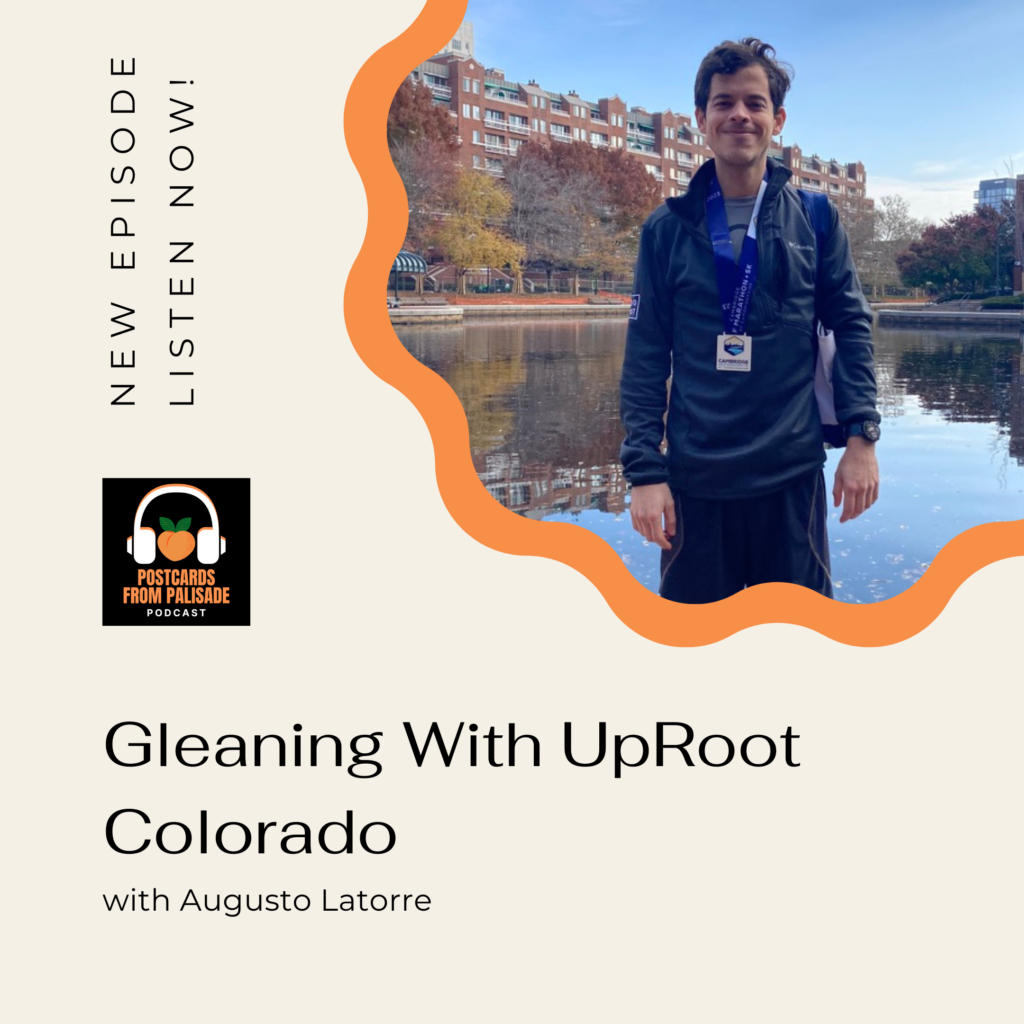
Augusto Latorre, Mesa County gleaning and food systems coordinator for UpRoot Colorado, joins Lisa to talk about the important role that gleaning plays in our food systems. UpRoot’s mission is to increase the nutrition security of Coloradans by harvesting and redistributing surplus, nutrient-dense foods while supporting the resilience of farmers. Learn all about it and what drew Augusto to this organization on today’s Postcard From Palisade.
Subscribe:

SpotifyAnchorApple PodcastsCastBoxPocketCastsPandoraAmazon MusiciHeartRadioYouTube

Transcript:

Lisa: How did the glean go this morning?

Augusto: It went really well. So it was officially my first glean since I started.

LM: Hold on, what’s a glean? What exactly are we talking about on this podcast today? Augusto Latorre joins me to talk about the important role that gleaning plays in our food systems. Augusto is with UpRoot Colorado, a 501(c)(3) nonprofit with locations across the state. Augusto is the new Mesa County gleaning and food systems coordinator for UpRoot.

The central idea of gleaning is that it’s a process to get food that would otherwise be wasted to people who otherwise wouldn’t have enough. Augusto goes into all the details, including the historical origins of this practice, how gleaning works, how it benefits farmers, the community, and the environment, and what drew him to this organization.

And then I join in and share my experience of being a farm worker for a day. Or, OK, for two hours. Keep listening for all that and more, on today’s Postcard From Palisade!

Augusto: So it was officially my first glean since I started. We have done a couple harvests, but this one was officially the first glean with Just Peachy. Just a couple, like a mile that way. Yeah. And it went great. Just Peachy had connected with us during Palisade Farm Festival. We had a booth with UpRoot. And he connected with us and we stayed connected. And he has had summer squashes that he picked and he was not able to sell that he connected with us to have us pick it up and take it to the food pantries and so on. And this time on Monday, I came to pick up some summer squashes. And he’s like, hey, do you have time to go check out some peaches? And I’m like, sure, let’s. Let’s go. And he’s like, we’re a little concerned that the heat from Monday to Wednesday would over-ripen them. But, they were okay. And we had six volunteers.

Lisa: That’s awesome.

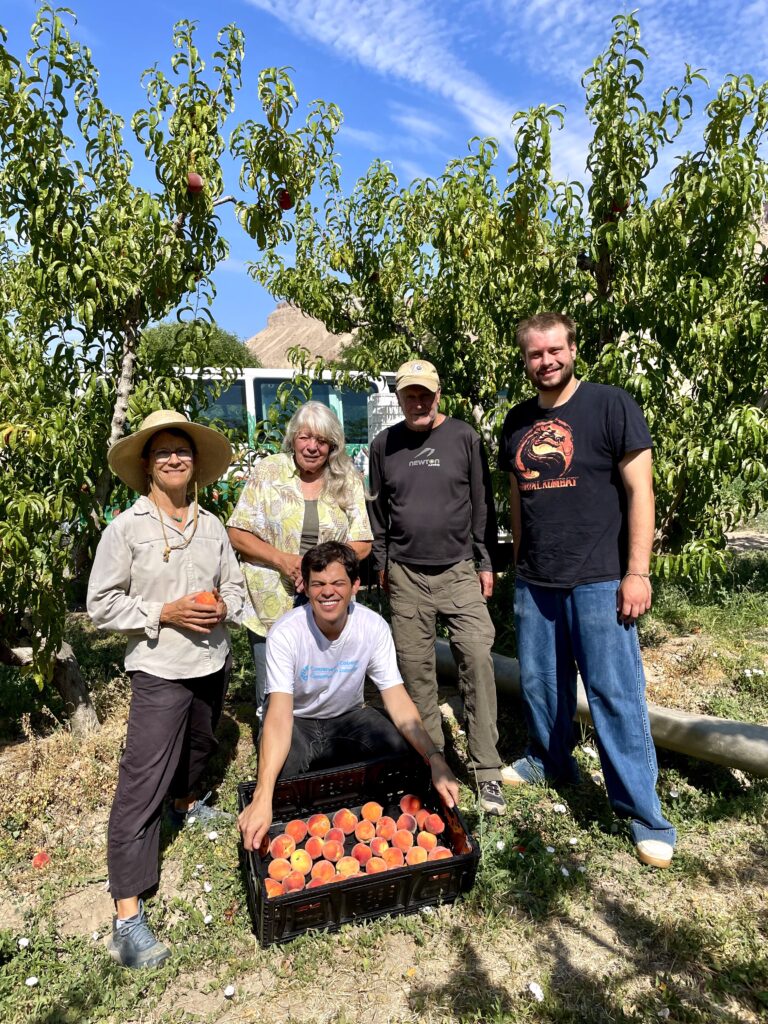
Augusto: Come out. And we collected close to, I think, 400 pounds of peaches. Yeah. Yes. It was nice. So excited for my first glean. And those have already been distributed, so it’s easy to find home for delicious peaches.

Lisa: That’s awesome.

Augusto: Yeah.

Lisa: All right, before we get too far, you should introduce yourself.

Augusto: Yeah. okay. So, my name is Augusto Latorre. I am originally from Venezuela, but I’ve lived in the US for 20 years. My 20th year anniversary would be at the end of this month. But I, in the West Slope, I’ve been for just under two years. And before that I lived in Texas and in Massachusetts. Yeah. And I work as Mesa County, gleaning and food systems coordinator. I started on this role a couple of months ago. Yeah, happy to be in the area, exploring. It’s just been a couple years, and now in this new role, trying to, you know, find, my way and support my community as, best as I can.

Lisa: So I first met you when you were the community engagement coordinator at La Plaza, and so you’ve since moved over to this other role, which seems really cool and excited for you. But when you were kind of telling me about it, what I thought was so interesting. Well, I think the whole thing’s really interesting, but, the concept of gleaning wasn’t something I had come across before, so I got really excited about it and learning more about it and kind of sharing it with everybody. So, like, first of all, I think the word gleaning is really cool. So can you just talk a little bit about, like, what does that even mean and where did it come from and why is that kind of what the focus is for this organization?

Augusto: Yes, so gleaning, it has deep roots. It comes up in the Old Testament and the Torah. It was a practice that landowners used to do, where they would leave excess or just crops in the fields for people who didn’t have the means to buy them through other avenues, so that they could go to the fields and collect it. Collect those themselves. So practicing food equity, in that way.

UpRoot has been around in Colorado. it’s the only gleaning organization in the state of Colorado, since 2017. It arose when the founder, at that time, David, in 2016, he had an event with volunteers where they collected surplus crops as well. If I’m not mistaken, that might. If I’m not mistaken. Yeah, it was kind of like they were doing a gleaning one-off, and they realized, whoa, this is not a thing elsewhere in Colorado. And that was in 2016. And in 2017, they decided to start the project, to launch it as UpRoot. And it’s been around since.

They did some research before that. So they did some research, like, why would Colorado benefit from a gleaning organization? And how could it be tailored to the needs of Colorado? And so, yeah, it’s been around since then. It’s in seven regions in the state, and in Mesa County, it’s been since, this would be our third season in the area. Before me, my predecessor was Marina, and she was here for a couple seasons.

Lisa: Okay. Tell me about how gleaning works. Like, how does, how does the whole process work? How do you all know, like, where do I glean? What do I glean? When? (such an eloquently stated question, right?)

Augusto: So gleaning, and like you said, I also found about gleaning when I first heard about UpRoot, about a year ago, when I was, like, in the nonprofit world. And so across. It’s been around for thousands of years. Across time, it’s taken different shapes and forms. Today, it looks like going to commercial farmers or producers, and first you would establish a connection with them, presumably. And then whenever they have an excess, then they would contact, in this case, us, UpRoot Colorado or a different gleaning organization and let them know, like, hey, we have peaches in excess that we cannot harvest or market or they’re not cosmetically adequate for the market. They don’t meet the standards.

Lisa: They’re ugly.

Augusto: They look ugly, but they taste just the same.

Lisa: Yes, exactly.

Augusto: And so then they contact us and we go out with them. Hopefully. This is usually how it would play out, check out the site, kind of go over a few logistical components, like how many people do you want in the field? Do you want kids here? Where are the bathrooms, all that. Where can people park? So a lot of those logistical aspects are sorted beforehand with the farmer. And determining how many volunteers he wants. Also scoping out the fruit.

Part of the practice of gleaning, it’s also bringing food that is dignifying. It’s a dignified experience for those who are receiving it. And so we as UpRoot coordinators also have that responsibility of like, okay, is this fruit okay? And that would be kind of like the first steps of coordinating a glean. And then finding a date, sending a glean alert, as we call them, to our list of volunteers. And we have them kind of segregated by areas. And then the volunteers would just sign up and we take it from there.

Coordinators would then, okay, we have the volunteers we need. If we don’t have the volunteers we need, we still do it. And we harvest. We do the glean, I should say, onsite, usually in the mornings, because the heat is brutal. And we pack. Usually, volunteers would support with the part of sorting and packing. Like this morning we had set up the packing operation of the glean out, like by where we were gleaning. So we put everything in boxes, we weighed it, and then volunteers get to take some home as well.

So like with peaches and with many crops, there is first, seconds, and thirds. We reserve the firsts for the hunger relief partners and the seconds volunteers can take, they’re up for grabs. And from there, it’s a distribution part, taking it to the different relief partners, food pantries in the area. Sometimes there is transport volunteers that may be willing to take them themselves. Or sometimes it’s just the coordinators. Sometimes when it’s large harvest or gleans, then we need to coordinate pickup and we do that as well.

Lisa: And then so then the farmer would get some sort of things to say, like.

Augusto: That part, yeah, that’s an important part. As UpRoot, part of the mission is to increase the nutritional security of Coloradoans. To support the resiliency of farmers and to reduce food waste. The farmers benefit. You would hear most farmers don’t want food waste. They hate to see their food going to waste. And sometimes that is a situation that may seem unavoidable because there’s no value for them to harvest it. Like the cost of harvesting offsets the cost of selling it. Or maybe they just have, they don’t have market for it. So it’s always great to see that we can support the farmers in that way.

And then at the end of the year we what we weighed, we assign the value to, just the market value, if it’s peaches, market value for the peaches and they receive a tax donation receipt, which they can then use as a tax deduction. The way it works. So in 2015 actually Congress passed a bill in which this type of donations are enhanced. And it gets a little like nuanced and I don’t understand it all the way but they, it’s enhanced so that the farmer gets an enhanced kind of like tax incentive. And it also expanded the time for which the tax donation receipt is eligible to up to five years. So if the farmer doesn’t have any profit to report, then it wouldn’t necessarily make sense for them to submit the receipt. So they maybe decide to wait until next year, save that receipt, and submit it then.

Lisa: Interesting. Okay. And you mentioned too that you are, you have insurance so that the people who come out and glean, volunteers and coordinators and everybody, is insured. So farmers don’t have to worry about that either.

Augusto: Yeah, there wouldn’t be any liability to the farmer. That’s something that we try to emphasize to the farmers. Like, we’re bringing volunteers onto your farm. Sometimes we’ll be climbing ladders and that’s obviously scary. So we do carry liability insurance for our volunteers.

Lisa: Yeah, makes sense. So there’s farmers obviously. That all seems pretty straightforward and really cool. But then you also have an aspect where there is just say like if I, well I used to have two peach trees. They are no more. But when I did, you know, they would produce a ton of fruit and it was like, you know, I loved picking it. And then you just message everybody and say come get some peaches. But you know, if that weren’t the case or somebody maybe grows like an excess of zucchini or something like that. You work with just regular people too, right?

Augusto: Yeah. Fruit stewards or backyard fruit. Or veggies as well.

Lisa: Oh, okay.

Augusto: Yeah. The term in UpRoot just for communication sakes, it’s fruit stewards. But it’s also tree stewards or. Yeah, it can be just stewards, backyard stewards you can call them as well. But those are not commercial partners that maybe have a few trees, maybe just one in their backyard and they want to find a way to distribute like what they can not eat themselves or consume themselves. So that’s also a part of UpRoot’s gleaning program. And yeah, it’s great. We had someone last month, with an apricot tree and we connected with her and it’s like I’ve seen so many here around Palisade. And so we’ve also been doing outreach there to try to connect with some people that maybe would be interested.

Lisa: Yeah, especially this year I noticed there are a lot of apricot trees and they just would ripen and fall and like, that really is painful to see that. So I think that’s such a cool aspect too. And one of the things I think is, I mean one of the many things I think is great about the organization is like how many different ways there are for people to get involved, depending on what they have or what they can do. So you know, not only is the farmers, and you said the backyard stores, and then people can volunteer to participate in the gleans. People can always donate. What’s the best way for people to get involved for each of those things? Like how do somebody hears this and they’re like, oh, I want to do that. Like, what is the pathway?

Augusto: Yes. So going to UpRootcolorado.org you will see options to kind of learn about all these different opportunities and to be a fruit tree steward. You would just go to the section that it says get involved and then you can sign up there as a fruit tree steward. We would receive an email and then we would get in touch with you as a potential fruit tree steward, or backyard steward. And.

Lisa: Steward, you said, okay. I thought you said store!

Augusto: Yes, steward.

Lisa: Okay, steward. Okay, gotcha.

Augusto: Yeah. And as a farmer there is also a section you can go online and then you would fill out a short form that would give us a bit of information about you. And then we would get back in contact with you to sort of like get that conversation going, get more information, and see where the partnership could lead to. As a volunteer, you would also go to that get involved section in our website UpRoot. And you sign up, you sign up first to like our mailing list and then we would sign you up to receive those emails. And once you first, like after you start receiving those gleaning alerts or those notifications for gleans in the area, then when you sign up for that, for one of those you would create a profile which then you just create it once and then you have your profile. You can just go back and register for any volunteering opportunities.

Lisa: Okay.

Augusto: And as hunger relief partners, if you’re a hunger relief partner and you want to get in touch with us, you can also do that through our website. There isn’t necessarily one dedicated section for hunger relief partners in our website. But there is a section to get in contact with us and we would get those emails as well as we would get the other ones.

Lisa: Okay.

Augusto: Yeah. I can also mention like for those who are getting involved, especially the volunteers, part of our mission. Our vision as well is to bring like the experiential learning experience. It’s a little redundant, but hoping that this will connect the volunteers and just the community in general with our foodshed and where our food is coming from, with the farmers, with the labor of farming and what it all means. And hopefully that kind of stewarding our food systems as an organization as well from that angle, as well as the angle of reducing food waste and bringing it to those who may not have access to fresh and local produce.

Lisa: Sure. I noticed on the website too, which I’m just looking at as we’re talking, that there’s an impact section and it’s really impressive. I mean this is for the state of all of Colorado. But I think the latest report on there is from 2024 and you know, 150,000 pounds of surplus fruit and veggies harvested and redistributed is like amazing. It says 1.9 million servings. And you know, I’m sure that it looks like in the past it’s just continued to grow. For that again, that’s for the state as a whole. But still, if you think about where you’re focused, we do have a lot of farms and everything here. Be interesting to know how much came from Mesa County. But yeah, I mean that’s just so impactful to see that number because it’s like that would have otherwise gone to waste. Most likely, you know, it would have gone or, or maybe it would feed pigs or chickens or something, but, or goats, but, you know, it’s feeding humans. And that’s really cool to see that number.

Augusto: Yeah, that’s, It’s. It’s like, like you said, it’s, it’s like inspiring, encouraging to see that. At the end it’s important also to kind of like see the impact, data has. Has its usefulness, for sure. And yeah, those numbers from 2024, from 2025, like an updated count is close to 500,000 pounds of food harvested.

Lisa: So that’s like a huge. Oh, like wait. Sorry to interrupt you.

Augusto: No, it’s okay.

Lisa: Let me just let you finish.

Augusto: No, go ahead. Yeah, it’s an increase because that number, well, in 2024. I’m not sure from what time period it is. This one is as of April 2025. So more than a year ago, it was 460,000 pounds of harvested and gleaned produce crops. And that amounted to around 5 million servings. And those are in seven regions. So as I mentioned, we have a presence in seven regions. It’s Larimer county and Fort Collins area, Boulder area, metro Denver, and Pueblo and Ontario counties, and Roaring Fork Valley and Garfield County, North Fork Valley, and Delta County, and then Mesa County, which I think is one of the younger or the areas where we have been in the least amount of time.

Lisa: Okay.

Augusto: But yeah, so.

Lisa: Seems like there’s a huge opportunity here.

Augusto: Yes, I mean there is from my research, and don’t quote me on this, there is more than a thousand farms in the Palisade/Grand Junction/Fruita area. And I think it’s actually, that’s an underestimate. And not that all of them are producing or anything, but there is a big potential here. We think so as well. It’s also part of the work that I do as a coordinator. It’s doing outreach, getting the name out and seeing if there’s interest.

Just kind of some numbers that have been helpful for me as I started my role here is, in Mesa County the latest numbers on nutritional and food insecurity, put Mesa County at 13% of its population being food insecure. Which means that at least in one occasion throughout the year a family might forego food or their food budget to pay rent or pay electricity. So they have to choose between paying rent which is usually a fixed value and forego food. That’s around the same amount, the same percentage as the rest of the United States. Colorado is a little lower. Colorado is closer to 12%. So that’s the population that we are kind of, we just try to harvest excess and bring it to the community to kind of bridge that gap in general. And what’s interesting as I was learning as well is like out of those 13%, 35% of them wouldn’t really qualify for SNAP either. Which is an interesting indicator. I was trying to think is that because of inflation where food is a lot more expensive or you know.

Lisa: Yeah broken programs, systems.

Augusto: And yeah part of like this data sometimes we’ll have like mini lessons during the gleans and so we’ll put them a little more structured and then bring it to volunteers. Because the experiential learning along with the mini lesson as we call them I think would complement themselves very well and it kind of plants the seed or kind of pollinates the community to be food stewards themselves and it’s slow and important work. I think that’s something that as a coordinator and in my role previously as community engagement coordinator, I’ve noticed that working with the community takes a lot of patience and trusting in what you’re doing. I have more statistics about farmers that I can share that is like quite impressive.

Lisa: Yeah, that’d be awesome.

Augusto: It’s impressive. It’s a little tough and hard to hear but that’s also kind of why UpRoot has been since this year, it’s my understanding, kind of meet the farmers from a different angle. The North Fork area after the freeze in early April or mid April this year they lost everything, like 100% crop loss across the board. And UpRoot understands that these extreme climate events are becoming more prevalent and recurring. So it’s exploring as an organization ways to support farmers other than just doing gleans or supporting with harvest of excess.

We are hopeful that we can come up with other ways that we can support farmers. Farmers, like 21% of crop workers had families incomes below the poverty line. So we understand the difficulty that farmers face and part of that I mentioned. Bringing this experiential learning to the community members that maybe have no experience with agriculture before is in the hopes that they understand that farmers, which are pivotal for any community and any society, deserve better conditions and more support and more recognition. I think with the awareness that will probably and hopefully it start to change. Yeah, because of all these pressures that farmers are under, there are also statistics pointing that they’re 3.5 times at higher risk of committing suicide and attempting suicide. And it’s combined with like the intersection of many things. Right. It’s rural and more isolated. But also the conditions of the circumstances of working in a food system that is not necessarily very supported. Very, very supportive of them. So we will hopefully have more news and information on what ways we are looking at and exploring to support farmers in more than just harvesting and helping them with the excess crops.

Also, reducing food waste has another angle that it’s beneficial. And that’s the environmental perspective. So and there is an upstream benefit or I should say it depends on how you look at it. If you look at the resources and that are placed in order to, are placed and invested to grow the fruit and the crops, then you would assume or you would expect that that’s not going to waste, that that’s going to be going to someone’s table. But that’s not the case. We know that 31% of the food produced in the US between 30 and 40% is going to waste. That’s around 20% or a little less than 20% from the farms. Like it goes bad at the farms. And then the rest, which is the majority of the food waste, is happening at the households themselves.

So by reducing food waste, you are making sure that those resources that were invested to grow the food are not going to waste. And then the other aspect is that after that, food goes to waste it will go to landfills. And in landfills it undergoes an anaerobic decomposition which emits a lot of greenhouse gases. So if all the food that was wasted in the US were to be kind of calculated as a country, it would rank third in terms of gas emissions, greenhouse gas emissions, after the US and China, which would be first and second. But it produces a lot of methane gas. And methane gas is remarkable for being one of the worst greenhouse gases. It just holds a lot of heat.

Lisa: Yeah, that’s a really interesting point that even think about the end of the life cycle. And I didn’t think about that either. That’s fascinating. I’m curious, since you started, so it’s only been a couple of months, but have you personally like, has there been anything in your experience where like you’ve done a glean, you’ve done some harvests and things like that, is there anything you’ve already come across or learned that you didn’t know before that surprised you?

Augusto: Yes, and I think more so like, it was surprising indeed. It’s like when doing outreach, a lot of the farmers in this. One thing that I learned is like this peak of the season, like starting May through August, it’s not the best time to do outreach and just learning how farmers are so busy, so they need to wake up really early at sunrise because like afternoon, then it gets too hot for them to be out in the fields. And then they even work sometimes in the evenings when the heat goes down a little bit. So that’s been really surprising. And I had an idea of that. Just being in the area, but witnessing it, like seeing the farmers day in, day out, you know, do this labor has been inspiring, but also sort of like a wake up call of like, okay, how can we do more to support the farmers?

It’s been also surprising to see how many small farmers and young farmers are out there and trying to start their own farms. And that’s really inspiring because so many times you hear it’s a difficult field to get into. And so as one farmer told me, it’s not for everyone. And so I see why he mentions that. Another farmer, like doing outreach as well, he kind of looked at me and he was not disrespectful at all, but he was kind of like, he thought he was a little cute, I think where I was coming from, he was like, well dude, we don’t really need help with the harvesting. That’s the easy part. So thank you. But once you are able to help me with everything else, like watering, weeding, please come back. And I’m like, okay. So that feedback is always better. Like, we also, appreciate it. Like, it was short. And like I mentioned, he wasn’t rude. He was just like, okay, thank you, but I really appreciate it. Some other farmers are like, they’ll take your flier and be like, okay, thank you, bye.

Lisa: Like, you want to hear what would be helpful, right? You want that feedback?

Augusto: Right. Even if it’s, like a little hard to hear it. Another thing that was surprising is that, I should mention too, our biggest partner here in Mesa County and they’re partners in other regions that we’re in as an organization is CSU here. And they have the CSU research research station in Orchard Mesa, where they have a lot of crops. And those crops are for research purposes, so they’re not commercial. Amanda McQuaid, who is a coordinator, the food systems coordinator there, she had her own crew of volunteers, who would, since the station, has been there, it’s my understanding since 2018, they would go out and harvest all the crops. And those wouldn’t be gleans, because you’re harvesting.

Lisa: Right.

Augusto: The glean happens after you go through the orchard one time and harvest what you’re gonna sell. But in this case, because they have no commercial purpose in their practice, then everything is just harvested. And what’s not harvested is just for them to do research. So. But this past Thursday, we did our harvest at the station and we harvested five pallets of peaches. So that was like close to 3,500 pounds of peaches, with close to 30 volunteers. And that was like, super. That was very inspiring and encouraging to see that many, that amount of volunteers showing up at, you know, 8:00am in the morning, and donating their time to harvest peaches. And they get to take some home, which is awesome. But the majority is going to hunger relief partners. And yeah, it’s really eye opening to see, from different angles, since I’ve been here for a couple years, how the community comes together and is supportive of each other. It’s a contrast from what you many times see in social media or in the news. So I’m really grateful for the community I’m a part of. Obviously, you know, it’s not perfect but it’s been great.

Lisa: Well, I think I’m excited to have an opportunity to do it because I really liked picking peaches from my two little peach trees. Like, it was really fun. Other than the bugs, which were not great.

Augusto: Have you heard of the insectary?

Lisa: Oh, yeah, yeah.

Augusto: That’s also a place that, as UpRoot coordinator, I’ve learned. And I think I’ve bugged them so many times with like, my colleagues, when they come, he’s like, we need to do a tour.

Lisa: Yeah. Have you gone?

Augusto: Yeah, like four times.

Lisa: Oh, nice. Those are good bugs. I mean, so, yeah, we didn’t spray our tree or anything, so it would just be like earwigs. You know, you pull it. Oh, gosh.

Augusto: Yeah.

Lisa: So I think other people use pesticides or organic products to not have those.

Augusto: Yeah. And, but it’s hard, especially with the heat and the early onset of peaches ripening, which I think it’s across the board. I think it’s increasing pest pressure. That’s what I’ve been hearing anyway. Like, a lot of farmers and even at the research station, it’s like they have more pests, more earwigs and other pests. And more split pits, which is when the peach grows. Like, the pit doesn’t completely kind of develop. And so there is a gap in the middle where the stem goes and then the earwigs make a home inside.

Lisa: Yes.

Augusto: And usually once that happens, the fruit is not edible. But the insectary is an awesome place that I try, I always try to tell people about it because it’s just so cool what they do. And, yeah, those are cool projects. I know that the research station also had a cool project where they were doing research on cherries and they were spraying them with. This is just like, kind of like a fun little thing that I learned. They were spraying the cherry trees with grape Kool-Aid because they’re. I know. And it’s like. Well, it makes the bird’s tummy hurt.

Lisa: Oh.

Augusto: So then they won’t eat the cherries.

Lisa: And humans also! Oh, that’s interesting.

Augusto: Yeah. But it’s organic because it’s not like.

Lisa: Yeah.

Augusto: So I thought that was really cool.

Lisa: I guess it’s like an acid, right? If you don’t put sugar in it, it’s basically like.

Augusto: Yeah. And I would imagine they don’t put sugar. I don’t know. Because then you have ants, but, it’s like, don’t pick these trees because they’re have, they’re research trees and they have grape Kool-Aid and so.

Lisa: That’s awesome. Yeah, and everybody who works at. I haven’t been to the research station but I’m sure it’s similar to like everybody who works at the insectary is just so like, so into what they’re doing and so passionate about it and they’re just fun people to talk to. It’s like a whole little world. I love it.

Augusto: It really is. I really appreciate the opportunity that they have to the community to kind of like can I just see what you’re doing?

Lisa: I know, anybody can just go in. It’s pretty great. It’s wild. So clearly you’re really passionate about this stuff. Like, tell me why?

Augusto: Well so I started, my background is in working in biology labs. So I worked in that for about five years. And then doing research and later on in biotech, less so doing research and working in molecular biology with a startup. So it was a for-profit entity. So yeah, I’ve always had like a deep appreciation for like biology and life and how intricate, interesting, and complex it is, but also in how much it has to teach us as humans.

And so after a while in Massachusetts I was looking at opportunities of joining the AmeriCorps. At that time the Inflation Reduction Act had passed and with that came the creation of the American Conservation Corps I believe it was, which would kind of create a workforce to support conservation, climate change, and educational AmeriCorps terms of service for the community. Community members who wanted to take these opportunities. So the AmeriCorps has like a two-part intention of like capacity-building for the people who are enrolling and also filling in gaps in the community.

So a great example that I like to use is Teach for America, which is also part of the AmeriCorps, where they find early graduates and they connect them with schools in rural areas so that they can go and get their experience there. In areas where there is a high demand for teachers. So in this case, I started looking when that came about, the new corps that was created by the Inflation Reduction Act. I was like okay, this is a great opportunity for me to learn about how I can use my background in biology to approach the different efforts to combat climate change and support the environment, which we are a part of as humans, we’re animals as well, and we’re a part of the larger ecosystem.

But then as a result of that, I ended up accepting a position in the City of Grand Junction in their Housing Division, as housing and outreach specialist. And that was for nine months. And during that time, the new administration came in and they did away with the Inflation Reduction Act. They also cut the AmeriCorps programs quite a bit. And so that kind of put me in a position of like, okay, I had just started in this new position as Community Engagement Coordinator, moving from a research associate position in the lab. So I was still like learning a lot. I was open to that opportunity. But it was certainly a challenge working from a lab, going from a lab environment to working with the community.

Lisa: Yeah. Like you’re dealing with cells to like whole people.

Augusto: Yeah. Which both are fun. But I was at that, that crossroads of like, do I go back to working in a lab with cells, which feel like a little more predictable than people? But I wanted to continue and I wanted to give like the Grand Valley more time and myself more time in it as well. And so then I started working at La Plaza. I applied. The AmeriCorps term of service was for a year. I had already been there for nine months. And the state of Colorado, despite the AmeriCorps funding being cut, the State of Colorado took a stance against that position and that decision. And they said, we’re going to support, we’re going to fund all the AmeriCorps positions in our state until litigation, on this issue of whether the federal government has the right to cut funding like this finishes.

And through that time, I didn’t know, I could have stayed. But I decided to take the job at La Plaza because there was so much uncertainty. The State of Colorado ended up winning, the State of Colorado along with a few other states. So Phil Weiser, who was the Attorney General at the time, he sued, the administration, he was like, you can’t cut the AmeriCorps. And they won that one. It was them and a few other states. And then by that time I was already working at La Plaza. I was in La Plaza for a year. But during that time I found sort of like a passion for working with people and realizing that it’s not all about, as a single person who doesn’t have a family to support. It seemed like an easier lift to do those transitions from working in a lab and moving from Massachusetts to Colorado, to pursue this.

So that was one of the motivations behind kind of doing it. And the other was like, as I was doing it and meeting new people in the community, I every day would feel encouraged to continue to do so and learning from the experience. I feel, as we do in UpRoot, that experiential learning is. It’s different than any other type of learning. It takes time. And just showing up every day and meeting people where they’re at has been very fulfilling. And since I decided to take that detour, I’ve enjoyed it.

And yeah, that’s kind of my trajectory. Where it will lead. I don’t know. But I try to just approach every day with like, grace and appreciation for the community I’m a part of. And yeah, it’s tough times, I think, for many people. So being in this space is definitely encouraging and helpful in keeping my spirits more optimistic.

Lisa: Yeah. I love it. Well, thanks for sharing that. Yeah, I think it’s like when you can see the person you’re having an impact on, it’s always really nice.

Augusto: Yeah. And like, even like, those that you’re like the organization in this case is supporting, but also the other side, like the volunteer side, like you, when you were volunteering at La Plaza, the events where we would have volunteers were usually the events that I enjoy the most because then you have the volunteers, you have the staff, and then you have the community members who are coming to all share. And it’s just a great opportunity to build a community and community resiliency and learn from one another.

Lisa: Is there anything else we missed?

Augusto: Yeah, I think one thing that is important is like, I try to mention it, but here it’s a little more eloquently put. Gleaning is not just about moving food from point A to point B. It’s about moving minds and hearts towards stewardship of our collective food system. So bringing that like, concept of like, experiential learning, pollinating people with the idea of food equity, why food inequity exists, and who are those that are more impacted by it and why is it that food at the farms is going to waste?

A lot of times it’s the farmer doesn’t have a way to sell it. So maybe, that’s the case. A lot of times it’s like this season. The heat came in. Like, it’s less predictable, the climate anyway. And so in this particular year we are seeing, as you may know, peaches and a lot of the crops are like three weeks earlier. Like, cherries were three weeks earlier as well. So farmers who plan their year to have everything ready by late July, early August are having to meet these unexpected factors and figure it out. Like, oh, my peaches are coming in. And when it gets hot, like I mentioned, Just Peachy, with Jeremy on Monday we went to see them and he’s like, if it continues to be this hot, then by Wednesday they might be too soft to pick. And yeah, today especially the peaches that are on top of the trees that they receive more sun, they were like, too soft to harvest. Like, you can harvest them, but literally you would have to eat it there.

Lisa: Yeah, it’s not going to transport.

Augusto: It’s not going to transport very well. So just sharing that. I think, the nature of the farming is so hard. And, just also highlighting the farmers, the farmworkers here in Palisade. I think it’s awesome. And that’s part of the work that I did before, with La Plaza. During the peak of the season, around this time of the year, it’s 500 new arrivals that come from mostly Mexico. And it’s just amazing. I’m just so grateful to them for their labor. You know, many of them are, most of them are migrant agricultural workers, which means they’re picking the fruit for the community here. But then they have their families back in Mexico. And so it’s a sacrifice in many cases, in most cases for them to be away from their family to do this work. Which it’s also a cornerstone of the economy here. It’s like in 2023, $25 million of profits generated from agriculture here in Palisade alone. And without the agricultural migrant workers, it wouldn’t be possible. So yeah, just grateful to the farmers, to the farmworkers and, to our environment and just the community in general. To environment, because without the environment, we wouldn’t have. Yeah, they’re the ones who provide. And yeah, so it is one. Yeah. But, yeah.

Lisa: Well, I think that’s a really good note to kind of end on just, like, thankfulness for everything, So. Yeah. And I really appreciate you coming in and talking with me.

Augusto: Thank you.

Lisa: And I’m just excited to share this organization and excited to see what you do with it in the future and what you do with your role. And I feel like I want to check back in, like at the end of the season to see, like how it went.

Augusto: Yeah, for sure. Thank you, Lisa, for having me, for all the thoughtful questions and comments. I would certainly be open. I’m also very curious to see how things are gonna play out. Yeah, we’ll continue to you know, show up as UpRoot and as a community member here in Palisade. Would love to, you know, be again here in the show or in other settings with you. I really appreciate it.

Lisa: Awesome. Thank you so much, Augusto.

Augusto: Thank you.

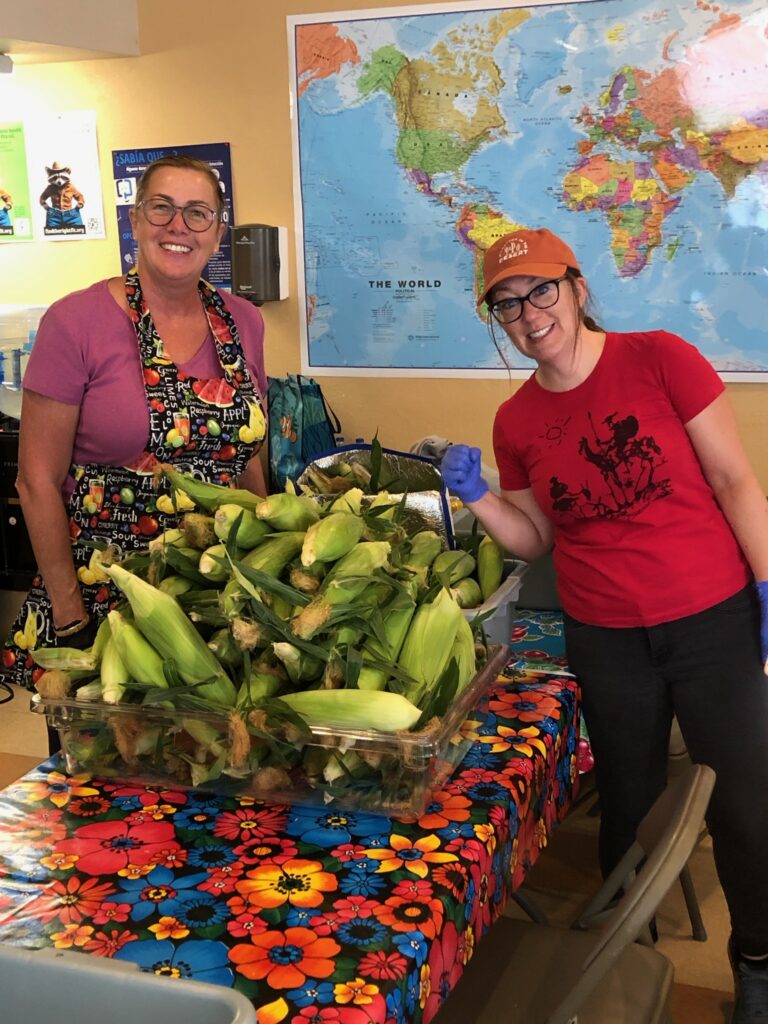
LM: I joined UpRoot for a harvest at the end of July and was so impressed by the experience. I helped pick peaches at the Western Colorado Research Center, which was why it was technically a harvest and not a glean. We started early in the morning on a steamy day, well before I prefer to be up and out of bed doing things.

I didn’t know what to expect, but after quick instructions, we suited up with picking harnesses attached to plastic bins and fanned out to pluck as many peaches as we could reach. The air was filled with the sound of peaches being plucked from branches, unsuitable peaches plopping to the ground, tractors running through rows of trees dropping off empty bins and picking up bins fully loaded with peachy goodness.

The other volunteers were very hard workers and so respectful of the trees and fruit. What at first seemed an overwhelming task when we arrived was quickly done, with the trees stripped of peaches in just a couple hours.

After harvesting was completed, the peaches were sorted according to quality, with the firsts boxed up for distribution and the seconds available for volunteers to take as many as they liked. Anything left over would feed the goats.

I was so impressed by the efficiency of the whole thing. And by how hard work it was. After just two hours of harvesting peaches, my whole body hurt – shoulders and neck stiff from the harness, arms sore from reaching for the highest fruit I could grab, fingers raw from separating the peaches from their stems, bruises on my legs from where the full bins rested.

Augusto sent a follow-up email a few days later, letting us know that we harvested more than 1,600 pounds or 8,000 servings of peaches that day. The peaches were distributed to a bunch of local organizations, including Mutual Aid, Homeward Bound, Catholic Outreach, the Community Food Bank, Clifton Christian Church, and Food Bank of the Rockies.

I can’t wait to do more.

If you want to get involved with UpRoot, in any way, go to their website, uprootcolorado.org, and click on Get Involved.

Thanks for listening. With love, from Palisade.

E55: “15 Years of Loving Lavender”

The 15th annual Colorado Lavender Festival is fast approaching! This year’s treat for the senses will be held from June 26th to June 28th. Friday, June 26th is the VIP farm tours, Saturday, June 27th is the main festival in Riverbend Park, and Sunday, June 28th is the day for self-guided farm tours.

Today, Olivia Coe and Lee Ann Nielsen join me to preview what’s planned for the festival this year. We also chat about why Colorado has the perfect climate to grow lavender and how you could even become a lavender grower yourself!

You can find the full festival schedule and get your discounted tickets in advance at https://coloradolavender.org/annual-lavender-festival/, or just head down to the park and get your tickets at the door on Saturday the 27th.

Subscribe:

SpotifyAnchorApple PodcastsCastBoxPocketCastsPandoraAmazon MusiciHeartRadioYouTube

Transcript:

Welcome to the Postcards From Palisade Podcast. I’m Lisa McNamara.

The 15th annual Colorado Lavender Festival is fast approaching! This year’s treat for the senses will be held from June 26th to June 28th. Friday, June 26th is the VIP farm tours, Saturday, June 27th is the main festival in Riverbend Park, and Sunday, June 28th is the day for self-guided farm tours.

Today, Olivia Coe and Lee Ann Nielsen join me to preview what’s planned for the festival this year. We also chat about why Colorado has the perfect climate to grow lavender and how you could even become a lavender grower yourself!

You can find the full festival schedule and get your discounted tickets in advance at https://coloradolavender.org/annual-lavender-festival/, or just head down to the park and get your tickets at the door on Saturday the 27th.

Join us to hear all about this fun festival and amazing plant on today’s Postcard From Palisade.

Olivia: Hello. My name is Olivia Coe. I am the director of the Colorado Lavender Festival. This is my fourth year, and I’m super excited to present this 15th anniversary of our festival. So thank you.

Lee Ann: Hi and I’m Lee Ann Nielsen. I’m the treasurer of the Lavender Association of Colorado. And I’ve been involved, gosh, for many, many years. So. It’s old hat for me, I guess.

Lisa: So tell me about the festival this year. What’s planned for this year? What can, what can people expect to see?

Olivia: Yeah, well, we’re going to have a lot of fun! As in prior years, the schedule is fairly similar. You know, our big event is Saturday. It’s June 27th, 9:00am to 4:00pm. We start the day off with all the vendors, and then they’re going to be there from open to close. So you can count, on minimum 60, I think 62 vendors roughly. And then we also have some sponsors, close to like maybe eight to ten sponsors. So looking at about 70 booths, with handmade products, services, food trucks, things like that. So it’s just a big fun event. We have three different musicians playing over that course of the day. So the first, the two musicians that are playing at the event are going to be the Bell Creek Band, which will be the first one. Fun, kind of, yeah, rock, jazzy sort of group in the morning and then in the afternoon it’s Sierra Budge, kind of more folksy, bluegrassy kind of stuff.

So that’ll be going on throughout the day and then in the evening after the big festival, we have our gourmet dinner which takes place at Maison La Belle Vie. We just went to that lovely event from the Chamber this morning, your community over coffee. So at Maison La Belle, as they do every time, they are a class act and they make delicious food and they’ve really honed their lavender culinary skills and so everything should be just right. You should get enough lavender, not too much, not too little in each bite. And it’s a delicious four course meal. Wine pairings with each one. Ah, so then at that one we’ll have Eric Mocko playing, and he’s a newer solo musician, but he does a lot of alternative, and like light rock kind of stuff. So it’ll be mellow and still nice.

So that’s, that’s the big day, before the festival, which actually I think we’re almost sold out. On Friday we have our private VIP tours, the farm tours. And that’s going to be so fun. Lee Ann’s participating this year [LM note: her farm is A Pinch of Lavender]. That’s a really beautiful, intimate event that happens with each of our farms in the area. Not every single one, but we have three farms and one winery that’s participating. And each participant gets to go and meet the farmer themselves, talk to them about their operation and how they grow lavender. They learn a bunch about why lavender does so well in this area, why it’s tricky sometimes, how it can be applied in all different ways. And then they also have a little food kind of at each spot, a nice little snack. And then there will be drinks included at Talon Winery. So they have their lavender wine and mead, which is delicious. So that’ll be the second stop. And then we’ll have, ah, we’ll finish out at Highlands Distillery and Belli Fiori Farm. Middle of the day you’re gonna have. They have lunch at Sprigs and Sprouts. So really beautiful event. Those farms are closed during the day and it’s just for those private events at the time.

Lisa: So is this the kind of situation where it’s like a full day thing where you go to each of these places? It’s a whole guided day.

Olivia: Yeah. Progressive.

Lisa: That’s so cool. Okay. I’ve never done it obviously.

Olivia: Yeah. And then we have a. You should definitely. There’s a couple tickets left if you want to get on, but, there’s a pilot car that drives you to kind of each location and a volunteer that will do that. Yeah, and it’s just, it’s a lovely, like I said, like, really intimate event where you get to know the person who’s making the products, then you get to go buy the products at the festival as well as you get some deals during the event from their stores too.

Lee Ann: I think it’s helpful because you get like an insider’s viewpoint about lavender itself and about what they have done with lavender. Because it’s such a broad range plant. I mean, our byline is one plant, endless possibilities. And we just. There’s just so many things that you can do with it. So this gives them just kind of an inside, not the secrets, I guess.

Olivia: A glimpse.

Lee Ann: Just a private, this has been their focus. Yeah.

Olivia: Yeah, it’s really beautiful. Then on Sunday after the big festival, we also have the open farm tours. And those are super cool because, that’s every lavender farm in the valley does something like a special event. So we’ll have that posted in online as well as in our program of each of the locations and like a little map that shows you where they’re located. And that is also a really great experience because there’s no cover fee to get in in most places, or there may be like a small fee. Yeah. But generally it’s. That also gives you the opportunity to get really involved with the lavender and see how each, like you said, each person does it differently. It also increases the business for these farms and helps them stay vital and keeps them operating in the community. So. Yeah, that’s kind of the big stuff we do. The fun stuff.

Lisa: Sounds wonderful. Is there anything different this year that’s different from years past?

Olivia: I would say. Well, actually, so we’ve had, we’ve pared back a little bit on some things. Like we used to have a North Fork Valley farm tour, the private one. But they have a couple of fewer farmers this year participating and so they weren’t able to host that. So that’s unfortunate. But that’s why I think the Sunday farm tours are great because I think they’re still doing their own open farm tours. They’re just not having the private one beforehand. So definitely, if you’re in the North Fork Valley area, make sure you get to those farms out there. But a lot of those farmers will be up here during the festival as well if you aren’t going down that direction.

And then we do have a couple of different like, classes that we’re offering. We have done painting. I don’t think we did painting the two years ago when you and I had talked. But we have a painting class on Sunday as well. So the open farm tours that take place, Belli Fiori is going to be hosting open farm tour as well as a private painting class. So you’ll paint a lavender painting. You’ll get a glass of something, a cocktail of some sort from Highlands Distillery. They’ll have special lavender inspired cocktails. And then you’ll have like, treats and things like that. I think that go with the event. So that’s a cool little opportunity as well to kind of do a different perspective on lavender. So that’s another exciting event that comes up.

And then, we’re also doing one that we’ve never done before. We thought it could appeal to the, you know, more ethereal crowd out there. But we’re doing crystal car diffusers as one of our art classes during the festival. So it’ll be a diffuser where you can, you know, drop in the essential oils and it’ll have a crystal and it’ll hang down in your car. So it’s just kind of another fun little activity to do.

Lisa: Yeah, that’s cool, if you feel like making something yourself.

Olivia: Yeah, yeah. And then I think another thing that we are doing this year, we’ve created like a slideshow. One of our board members has done that. And so that’ll kind of be playing at the register or at the LAC tent. The association has a tent where we sell kind of our own goods and things like that right when you come into the festival entry. And so that’ll be like the History of Lavender slideshow playing in the background so people can come and just hang out and watch that. I think it’s about 10 minutes. It’s something short. Yeah.

Lee Ann: Eight to 10, something like that. It’s not very long.

Olivia: Yeah.

Lee Ann: And it’s narrated so you can read along.

Olivia: Yeah. Or listen if you can’t read. And then we also will have our president doing the History of Lavender talk at the beginning of the festival. So that’ll be really nice. He’s from Cortez. And he’s really great, awesome, high energy guy. So, definitely don’t miss that talk. But yeah, just kind of trying to make sure that we’re maintaining a lot of what we’ve done in the past, but doing it right, you know, and not trying to do more than we have capacity to do. So I think really kind of scaling back a little bit to make sure we have our feet under us the right way.

Lisa: That makes sense. That’s always a good thing.

Olivia: Yes, for sure.

Lisa: Now I know you mentioned earlier a little bit about ticket sales this year. I thought that was really interesting. And one of the things I think is really nice is the general admission tickets for the festival on Saturday are really reasonable. They’re like $7 in advance, $10 at the door. What do the ticket proceeds go to support?

Olivia: So the festival itself, we have a good number of expenses. We have to pay for all the service providers and things like that. And we pay a fee to use the park and all those things. So in general, the fee goes to the association to continue the festival in general. And then any over and above the expenses of the festival would just go into continued operations basically for the festival.

Lee Ann: If there’s anything.

Olivia: If there’s anything.

Lee Ann: I mean, we aim to break even because this just meets our educational focus to the public.

Olivia: Exactly.

Lee Ann: So if we can cover all of our expenses, if we have a few dollars left over, then, yay. But otherwise it just helps us to fund the festival, make sure we pay for the rentals of everything that we have to have there and try to make it a nice experience for the patrons when they do show up. So. But it also gives them, the ticket itself gives them of course access to all the vendors, that we hope that they take part in. And then the seminars that we provide for in the seminar tent, which some are, I mean we generally try to do a cooking with lavender, that’s been kind of a mainstay so that people know that yes, you can cook with lavender. And then we’ll have the talk about the history of lavender. And I’m excited to hear that one too myself. I think he going to touch on like way back history and how it made it to Colorado type of thing.

Lisa: Yeah, that would be really interesting. What I’m so curious about is who first looked at it and was like, I should eat that.

Olivia: I know it’s a pretty purple flower yum, right?

Lisa: Yeah, this tastes delicious, right?

Lee Ann: Actually that was, way back in ancient times, it was a culinary item. And I don’t remember, I keep forgetting to refresh my memory and look it up. But there was a particular queen in the Great Britain area who that was all she allowed on her table was lavender adornment as well as compotes and jams and foods. And I mean they were obsessed with eating lavender. And then I think it fell by the wayside when the whole commercial products of adding it to bath and body stuff, I think. And then culinary got a bad rap because they said, oh no, it tastes like soap. And then it’s making a resurgence again. My focus has been culinary since I started and I can say probably the mid teens, 2000 teens is when people really starting to appreciate it again and really get into it.

Olivia: Yeah. It’s not. It’s in no little part to what LAC has been doing, I think, in the state. You know, they’ve been trying to promote lavender as a cash crop in Colorado, for, since 2009. And so I’m sure that, you know, even though you can’t exactly quantitatively attribute what LAC is doing to that resurgence, I feel like you can see it in the way that people are coming to the festival, the excitement of people wanting to eat lavender at our events.

Lee Ann: Oh and we have lavender lovers that specifically come for the festival, they’re hounding us. Email when are the tickets when are the tickets. Oh, yeah, we’re getting there. We’re getting there. The planning takes a little bit of work, but we’re getting there.

Olivia: Exactly.

Lee Ann: And now everything’s ready. So now, yeah, tickets are available. All kinds of, yeah, good things to work on.

Olivia: Yeah. And they’re selling pretty well this year, too. I’m pretty excited. We’ve already sold almost I think, like, 30 dinner, tickets, which is way ahead of last year. So it’s going to be a nice, busy dinner. I’m excited about that. And yeah, I just feel like it’s a shame if people don’t get to the dinner because of how delicious it is. So, yeah, so it’s, it’s, I think it’s. This year has been going pretty well, if I have any wood to knock on. But, yeah, I, I, and I do think that for me, when it comes to, like, you know, the financial side of things, I just think it is super important that everybody understands that, like, our job, our goal is to educate people about lavender in the region, in Colorado, all over. And that we want to be promoting people learning more about lavender and getting involved, growing lavender themselves, things like that, because it’s such a unique crop that is, it is so perfect for this region.

Lee Ann: It really is.

Olivia: And, the more people that are interested in it, the more likelihood there is that there will be more farmers coming around and keeping it alive.

Lisa: Okay. It’s the Colorado Lavender Festival. It’s not the Palisade Lavender Festival. It’s the Colorado Lavender Festival. Just happens to be held in Palisade. But what I don’t think we talked about, you know, because lavender grown across the entire state. I don’t think we talked about last time why the festival is in Palisade. So why is it here versus anywhere?

Lee Ann: It started here in the very beginning. We had a couple of visionaries that knew that lavender could do well in this region because we’re hot in the summer, it’s dry, and we’re cool in the evenings, much like the vineyards. You know, they grew up knowing the same climate aspect was very good for grapevines. And so we had. There was a couple. Couple of people I can mention, if you want.

Lisa: Yeah, sure!

Lee Ann: Dr. Curtis Swift. He worked for the CSU extension here in Grand Junction. And Kathy Kimbrough was a master gardener. Well, she probably still is. But the two worked together closely and with all of their contacts and friends that they had, got this, I guess researched and figured out and said, yeah, this is extremely doable. And so they launched the association in 2009. So, you know, there was planning and growing happening before that, but, the association got started in 2009, but it was here in the Western Slope. It’s where it got started because that’s where those two people were.

Olivia: It was called the Lavender Association of Western Colorado initially, right?

Lee Ann: At the time. It was, yeah, because we started on the Western Slope, so. And Western Slope likes to have a little bit of ownership anyway. So they promoted it for Western Colorado. And then in 11. So two years later is when they did the first festival and then it just went annually after that and have grown. And it wasn’t just a few years after that, really. It was by 2019, I think it is. We changed our name because we knew there were lavender farms on the Front Range and Colorado is an entire state. So we wanted to broaden the whole thing and go statewide. And changed our name to the Lavender Association of Colorado. So that’s why the inception of everything occurred on the Western Slope. But it is now. So traditionally, I guess, we’ve stayed in Palisade because that’s where it kind of has grown up, and it’s maybe tradition as well as, tradition. It’s kind of where it’s been. It’s just been. Palisade has a good festival footprint that people recognize. So, we have just kept it in that fashion.

Olivia: And proximity to other lavender farms, there’s a lot of, there’s a huge concentration.

Lee Ann: We do have that, we have. They’re drive-able to each other.

Olivia: Yeah.

Lee Ann: Where on the Front Range, they’re not that close together. So it’s such a huge expanse. I mean, from Fort Collins down, north of Fort Collins down to Pueblo and even one out on the plains, it’s like. Yeah, you just can’t drive to them in a daily. In a daytime trip, you can’t hit several. Where we do still have that capability on the Western Slope, between the Grand Valley and the North Fork Valley. Southwest corner has a number of them down there, but they’re not quite as close in proximity as we are here. It’s not like you can go, like, in North Fork, you can go to one location. You can hit about, I don’t know, four, five, three to five farms there in a day. If you didn’t mind doing a little bit of traveling. I’m not sure even in Southwest corner you could do that. I mean, there’s quite a number down there, but they’re just, you know, driving from Bayfield to Durango to Ignatio. You know, there’s just. They’re just in each of the little towns down there.

Olivia: And the Grand Valley is. it is perfect for growing. We just know that across the board. So that does make it like you said. I mean, lavender farms are across the highway from each other here.

Lee Ann: Yeah. That’s how close we are.

Lisa: How many do we have here in the Grand Valley? How many lavender farms?

Lee Ann: Oh, gosh, on the Grand Valley?

Olivia: I would say dozens, maybe. Like, if not a dozen.

Lee Ann: Maybe upwards of that much. I meant to bring my map. I know we’re only verbal, not visual, but I was gonna bring my map and I forgot.

Olivia: But I think at least I could say I could probably pin down at least a dozen people that have, you know, 50 plus plants. I would say.

Lee Ann: Oh, yeah, at least.

Olivia: Easily yeah. And that’s like a real farm.

Lee Ann: Well. And, yeah, I mean, granted, it. It’s just not that many of us are open to the public.

Olivia: Yeah.

Lee Ann: So there’s. There’s many that are growing it and produce their own items, but they’re not necessarily open to the public.

Lisa: Sure.

Olivia: And I would say, too, for why we’re still in Palisade, the town of Palisade, you know, it is, like, ideal for festivals, like you said. But I know that we are officially considered an anchor event. And so they’ve really just in my four years of working here, they’ve really, I think, met us halfway, I would say, and really come to the table for us to make sure that we can still afford to be here as an association that isn’t a huge moneymaker. But we do increase tourism for them and I think it’s a mutually beneficial relationship. So as long as we can maintain that positive relationship, I think it makes sense for us to be in the area, helping each other out, you know. But, it’s a great accolade to be called an anchor event, you know.

Lee Ann: That is very cool. That is very cool.

Olivia: Yeah.

Lisa: So of course, we know too, this, we all know this is a challenging year for growing things, a little bit. Every year has its own challenges, I’m sure, that are unique. But, one of the things that I thought was a little ironic was I looked back at our notes from last time and two years ago it was that cool, wet year where, the lavender wasn’t. You know, there’s some stress that it was behind schedule, it wasn’t going to be ready for the festival. I know this year is different.

Lee Ann: It’s ahead this year.

Lisa: Yeah. What does it look like this year?

Lee Ann: We had such a warm winter here that, some areas are ahead by two plus weeks. And then fortunately, lavender is an extremely drought tolerant plant, so we’re gonna probably face the summer fine. You know, with all the drought issues that are. That we’re dealing with. But I, I think lavender is just a little bit of it ahead this year in this area.

Lisa: Right.

Lee Ann: So and each area’s a little bit different. I know the Front Range, they got hit with some terrific snow and some cold weather, so. And that’s going to slow things down a little bit. Whether it’s harmed their plants, I’ve not talked to anybody to know for sure. I kind of doubt it because lavender is extremely resilient, also. And that’s that’s one of the beauties of it. Now in, we probably when we were here last time. We were, that was our third year past the terrible fall freeze we had of 2020. So that’s why we were finally breathing a sigh of relief a couple years ago that things were going to start looking good again. So I think we’ve done well last couple of years. Now we’re just status quo at this point, other than I think we’re a little bit ahead.

Lisa: So cold is worse than heat when it comes to lavender. Would that be a fair statement?

Lee Ann: It can be, certain plants. The two main plants that we grow in the region are angustifolias, lavender angustifolia, which is true lavender, or the one that’s culinary capable, in most cases. And then the second, variety is the x intermedia, which is commonly called lavandin. And those, for the most part, are cold hardy also, although they can be a little more susceptible to some of the cold factors. Kind of depending. I know for six years ago, it wiped out a lot of the lavandins in the area, where the angustifolias hang in there and they’re a little bit more cold hardy. And even though it hurt them and they died back, they can come back from their roots a lot easier, a lot more efficiently, I guess. So in one way I’m going to say cold is hard for them. It’s not like you cover them or you have to mulch them or you don’t have to do anything to them in the wintertime. I mean, they’re a perennial. They go dormant and then they’ll just come back in the springtime.

Olivia: Another reason why lavender is an amazing cash crop in Colorado.

Lee Ann: It is, it is. It really is.

Olivia: It’s perfect.

Lee Ann: Yeah. You know, you read on Facebook about other regions in the country, and some of them deal with terrific. I mean, they have a high rain involvement anyway. Their rain climate is much greater than ours, and if it’s too great, it’s very harmful for the lavenders. So, I always commiserate with them. It’s like, oh, my gosh, you guys, that’s. I’m sorry for you. You should be in Colorado!

Olivia: With our 300 days of sun a year.

Lee Ann: Yeah, just about. Yeah. That’s so true. No, lavender, it wants the sunshine. It wants the sunshine. Minimum of 6 hours and very little water. Very. Don’t plant it next to your grass because grass needs more water than lavender does.

Lisa: So how did lavender get to Colorado? Is that something you’ve got a little background in?

Lee Ann: I don’t have anything significant other than I mentioned with Dr. Swift and Kathy in the beginning, when they got to looking at what is something that we can bring that could be a cash crop other than the fruit trees, the stone fruits, and the vegetable gardens, you know, because we have amazing amount of vegetable growers and such, so what else can we do? And I think that just their involvement in agriculture is what probably spearheaded this the most to get it to Colorado and then from there. And they were hard workers. I mean, them, and the team they and the team they had working on this. Hard, hard workers, getting this thing going and growing. And that’s been many years ago. A lot of them have retired and gone on to other things. So it’s like, we need some new lavender growers. It is so easy once you get it established. It’s so easy.

Lisa: I’m just wondering, too, you know, coming from kind of Mediterranean area, we do have a pretty similar climate.

Lee Ann: Yes.

Lisa: So I think that, too, is, you know, I know enough about the history of wine and grapes to be dangerous. But a lot of that was, you know, people immigrated to a new area and they’re like, oh, hey, this looks like where I came from and where I came from, we could grow this thing. So I’m going to try here.

Lee Ann: You know, I think lavender was in other parts of the country, up in Washington, in Sequim, kind of northwest island of state of Washington has probably, to my knowledge, the longest growing area in our country that I’m aware of. There may be many others elsewhere. And I know a lot of people, and I believe even Kathy, went up there and talking with them and learning about it. And that’s where a lot of people get their stimuluses, because they have the ability to have the huge fields that you envision in a, you know, in a photo.

Lisa: Yeah, like that screen saver that was on Windows for a while.

Olivia: The lavender porn. Yeah.

Lee Ann: Yeah. Just about. So they have. They have huge, huge farms in that area, but I mean, it’s just darn near. And the only place I think might not grow it in this country is Florida, maybe. Maybe. Well, because of the humidity and the high water table they have and that kind of thing, I’d heard in conferences in the past, they said Georgia should not be growing lavender. But they do. They do. They do. Well, yeah, it’s in New York. You know, it’s just everywhere, all over the country. So.

Olivia: And I guess I would encourage you to come to Jeremy’s talk. He’s our president. He’s the one doing the first talk at the festival to hear the real kind of. I think he’s researching a lot about the long term history of lavender. So make sure to come to the festival and you’ll hear all about it.

Lisa: So, what would it take, say, if somebody, somebody wanted to start a lavender farm? What would it take? Like how you mentioned, you know, Washington has huge fields. I know here we have pretty good sized fields, but we don’t have acres upon acres. So like, what’s a viable, you know, if somebody listens to this and they’re like, oh, maybe that would be interesting to me.

Lee Ann: You know, a lot of people plant it just in their landscape, you know, and they might have 15 to 30 plants in the landscape. And it doesn’t matter because it’ll do well. I think the biggest thing to do is to learn a little bit about lavender and the two most common types, the angustifolia and the lavandins that we see in our area. Research a little bit from, you know, websites or whatever, do your Google searching and determine which one you think you might want with what its capabilities are.

Your lavandins, you can eat them, but they won’t hurt you, they’re just not going to taste as good. There’s a couple, there’s a couple that can be fine. Yeah, there’s a couple. And if you use a lot less of it, I mean, really less, then yeah, you can do just fine with it. It just. Those have a higher camphor content. Kind of like that mentholatum thing. Yeah. So it just doesn’t have that nice of a taste, but it has the other value where if you wanted to get into the distilling side of things, it’s the high oil producer as compared to angustifolias. So because those are, I mean they’re just known for being the low oil producers, the higher.

Well, and there could be arguments on who has the highest quality between angustifolia and lavandins. Just depends on what you want to do with it. And that’s kind of the thing. And that’s where I got, when I got started in 2011, I didn’t really like lavender, and my husband said, this is going to be a good thing. We can make money on this. Wait a minute. But in researching, that’s how I learned that there is a difference of what grows in this area and then what their capabilities are. And of course, I opted to grow culinary, the angustifolias, because I thought, you can eat this? Okay, we’re gonna figure that part out. And, so it kind of just depends on what you want to do with it.

Lisa: And I’m sure, is the Lavender Association of Colorado a resource, too?

Olivia: Oh, yeah. I was just about to say that. The first thing you do is join the Lavender Association of Colorado. You become a member, and they have educational opportunities regularly, at least quarterly, if not even more often. Yeah. And it’s the. The festival is really just to, for people to dip their toes in, or just come and buy products as they’re not going to become growers. If you join the Lavender Association as a member, you’re automatically included in all of those, trainings. The educational opportunities.

Lee Ann: We do a lot of online stuff. Because of being statewide, we want to reach everybody.

Olivia: Yeah. So first things first. Do that.

Lee Ann: Yeah, good plug. And there is a lot of educational stuff just to look at. Say, do I want to. How do I do that? You know that we have different opportunities available just for someone who’s kind of thinking about it.

Olivia: Yeah. And then I think too, I’ve seen you guys, as an organization, somewhat mentor people, too, you know, so if somebody’s interested, you all have been resources for them as well, just to ask questions and provide support. They’re very approachable as an association. So, you know, you won’t be, you know, on an island out there by yourself.

Lee Ann: Oh, no, no. That’s one of the other reasons we got into it, is because they were so gracious, so wanting to share. You know, they loved what they were doing, they loved lavender, and the enthusiasm just is contagious. And that’s what makes it really nice.

Lisa: Yeah, that is nice. It’s more of a community/cooperative effort versus competitive.

Lee Ann: Well, it is. And on our website, we have a member, map, member directory and a map. And you have the ability to search for farms that are closest to where you live. Or maybe you want to find out, I don’t know, you’re more into making teas and you want to put lavender in your teas. You know, we have some resources available, searchable for you on the map. Then you can call up those people that are closest to you and do your own site visits. Do your own checking on resources and information and so, yeah.

Olivia: Yeah. Well, I feel like, you know, utilizing Google and searching is totally valid. But I, I found definitely in working with lavender growers, you know, is that that person to person interaction really makes a huge difference.

Lee Ann: Oh it makes a huge difference.

Olivia: And it’s. I feel like you’ll just get stuck, stuck kind of in a rut if you’re just looking, searching on your own, like making. Exactly. Making those connections with those individuals who have experience. I think it’s just a next level opportunity for anyone that’s interested in growing.

Lee Ann: And I think that’s the other beauty of lavender is we want other lavender growers to succeed.

Olivia: Yeah.

Lee Ann: So. And especially the ones in Colorado because we’re the Lavender Association of Colorado. We want to promote Colorado.

Lisa: So do you ever have any regrets for getting into lavender growing if you weren’t originally interested?

Lee Ann: I can certainly address that. I came from a vineyard, doing a vineyard by myself, just three acres. I had a very small vineyard. It was about 3,000 plants, and I couldn’t do it. It is very labor and time intensive and learning about lavender was like, wait a minute, I can do this and I don’t need help that often. I can ask for help once in a while. Now, it depends on the scale you want to go to. I didn’t do 3,000 plants. I only did 500. A little more than 500, but we’re right at about 500 now. And yeah, one person can do that, on your own. It just does not require the intensity of care and attention like vineyards do.

Lisa: Sure.

Olivia: So you’re saying no regrets.

Lee Ann: So I’m saying no regrets! No. I’ll do lavender over vineyard any day.

Lisa: Okay, good. Just curious.

Olivia: It seems like there’s very few downsides to it, like, other than just having to know when to water and when not to water. Like, I feel like it’s, it’s a super simple plant and I, you know, I don’t, I don’t own my home or else I’d be growing a bunch of lavender myself, I think.

Lee Ann: And that’s, that’s the beauty of the plant. It’s just, it’s so. It grows in lousy, lousy soil. You know, as long as it’s got its sunlight and once in a while a little moisture. Yeah, it doesn’t really need fertilizer. It doesn’t need, it doesn’t have much pests.

Olivia: It repels the bad ones. Pretty much.

Lee Ann: Pretty much does, yeah. If you try to search for, you know, what will keep mosquitoes away. Lavender is one of the first things that’ll come up. People that are in mountainous areas, sometimes the deer and mountain creatures will go after the younger plants, and more because they want to see what it is by them testing it out, it might rip it out of the ground, but generally it repels deer as well. So.

Olivia: Once it’s established.

Lee Ann: Yeah. Yeah. It’s a pretty, pretty cool little plant to grow.

Olivia: Yeah.

Lee Ann: Or a big one.

Olivia: Depending how far you go with it.

Lee Ann: Yeah, some of them can get to six feet across. So. Yeah. You have to decide how big of a space you have.

Olivia: Yeah.

Lee Ann: What do you want to do with it?

Olivia: There’s one thing I do want to mention. And this was a couple of months ago that we actually got the accolade. But we are in the top 10 best flower festivals for USA Today. So we were approached by them that we were nominated to be on the list. And there’s about 150 flower festivals in the U.S. And we are in the top 10. So.

Lee Ann: Yeah, it was pretty cool.

Lisa: It’s a good validation of your work.

Lee Ann: And then right, right after that they did the best small town you know, in the country. And turns out it’s Palisade.

Olivia: So we are doing something right.

Lee Ann: Lavender and Palisade. We’re good.

Olivia: I feel like again that proves the symbiosis where, you know, we’re doing good, they’re doing good. Let’s keep it up. I just think, it’s going to be a really great year. Working with the town of Palisade has been really simple this year. And again we have all of our kind of ducks in a row. And it, I feel like it’s just going to be a nice smooth year hopefully. So we’re gonna, you know, like pray and everything, there will always be something. But I know that we’re gonna, you know, we’re gonna come to the table with the best that we can offer, so.

Lisa: Looking forward to it. And I appreciate you guys coming in and talking to me.

Olivia: Our pleasure.

Lee Ann: Well, it’s fun. Yeah. I’m glad you. Glad you suggested it again.

Lisa: You know what I think is interesting seeing you both now is you both are. You seem a lot calmer than two years ago, which is cool to see. Not that you were, like, frazzled or whatever, but you seem very calm.

Olivia: Yeah.

Lisa: So what’s kind of changed in the last two years that you are kind of feeling good this year?

Olivia: Well, I feel like, I trust myself and I think Lee Ann trusts me now. It’s been like I said, four years going and we’ve worked out a lot of the kinks over that time. So we’ve, we both are just, I think, pretty. Feeling pretty solid and we know what needs to happen kind of from the get go. So I know that me and Lee Ann are like besties when it comes to Lavender Association, even if she doesn’t want to be.

Lee Ann: Yeah. For the whole festival planning and everything.

Olivia: Yeah.

Lee Ann: I’ve been involved as long, I guess, longer than you.

Olivia: Oh yeah.

Lee Ann: In the planning with the festival. So I think that’s been the biggest difference is we’ve had some longevity with the festival director. And that’s been extremely helpful. And then she keeps learning every year.

Lisa: And you also have someone helping you too, right this time around? I don’t think you had that two years ago.

Olivia: The assistant director position has been impossible to fill long term, so it’s you know, what we have now is an intern. Her name’s Kai. She’s from the Palisade School. She did graduate this year and so she’s heading off to college. But she’ll be, she wanted to learn about nonprofits. She’s not necessarily like obsessed with lavender like some of us are, but more so just the opportunity to understand how, you know, fundraising works and how you make connections and network and, you know, what goes into nonprofit organizations. So it’s been wonderful to work with her. And she’s learning a lot as well. And I love having a, you know, high school aged person coming and helping us because they keep things vital, you know, they help us understand what young people are looking for when it comes to like, marketing and things like that. So very excited to see where we go going forward.

Lee Ann: I’m sure her enthusiasm has made it, as a youngster, her enthusiasm is probably what’s really been fun to work with.

Olivia: Yeah. Yeah. So we’re hoping to expand the internship program for next year and, and just focus especially on that in keeping like, one of the high schoolers, like in the internship position longer term. And I’ll start working with the school kind of like right as school starts, so that’ll be cool.

Lisa: Is that through like Crystal Green and that program too?

Olivia: Exactly.

Lisa: Awesome. I had her on the podcast a few, gosh, I don’t know how long ago now, but a few podcasts ago and it was such a cool program to learn about.

Olivia: Absolutely. The school’s doing amazing stuff for how small they are. Yeah, it’s pretty incredible.

Lee Ann: She’s got a huge program that she works with.

Olivia: Yeah.

Lee Ann: At the school. So. Yeah, I think it’s great that we were able to tap into something.

Olivia: Yeah, totally. One more reason I’d like to say we work so well together is I. Well, just a cherry on top is Lee Ann last year, we made all these little name cards for everybody and I had like operations lead and registration lead and I made festival guiding light for Lee Ann because she does everything. Yes, she’s the treasurer, but she also is. She just keeps me on task and is extremely organized and really on top of everything. So I couldn’t do it without her, obviously. So thank you for all you do, Lee Ann.

Lee Ann: Oh, thank you.

Lisa: Great. Thank you both so much.

Olivia: I feel like we’re peaceful because you’re peaceful. Like, you’re, super chill.

Lisa: You know what’s funny is I also feel more confident, obviously, the two years later. I feel like I’ve got my equipment dialed in. I’ve got my editing tools dialed in.

Olivia: You seem so chill.

Lisa: So that helps.

Lisa: OK so first of all. I love when my podcast guests reference one another, and I think it’s so cool that the festival is able to work with the high school’s internship program. If you haven’t listened to my episode with Crystal Green, go check that out. It’s called Back to School with D51’s Work-Based Learning Program, and somehow it wasn’t just published a couple months ago, it was published in August of 2025.

Second of all. Did you notice how intrigued I am about the idea of starting a lavender farm?

Check out the 15th annual Colorado Lavender Festival, June 26th to 28th, with the main festival in the park on Saturday, June 27th. Find the full schedule at https://coloradolavender.org/annual-lavender-festival/.

The podcast’s theme music is Riverbend, by Geoff Roper.

Thanks for listening. With love, from Palisade.

E54: There’s A New Festival in Town: Palisade Farm Fest!

A group of Palisade locals is heading up a brand new festival that is set to take over downtown Palisade and Veterans Park on May 2nd, 2026: Palisade Farm Fest. Find out about all the fun opportunities to celebrate Palisade’s agricultural heritage at the upcoming Palisade Farm Fest at Veterans Memorial Park and Farm Fest Market!

And…we’ll also get a sneak peek on what Cygnus Crossing and the Milky Way are planning for the property by the high school!

Subscribe:

SpotifyAnchorApple PodcastsCastBoxPocketCastsPandoraAmazon MusiciHeartRadioYouTube

Transcript:

Welcome to the Postcards From Palisade Podcast. I’m Lisa McNamara.

There’s a new festival coming to Palisade this spring: the Palisade Farm Fest. Organized by a group of locals, this festival aims to celebrate Palisade’s agricultural heritage with a big, family-friendly party filled with a ton of fun ways to honor and learn about our farming past, present, and future.

The Farm Fest, held on Saturday, May 2nd, has two hubs: there’s a market downtown from 10am-4pm and a festival in Veterans Park from 11am-5pm.

I talked with Amy Gekas and Charles Talbott about the Farm Fest at Veterans Park and Kathy Gilbert about the Farm Fest Market to hear about what is in the works for this full-day celebration of all things agriculture.

And…we’ll also get a sneak peek on what Cygnus Crossing and the Milky Way are planning for the property by the high school!

Join me to learn about and make plans to attend this new event, on today’s Postcard From Palisade.

Lisa: Thank you so much for coming in today and talking to me about Farm Fest.

Charles: Thanks for having us. My name is Charles Talbott.

Amy: I’m Amy Gekas.

Charles: And we’re here to talk about Farm Fest.

Lisa: So tell me about where the idea of Farm Fest came from?

Amy: This is a fun question. The town of Palisade essentially lost Honeybee Festival. We won’t say it’s a total loss. We loved Honeybee. Our community loved Honeybee. We wanted something else to fill that space, especially for an early spring event. Going into event season, it was important to the town of Palisade, our businesses, and economics and agricultural to have another event that really encapsulated what was Palisade.

Charles: And with it being Honeybee Festival, it very much was an agricultural type of festival. So we wanted to keep the same light and try to find something that promoted the farmers here, promoted the wineries here, but really was a festival focus on what made Palisade, Palisade. So, our idea in the event was to bring out farmers, farm vendors, people who use local fruit. But then also to show the value added agriculture that we have in the valley. Because it doesn’t just stop at the farm, it leaves the farm and then it goes to a brewery. And then it leaves the brewery and it goes back to a farm and you know, it’s feeding pigs, it’s feeding cows. So it was kind of how do we show this whole cycle and then bring out educators that give people the opportunity to ask the hot topic questions and different things like that that we have in our local area and the struggles that we face and the opportunities that we have.

Lisa: I love it. I think what I like so much about the concept is that, Honeybee festival is important. Bees, obviously, pollinators, very important. But it’s a little bit of a narrower focus and this is broadening it out to basically all of the agricultural community and all of the products that Palisade produces and all the things that go into it. That’s why I think it’s such a cool thing.

Amy: Absolutely. It’s everywhere the bees go.

Lisa: Yeah.

Charles: Well, and I think it’s the thing about how we designed the festival is I think it has a long-term strategy for Palisade and I think it has the opportunity to become as iconic as Peach Fest, as iconic as Bluegrass. It’s just, it’s an earlier event that continues to promote the town of Palisade.

Lisa: Yeah, it’s a great kickoff to the season too.

Charles: Well and it’s at a time of the year, the biggest argument we had, is it’s at a time of the year farmers can actually attend. They can actually be a part of it. They can help speak, they can enjoy some food and alcohol. It just makes it a lot more fun.

Lisa: Yeah, absolutely. So give me a little preview about what’s going to be at the Farm Fest at Veterans Park.

Charles: So the, it’s, we’re going to be running at Veterans Park from 11:00am to 5:00pm. The 11:00am to noon is going to be our VIP section. On top of that VIP section, we have guest chef Matt Tezak coming out to do a, High Lonesome Ranch has donated half a beef and he’s going to be doing an educational seminar on how, where does your meat come from? What is this meat? What is like when you go and buy a ribeye, where part of the beef did that come from? And so that’s how we’ll start the first part of the day. From there, noon on to five will be general admission and VIP can obviously come late, but we have a bunch of different seminars.

Amy: We do. So we’re starting off with the beef butchering, which I think the most important part, or at least to me, the most important part of that is this is using the entirety of half a cow. This is really sustainable practices that we’re talking about with it. We’re super excited to open up with something as bloody and gory as that. But going from there, we are doing a Q and A session: Past, Present, Future with Green Junction Farmstead. Their story, how they got started, what the future of organic veggie production really is, what their story is. We have Still House String Band, which we’re extremely excited about. I know that’s a local favorite for all of us. Good friends too, to most of us in Palisade. So we’re really happy to have them there from 1 to 3. 3 to 5 we have two different seminars going on in the educational sphere. And that is Brian Reed from CSU Extension. First seminar that he is going to give for us and bless him for talking for two hours. But we are so excited to have him there. he is doing soil science and drought mitigation. I think that is a topic that is important to all of us in this valley this year. We all know it was a rough snow year. Watering everything just from our lawns to our crops is going to be a big deal this year. So we’re happy to have him here for that. Not only that, but he is doing at home fertilizer and compost seminar as well. So I think all these things are just so valuable to our community and things that we all really care about.

Charles: And then what we’ve brought out on the part of the light in this is one that I’m in the alcohol industry and that’s kind of what I know well. And, as does Amy, and we used to have Brews N Cruise and that was one of our favorite events. We’ve never had a beer festival in Palisade again since then. And so when we reached out to all of our vendors, we said the biggest thing we want to push is how you use fruit, how you use grain, how you use these different things and take a beer fest and make it educational. So you can still go and have your beers and everything else, but there’s that value added aspect of. And that’s why we opened it up past just breweries and cideries, wineries. And then the distillery will be running VIP.

Amy: Peach Street Distillery.

Charles: It’ll be a lot of fun educational aspect to this beer fest that I think will make it different than most beer fests where people are just going to taste and over-consume.

Lisa: Taste and waste.

Charles: Yeah, taste and waste.

Amy: We semi adopted the slogan more than a beer garden.

Lisa: Nice. Who are some of the people coming in that you’re excited about?

Charles: Excited about everyone that’s coming in, but.

Lisa: Yeah, trick question.

Charles: Yeah, it’s really hard. What’s cool is we were able to get not just people in the local community. We have people coming up from Paonia, so Paonia United, Chrysalis, Big Bs. from the Front Range, we have New Terrain, Breckenridge Brewery. And then locally, of course, we got all of our big favorites here. Palisade Brewery, WestCo, Ramblebine. And then when it came to wineries, we you know, unfortunately the same weekend as Sip Into Spring.

Lisa: Yeah.

Charles: But, it was the weekend in the town approved, so it’s what we have. So some of the other wineries in town are going to be coming. Mafia Princess, Carlson Vineyards, Periphery Cellars. So really mixing up some diversity there on what we’re going to see in both beer, cider, wine. I think we’re at 16 alcohol vendors.

Lisa: Oh, wow.

Amy: We, we’ve got that side. But we also have the farm side of it, too. So we’re very excited to host Paonia Soil Company, Mesa County Conservation District. Several other vendors you’re going to see there, including High Lonesome Ranch, that are on more of the ranch side of Farm Fest. What we’re doing to really more encapsulate what we’re after. Again, more than a beer garden.

Lisa: Yeah, absolutely. That sounds really cool. And you know, because Sip Into Spring isn’t a full day thing, people can put these two together and complement the two and have a whole big Palisade day also.

Amy: Exactly.

Lisa: So I know an important part of this too is also supporting La Plaza. Is like part of the ticket sales going to go to them or how exactly are you gonna organize that?

Charles: So this is a nonprofit and we’re doing a couple different ways you can give. La Plaza is gonna be there and we’re gonna have a booth that you can physically donate. But on top of it, any profit that’s made during this festival, once we cover cost, every dime’s going to La Plaza.

Lisa: That’s awesome. Very cool.

Charles: Again, it goes back to investing in Ag here, investing in our farming community, investing in our neighbors. And we thought that that would be. We support them when we do our bluegrass festival for when we do Palisade Bash. It’s very much the same thing. Everything that’s made at Talbotts goes down to them.

Lisa: Right. And of course, Talbot’s has an extremely long founding history of the organization that became La Plaza as well. So that’s cool. Just to continue that ongoing, you know, tie back into, that organization.

Amy: I keep kind of reiterating, this is a family friendly event. Just like downtown Palisade Farm Fest is. So we will open ticket sales. We do have the VIP section which has been sponsored by Peach Street Distillery. We’re so happy to partner with them and just to go in the history of that. Cody was actually one of the original planners for Palisade Brews N Cruise back in the day. So we’re so happy to have her support and honestly, just knowledge in how to make this happen at Veterans Park. It’s been several years since anyone has done something at Veterans Park. So to highlight that as well, the Town of Palisade will have a booth at Veterans Park event as well. It’s not going to be directly tied to the Veterans Center, anything like that, but community feedback is always something that’s extremely important to not just us as event planners, but being part of the Town of Palisade. So to tie back into this is family friendly. Everyone is welcome to come and go out of Veterans Park. The only people that need to purchase tickets is anyone who wants to participate in the beer tasting, wine tasting, cider tastings included in that or VIP tickets as well. So everyone is welcome to come and go. We do have plenty of other things for kids to do as well that we’re very excited about. So I, I don’t. I don’t know. Maybe there are kids that are interested in seeing half a cow being butchered. I’m excited about that part of it too. But it. This, this is family friendly.

Lisa: What kind of. Oh, go ahead sorry.

Charles: Well, I, I would say another big part of choosing Veterans Park is, when we were kids, that’s where the Peach Fest was. That’s where all these festivals were. Like, it was very small and so like parts of our childhood are remembered, you know, back in the day, we used to have weddings of Veterans Park. All these different things, and again, nothing political, but that is a big part of our history and it was fun to be able to do something that’s right in town.

Amy: Charles and I spent a lot of time at Veterans Park as kids growing up. I think that was actually the hub for a lot of us growing up, outside of the pool and Riverbend, we hung out at the skate park.

Lisa: Yeah, that’s awesome. What kind of family friendly things or what kind of kids activities are you going to have? If you can share anything.

Amy: The one I’m most excited about is our bump and jump. Who doesn’t love that? I don’t know. We might have to put an age restriction on the bump and jump. So we’ll see.

Lisa: What is a bump and jump. Am I the only one who doesn’t know what that is?!

Amy: The bump and jump castles?

Lisa: Oh, okay. A bouncy house. I don’t know if that’s like regional or something?

Amy: Exactly. Every everything about Farm Fest, including our seminars, is designed to be family friendly. So even when we’re talking about composting and how to make at home fertilizers, this is very interactive. You will be able to touch soil and plants and I don’t know about raw beef, but it’s very interactive for families.

Lisa: Awesome. I think one of the coolest things, in addition to like highlighting local farmers, is just the interactivity of it and the way that it encourages people to get into Palisade and explore and find the things that you think are really cool and dig deeper into what you are interested in. And it seems like there’s a ton of opportunities to do that.

Amy: Yeah, absolutely. That’s what we’re so excited about, honestly, is the 360 of everything from food production, whether that’s a farm or a ranch or. You know, I think a lot of farmers enjoy a nice, cold beer or cider or wine after a long hot day in Palisade too. But also tying into: this is Palisade. This is not something I think any of us in this community want to step away from or see go away. I hate to put Charles on the spot as a legacy family in Palisade, but it’s hard to vocalize really what this means not just to us.

Charles: Well and I think that’s, you know, farming is going to change and it already has. And it’s, you know, you used to be able to raise a farm, you know, six kids on seven acres with one income. And that’s the way it was. And anymore farming’s changed so much that I think if we don’t learn to cross-diversify and do different things, things that are value added things to the farming industry, ultimately we will. What none of us want to see, but we don’t want to see urban development all over prime farmland.

Lisa: Right. Absolutely.

Amy: We went from hanging out at the skate park to this. We’re very happy to be here.

Lisa: I think that’s some good progress. While I have you both here, is there anything else you want to plug?

Charles: I do. The one thing that I do want to plug is that we have some sponsors. When it comes to our sponsors, we do have GJ Radio that has came in as our biggest sponsor. And then behind them, Fruita Co-op came in as a sponsor, as well as High Lonesome Ranch in both the sponsorship and donating the beef for our show. So, we want to thank our sponsors.

Lisa: Absolutely. Very important.

Amy: Sponsors. We’ll thank our community and the Town of Palisade, everyone here. We can’t wait to see what this is gonna grow into. This really, truly is in its infancy. And it has been so fun to see what people have pulled together so far. So to infinity and beyond.

Lisa: Yeah, I can’t wait to see what it is and what it becomes. And it’s such a cool thing to be local, grassroots, locally developed. So thank you guys.

Charles: Well, and that’s the thing. We’d like to see how it grows in years to come, but eventually we’d like to see it be more than just one day. And different events on different days. You know, whether we bring back, like, Peach Fest still does it, but it’s not as, not like it used to be, but, like, you know, Friday night street dance, and then on Sunday, we could do a tractor and hooptie. I mean, but it’s the time of the year again when farmers can actually come out, so we could do a parade that celebrates them and they get to bring out some of their cool stuff that no one gets to see, you know.

Lisa: That would be so cool.

Charles: It’d be fun.

Lisa: I love it.

Amy: Hooptie. I love it.

Charles: Hoopties. My dad calls them orchard hoopties.

Amy: Farm Fest hooptie day. I like that.

Lisa: Well, thank you both so much. Just not only for spending your time. I know this is volunteer time, but your energy in putting this together and doing something really cool for the town. And thanks for coming to talk to me and taking the time to do this. So appreciate you.

Charles: Thanks for having us. We really appreciate it.

Lisa: I’m told that there might be something cool happening in downtown Palisade on the Friday night before the farm fest, but I can’t say exactly what. So plan to head down there to find out…

Next, I chatted with Kathy Gilbert about the Farm Fest Market.

Kathy: Kathy Gilbert, owner of the Milky Way and the Cygnus Coffee Bus. And soon to be, oh, like what are we calling the warehouse? We’re calling it the Launch Bay. That opens soon. And Palisade Kombucha is already in there.

Lisa: Awesome. I have more questions about that later. But so first of all, tell me about Farm Fest Market. What is it?

Kathy: So I am in charge of the Farm Fest Market and that is Downtown Palisade, 10am to 4pm on Saturday, May 2. And we are doing basically the farmer’s market footprint with all kinds of different farmers showing what they make or what they grow. And then we have people that make their own tallow and like face cream and seeds. One of my favorite is what is oh, J.D. heirloom seeds. Yeah, J.D. heirloom seeds. And he’s got some great stuff. He’s always got like frozen chickens and stuff out there that they process too. So we’ll have as many farm or from the farm to the table vendors is generally what we have in there. We also have like the backwood anglers from, I think they’re out in Fruita, so you can go fishing. But the whole point is to show that we are a farming community. That is how we were founded. That is what we want to continue to be. We may have wine, which we do, grow the grapes, but Palisade is all about farming and we want to respect that and feature that. So I’m excited.

Lisa: So how did this idea come up in the first place?

Kathy: Honestly, I’m not sure. I just kind of had it floating in my head. And then the Talbotts kind of had theirs floating in their head and we said, hey, let’s do this thing together. And so we’ve kind of got. We’re taking over all of Palisade that weekend. We’re sorry. Not sorry. We’re taking over all of Palisade downtown and Veterans Park and there will be something for everyone. So I am leading in the plaza. We’ll be doing presentations in the plaza that are geared more toward, hey, is it your first time trying to grow something? Let us help you. We’ve got Desert Bloom Hydroponics. They’ll be doing grow your own food and medicine. Like, grow real food. 4H beekeeping is coming out to show us how. So they will give a presentation and then if you go over to their booth, they can even help you more one on one. Mesa County is going to compost, come by and do composting. And if I understand right, there’s going to be a compost sweepstakes, which I’m not quite sure on. But I mean, compost is expensive. That stuff’s expensive. And, man, your stuff can just really grow with it. So, yeah, we’ve got all kinds of fun things.

Lisa: Oh, yeah. I’m just. I’m curious to hear more about it. Like, what other, so, like, what other things are happening in the plaza?

Kathy: So here’s kind of the full rundown. We’ve got, grow your own food and medicine from Desert Bloom Hydroponics. They are over, I think on Pitkin. Yeah, they’re pretty cool. They do all kinds of interesting things there. Then we’ve got the 4H beekeeping. Then, Dodi from J & D Heirloom Seeds. He specifically has grown a tomato plant and he’s let it get wild, just absolutely wild. He’s been working on this since I think February in his hothouse. And he’s going to show how to prune tomatoes and houseplants for patio growing spaces.

Lisa: Oh, that’s awesome.

Kathy: So even if you don’t have a giant plot of land, you can grow anything in just a tiny pot on your patio. The more we grow our own food, the less we are going to supermarkets and we’re cutting down on carbon footprint and just healthier, better, you know what’s in your food if you grow it. Palisade Insectary is coming. Very excited about that. And I would ask them, hey, what’s a fun name we can do, you know, to put on the presentation for the plaza? And I love, I just absolutely love our government agencies because it will be. Not joking. Biological controlling in Colorado. Okay, okay, so we’re doing that.

Lisa: That’s the scientists. They’re very dry.

Kathy: My favorite. Oh, my God, my favorite one. Mesa Weeds. Mesa Weeds is coming out and their catchy title, Eradication of the Japanese beetle in Mesa county in the upper Grand Valley pest control district. That’s a lot. That’s a lot to put on a sign, but I’m going to do it.

Lisa: Bye, bye Japanese beetles. How’s that.

Kathy: Yes. Yes. Everybody needs to come and learn. What is a Japanese beetle? What do I look for? Who do I call when I find the Japanese beetle? Because they could wipe out everything. We would like to not have them, and we would like them to all die a flaming death. So, yeah, that’s how I feel strongly about it. We have La Plaza coming out and giving a talk. Palisade Historical Society. I’m very excited about this one. We’re giving them one end of the street to take over with their vehicles and their stilts. And they’re going to be doing demonstrations on the stilts. Do not let me on there. I don’t want to go to the ER. It’s accurate.

Lisa: That’s awesome, though. So they’re gonna have a lot of their collection items out there that can move down here?

Kathy: Yes, they’re gonna be bringing all kinds of stuff. And the goal is for people to understand this is Palisade. We come from this. Yes, there have been changes and not everyone likes the changes. Change happens inevitably. But I can tell you, since I was here in 1983 and 84 and 85, there’s still no stoplight. Some of the businesses have changed names, but it is still the same town. It’s just still the same town. It’s the same vibe, it’s the same community and you just can’t replicate that. And so we would like to keep that going by continuing to farm.

Lisa: Well, it’s such an awesome idea just to feature all of the cool things that people are doing around here in one place.

Kathy: There’s a lot of interesting farming going on. There’s a lot of interesting things. And there’s a lot of, the smaller farms have the CSAs. And how that works, if you don’t know, is you go in and you just, like, buy a share or you pay this much, and then every week or month or I’m not. Depends on the farm. You get a box of farm things. It could be whatever they’re growing at the time, seasonally. And we do want people to understand the life cycle of a peach. Like, how do they grow? When do they grow? Because people will come to me in my shop in April and be like, all right, so where can I go pick some peaches? Well, you can come see them and I will pull up my phone. Like, I took this picture last night. It’s a quarter of an inch. And isn’t it so cute and tiny? And we just have to explain that. And sometimes they understand, sometimes they don’t. But I can go to the grocery store and get them. Yes, you can. But it’s not going to be as good, right?

Lisa: Read the sticker.

Kathy: Look at the sticker. Where did it come. If it has a sticker on it, it’s not from here.

Lisa: Right? So and I’m sure I don’t think farmer is the first thing that comes to mind when people think of you. They probably think of all the other things.

Kathy: It’s probably.

Lisa: But you guys are. You and Scott are farmers.

Kathy: We do own a farm. Luckily the Ruckman family takes care of our farm because if it were up to me, we would not have peaches. It just. I.

Lisa: Alright, maybe I’ll cut that out.

Kathy: I understand it all. I can explain it and I can say, rah, rah. And I will be out there at 2am taking temperatures like whenever it’s a freeze. And I will do all of that. I will turn on the water, I will turn off the water. I can drive a sprayer. I can do all of that. But you don’t want me to be solely responsible for that. That’s a bad, bad idea.

Lisa: It’s a lot of work.

Kathy: It is a lot of work. And we have a lot of peaches. We’ve got 12 acres of peaches. We are finally fully planted after five years. So we have 12 acres of peaches, nine of wine grapes. I can’t tell you acreage on plums, but everywhere we have like a spare row, we put in plums. And then we have a quarter acre of apricots. Because we put in, I think even in that quarter acre, like six different kinds. And so we watched. Okay, who was the last to bloom? Okay, that was the last to bloom. We like that one. So when we go put in more. Let’s put that one in. Cause we got the hailstorm.

Lisa: Right.

Kathy: Was it like last week? Yeah. Apricots aren’t looking very good right now. They’re kind of sad. They’re gonna taste great, though. They’re gonna taste really, really great.

Lisa: Okay. You think you still will get some?

Kathy: Yeah. If they were on the top and they weren’t under a leaf, ours got a big hit. If they were toward the bottom and they had something over them, they’re okay. According to Ted, our farmer, Ted Ruckman, he said they will continue to grow. They just won’t be very pretty. So there’ll be a lot of seconds this year.

Lisa: That works for me.

Kathy: But you know what? They make a great jam. They make a wonderful jam.

Lisa: I mean, they still taste absolutely delicious.

Kathy: They do. I like to do a mix. When I make a jam, I like to do a mix of apricot and peach because then you get that really vibrant color and that extra little bit of tang from the apricot enhances the peach. But that I can do. I can can like crazy. Just don’t ask me to do all 40 acres. It’s a bad idea.

Lisa: I mean, it’ll be, it’s a full time job. Right?

Kathy: It is a full time job. It is very much a full time job.

Lisa: So you’ve got a couple other of those too.

Kathy: And we, we just absolutely, we love the Ruckman family. They, they’re family now. They’re family now.

Lisa: Tell me about some of the family-friendly stuff that is planned, like the kids activities.

Kathy: I’m so excited. I’m so excited. My grandma, former preschool teacher, has come out to play. we are doing lots of hands on activities. We have a water wall that the kids are gonna pour the water in and see how it goes to. Okay. This is how we get our water. It goes in the irrigation canals and then it goes through a head gate. And so we’re gonna let the kids play with that. And I don’t know if they’re gonna understand, but they’re gonna, gonna have a blast.

Lisa: Like, I wanna play with that.

Kathy: Right? It’s gonna be actually really, really fun. I’m excited about this one. I’m like field testing it with the grandkids. All right, kids, do we like it? And they do. And then we’re doing, we have for the younger ones, we have sensory bins. Just sensory bins. Here’s like, here’s how you load up the corn, go feed the animals, so forth. And then we will have plant your own little terrarium garden. Because how can we teach kids to save the world and the environment if they don’t know how to take care of their own plant? So we’re going to teach them that. And then like a fun little science thing we like to do is it sounds simple but they love to watch this one is you plant a bean in a bag with a wet paper towel and then they watch it sprout and they get to see the whole root system.

Lisa: Oh, that’s cool.

Kathy: And then we’ll be making butterflies and talking about how important butterflies are as pollinators. Monarch butterflies will only lay their eggs on milkweed. They will only lay their eggs there. And the monarch butterfly population has taken a big hit with the fires. We do have some natural milkweed here. If you ever see any and you see the pods bursting, go grab some seeds and plant them. Because the coolest thing, once a mama butterfly lays her eggs and those babies hatch, that will be forever in their genetic memory. And they will come year after year and you will need more and more plants year after year and it’s so cool.

Lisa: Plus it’s really fun to spread the milkweed seeds.

Kathy: It is, it is very, very fun.

Lisa: I used to feel guilty. I feel like at one time people were like, oh no, it’s a weed, you shouldn’t spread it.

Kathy: Right? It was treated like a weed.

Lisa: Little did we know.

Kathy: And I, I find around our farm we have a couple of patches where it’s just still kind of like kind of naturally. And I find the milkweed there. And so I go and I take the seeds and we put them in our pots because we have we have a lot of bees too. We have tons of bees on the farm. We have got one, my daughter in law’s doing I think six hives right now. So I’m like, oh, that’s a good excuse to plant flowers. More pollinators. Because pollinators are important and except for wasp, I just. No, no, they’re gonna die.

Lisa: So the day of, are you just gonna be kind of. What are you gonna be doing? You told me once you were gonna be wearing an awesome outfit. You gonna be running around?

Kathy: I’m be gonna running around like a crazy person. Pretty much. I will be running around like a crazy person. But, hey, if you volunteer for Palisade Farm Fest, you get a moderately attractive T shirt. I, I. Yeah, it’s moderately attractive. It’s cute. It’s just like, huh, okay. That’s all I get? No, no. I’ll give you food and drink, too.

Lisa: And you get to be a part of a really fun experience. The inaugural farm fest.

Kathy: It’s honestly fun. Everybody’s happy to come out. A lot of times they dress. You know, festivals, they dress the kids up in cute stuff. And it’s going to be exciting.

Lisa: Are you trying to encourage people to dress up as anything in particular?

Kathy: I mean wear your best overalls. I don’t own any right now because I ripped them. But I would say, what is the Duluth. Duluth Trading has got some styling ones, some truly styling ones. And Seraphina from the farmer’s market, she has some, and they’re lightweight, so I might have to order some because they’re pretty styling. They’re pretty sassy. They’re like, sassy. What girl doesn’t want a good pair of overalls? Possibly a crinoline skirt. Not necessarily together.

Lisa: Yes. Yeah, I’m more the skirt one.

Kathy: I do like the skirts.

Lisa: Just functionally. While I have you. Do you want to say anything about the property by the high school? Any update? There’s a lot of work going on. Fast progress.

Kathy: There’s so much going on there right now. I’m excited because we are going to strike stripe the parking lot tomorrow. So I’m very excited by that. So we’ll have a real parking lot. Palisade Kombucha is in the warehouse. They are up and running and we will be having stuff in the front of the warehouse. We’re running the front half. Palisade Kombucha is running the back half. We’ve got a shared seating area. We will be doing some food and other things that will be revealed shortly and everyone can come take a peek.

Lisa: Now, do you have, like, a specific Facebook page for that or a specific website set up?

Kathy: I haven’t. I think what I’m probably going to do is just hook it up with the Milky Way, because we’re calling it the Cygnus Crossing Launch Bay, because we’re kind of space nerds. Can’t seem to stop that. And it’s taken a life of its own, so we are leaning into it. And I’m kind of going for, since Palisade Kombucha is definitely that 70s hippie vibe going, we’ve kind of gone into 70s sci fi, a little a la Logan’s Run vibe, because, you know, that is just truly classy. Also, it turns out I didn’t realize this because I hadn’t seen the movie since 1979. The really bad Disney movie the Black Hole. Yeah. Yeah.

Lisa: I don’t remember that.

Kathy: Oh, you should watch it. You might want to get drunk before you watch it, though. It’s so, so bad. It was during the dark Disney time when they were like, we’re going to do serious movies now. And that was a huge mistake, because they almost went bankrupt. But it turns out the evil ship. I didn’t know. But the evil ship in the Black Hole movie is called the Cygnus.

Lisa: Oh, no way.

Kathy: So now when people go, why did you call it Cygnus Crossing? Oh, because I was like, a huge fan of the movie Black Hole and it was formative in my formative years. Yeah, it actually wasn’t, but.

Lisa: Okay, so follow Milky Way for updates.

Kathy: Follow Milky Way. Yep. And we have an official address over there. Okay, we are 808 Shiraz Drive is the official address.

Lisa: How about the front half of the property?

Kathy: That is such a good question. We kind of have an idea of what we’re doing. It’s not a Cracker Barrel. I know that the rumors are flying.

Lisa: It’s not a 7/11.

Kathy: Oh, my gosh. There were so many. No, there were so many rumors. Some of the best ones were drive thru Weedery. Another one was strip club. That was a rumor. My favorite one was that it was a parking garage for festivals only. When they were doing the basement and they were doing the whole structure thing down there.

Lisa: For, like, two cars?

Kathy: Yeah, we could. We could fit, like, six cars in there. So I think if we charge, like, 20 bucks a car in 400 million years, we might make our money back.

Lisa: That’s a good business plan.

Kathy: It’ll be fine. The engineering was fine for that. So it will be a restaurant. Exactly what it will be. Can’t say yet. We are. We’re leasing it out. At least part of it. We’re leasing it out, it is a huge, huge space in there. I’m so excited. I’m so excited. I just. We’re not quite sure what it’s gonna be. We know what it needs to be, but I also don’t really want to do it because I’m already doing two things and I’m tired.

Lisa: Yeah. That’s fair.

Kathy: Actually, three with the farm. It’s fine. It’s fine.

Lisa: Right! Well, I’m really excited for that, whatever it may be when it opens.

Kathy: We’re very excited. Everybody’s like, what’s the timeline? Honestly, only the Lord knows. Because, yeah, we can say it’s gonna be done by this. And then this, this, this. And then you wait for this one part that’s holding everything up in. And that’s gonna be an extra three months. I’ve learned to quit asking. Cause I don’t know. It will be open when it’s open.

Lisa: It’s in progress.

Kathy: And if I sit and I worry about it, it will stress me more.

Lisa: Yeah. I hear ya.

Kathy: It’s gonna be what it’s gonna be.

Lisa: Well, thank you so much, Kathy.

Kathy: Thank you for having me.

Lisa: Yeah, I appreciate it. I’m really excited about the farm fest.

Kathy: It’s gonna be fun.

Lisa: It’s gonna be so much fun. It’s such a cool way to honor Palisade. The heritage.

Kathy: And people need to. Yeah. Okay. So a lot of girls come here and get drunk on the weekend. Oh, it’s wine fest or wine. It’s all wine. No, no, it’s actually farming.

Lisa: There’s a lot.

Kathy: It’s actually farming. And when you see a tractor. Slow down. Don’t try to.

Lisa: Wave.

Kathy: Don’t try to. Always wave at the farmers. Thank you very much, you guys. They’re feeding us. The farmers are what feed us. So.

Lisa: Absolutely. So cool. Well, thank you so much, Kathy.

Kathy: Thank you.

Lisa: OK, so. Go get yourself some styling overalls and head down to Palisade Farm Fest in downtown Palisade on Saturday, May 2nd. I’m so looking forward to seeing what this awesomely energetic group of people can do. It’s so great to see locals stepping up and finding creative new ways to honor Palisade’s agricultural heritage. So come on down and join in the celebration!

The podcast’s theme music is Riverbend, by Geoff Roper.

Thanks for listening. With love, from Palisade.
E53: Town Grouch Part 2: The History of Palisade’s Town Grouch

In part two of the Palisade town grouch series, hear all about the history of Palisade’s town grouch contest and its tragic, funny, and silly stories, get the dirt from previous grouches, and find out who our sister-city grouches are!

Post-release note: this episode has been updated to remove the reference to 1991’s grouch. It turns out he was convicted of committing a terrible crime in 2002. And while I don’t completely agree with erasing history, I do agree with not honoring a convicted murderer.

Subscribe:

SpotifyAnchorApple PodcastsCastBoxPocketCastsPandoraAmazon MusiciHeartRadioYouTube

Transcript:

Welcome to the Postcards From Palisade Podcast. I’m Lisa McNamara.

This is part two of the town grouch series: the history of Palisade’s town grouch. In the last episode, I spoke with the current town grouch, Jamie Somerville, and a town grouch hopeful, Lisa Moose Kral. The Lions Club is currently determining how they will carry this beloved tradition forward, and I look forward to seeing what they make of it in years to come.

But I also wanted to know how the Palisade town grouch came to be! So I spent some time digging into past issues of the Palisade Tribune, to find out how the contest started. I talked with a couple previous town grouches to hear why they wanted to have their names documented for all time as a town grouch. And I found a couple other cities that also have grouches, and reached out to their representatives to learn about their contests.

Join me for this delightfully grouchy story, on today’s Postcard From Palisade.

A quick note before we jump in. This episode owes a big debt of gratitude to the Palisade Historical Society. Their efforts to both save the past issues of The Palisade Tribune (which we learned about in episode 50, with Priscilla Walker) and to digitize the issues made my research through 1999 possible. I’ve included links to all of the articles mentioned in this episode in the transcript on the website, postcardsfrompalisade.com, if you’re interested in reading more.

OK, now, let’s get started.

In the summer of 1985, Palisade got a new sign on the corner of Elberta and 1st, beautifully handmade by Linda Rocco, to welcome visitors to town. This sign gave the editor of the Palisade Tribune at the time, James Keener, an idea. In a June 20th, 1985 editorial, Keener wrote:

We congratulate the Palisade Chamber of Commerce on the erection of the new sign located at the intersection of Elberta and 1st Streets. The sign does an outstanding job of welcoming visitors to our town. We have long been in support of the chamber’s efforts to brighten the image of Palisade and extend a hand of welcome to visitors. The sign erected last week by chamber President Larry Walton and Bill Hamann goes a long way to those ends. It is carved in wood and proudly announces that Palisade is the peach capital of Colorado. We were particularly enthralled with the proclamation: “Pop. 1,700 friendly people (and 1 grouch).” That one grouch addition has a tremendous appeal, and it recognizes that the townsfolk have a healthy sense of humor.

We feel the Palisade Chamber of Commerce should go further, however. We make a motion that the chamber actually elect a designated grouch each year. The title should be one of affection, not derogation—sort of in the spirit of an ugly man contest. The person designated as the grouch for the year should be someone who the chamber feels deserves recognition, either a chamber member or non-member, who has contributed to the town in some way. Besides, such an election is something the chamber can build a party around—an annual celebration of the grouch. The grouch can ride in parades, and generally serve as a good-natured representative of the chamber. Who will second our motion?”

Now, it’s possible that the idea for a Palisade town grouch started earlier than 1985. According to Bill Floryancic, Bill Lorenzen had been writing about a town grouch in the Tribune starting in the 1970s. And Priscilla Walker remembers a more normal-sized street sign on the south side of West First Street that listed 789 people and one grouch.

But the grouch contest as we know it started in August of 1985, when the Palisade Chamber of Commerce took up James Keener’s challenge.

Bob Delavan was the first registered contestant for 1985’s town grouch. Over the next month, five people ended up in the running to be the first town grouch, with Bill Floryancic winning the honor and being named the first ever Palisade town grouch.

The grouch contest was intended to be a fundraiser for the Chamber of Commerce and a way to publicize the Palisade Peach Fest. At the start, each 25 cents collected by the candidates counted as one vote. The person who raised the most money won the town grouch title. The winner was named right before the start of the Peach Fest Parade, with the grouch then going on to be the grand marshal of the parade. So all contestants needed to show up to the parade ready to party!

The contest continued each year, with the names of winners from 1985 through 2014 captured on a sign in the downtown plaza. It has always been a tongue-in-cheek kind of contest. In the old Palisade Tribune articles you can feel the fun the writers had with the topic.

For example, in August 1987, an unnamed author wrote about that year’s contest, on the front page of the Tribune: “Opponents are choosing their corners and are ready to come out slugging in the Palisade Peach Festival’s “Grouch” contest. In one corner wehave Gardner Clymer, known to be a subversive “grouch,” hiding behind a mask of smiles and friendship. In the other corneris battling Mike McEvoy, whose “grouch” tendencieshave been carefully nurtured in private, and who is expected to give Clymer a run for his money. The arena is not closed, however, and anyone can be nominated for thisposition. (Are there no female grouches out there? Or are they all even tempered soft voiced specimens of the gentler sex?) The gauntlet was thrown down this week when McEvoy was heard to say, “Gardner will have to comeup with at least $100 in points to better me!””

And in July 1988, in another front page article, the author cheekily claimed that “there are no rules against stuffing the ballot boxes (cans). In previous years, winning Grouches have even been accused of buying the election.”

In 1989, one of the contestants, Bill “Grand-Ma” Goddard of Grand-Ma’s Restaurant even took out an ad in the Palisade Tribune, saying, “”We’ll do this the Old Political Way, We’ll Buy Our Way” Support “Grand Ma Bill” for “GROUCH””

And if you want to see a truly delightful image, pull up the August 24th, 1989 issue of the Tribune and check out the photo of former grouches riding the grouch train, driven by Bill Floryancic. It resembles the kiddie train ride at Olde Fashioned Christmas, only full of grown men wearing sunglasses and their very grumpiest pouts.

There are a few darker twists in the history of the Palisade town grouch. In 1992, someone tried to steal Tom Underwood’s grouch collection jar from the C&F gas station. Doug Mercer saw what happened, chased after the man, and wrestled the jar from him, which was found to contain about $100.

But most tragically, 1988’s grouch, Ron Vanlandingham, the owner and operator of the Palisade Livery Saloon, was murdered at the Liv in 1993, along with patron Garry Moss. Their murders have never been solved; the case is a CBI cold case to this day. According to an article in the Grand Junction Sentinel from 2014, Ron was a former Army paratrooper and a father and grandfather. He and his wife, Rita, had purchased the Liv in 1987 “as a way to unwind and save some money for retirement.” He cheerfully joined in the grouch contest for a few years and was proud of his former grouch title. Garry was a regular at the Liv, often helping Ron close up at the end of the night.

Of course, this had nothing to do with Ron’s being a town grouch, it was just very bad luck. So a moment of silence to remember Ron and Garry.

And so time went by and Palisade grew. In 2022, the Chamber decided to stop running the grouch contest and in 2025, the Lions Club decided that they would continue the tradition. I talked about that more in the last episode, so go back and listen to that one next, if you haven’t already and want to know more.

But I also really wanted to hear from past grouches. Now, it’s true that people have to be nominated for grouch by someone else. But they also need to accept the nomination, so there is an opportunity for them to decide whether or not to be in the grouch running. I wanted to know why previous grouches decided to be part of the contest and what winning the honor meant to them.

So I tracked down two past grouches.

First up is Mary Lincoln. Mary was town grouch in 2022, the last year the Chamber ran the contest. She owns and operates the Slice O’ Life bakery in downtown Palisade, which is located right below my office, regularly sending delicious aromas wafting up between the old floorboards, especially now that they’re back open for the season.

Lisa: It’s nice to meet you in person. I can’t believe I haven’t met you yet.

Mary Lincoln: Well, now you have.


Lisa: I really appreciate you coming in today and talking to me.

Mary: Sure.

Lisa: I’m curious about the Town Grouch program. So I’ve been talking to different people who have been past grouches and Jamie, obviously, the current grouch.

Mary: Yeah. I think I was grouch in 22. I don’t think they did it in 21.

Lisa: And they didn’t do it in 23 or 24, so, you technically were the longest reigning grouch of history.

Mary: Oh, Hot Dog.

Lisa: And I also saw when researching it, that I think you ran in 1990, which was the year that it was only women who were vying to be the grouch.

Mary: Yeah. And Lois Gaspar won.


Lisa: So 1990, did you ever try any other year until 2022?

Mary: No. Well, you know what it is? It’s usually, somebody nominates you, you know. Well, not always, but yeah, I. That was the deal.

Lisa: Well, that’s true. But I do think some people might say, hey, nominate me.

Mary: Yeah, I wanna do that. So I looked at it as just an honor and you know a nod from the town of Palisade. Recognition.

Lisa: So what did it mean to you?

Mary: Pat on the back. Oh, it’s, it’s real meaningful, you know, when your community acknowledges you outside of just patronizing your business.

Lisa: And it’s not about being grouchy, right? Or is it?

Mary: No, but for me, I know at least when it started. I think it started in the early 80s. I think Bill Hamann was on chamber board or something. I think it was his idea. Anyway, for a long time I just voted for a person I thought was grouchiest. I mean, if you can get the recognition. And yeah, it was an honor. Then I got to ride in a freezing cold parade in an open top fire engine. But my oldest granddaughter was just so. Her mom had said, oh, you should ask Haven to ride with you. She would love it. So she really was. She really had the time of her life.

Lisa: Aw, that’s awesome. Was that the Christmas parade? Olde fashioned Christmas parade. Okay.

Mary: Because they did it. You know, they used to do it in conjunction with Peach Fest. And then some of that money just offset the cost of putting on the Peach Fest. Which, I mean, it’s a lot of money to do that. I know that.

Lisa: Yeah.

Mary: I was kind of like shocked when they said, okay, what charity do you want to give it to? Well, if I, you know, I did it for young life because my son’s real involved with that. But I had. If I thought I’d have said the Chamber of Commerce. Because I’m sure they’re a nonprofit.

Lisa: I didn’t realize that they let you donate to whatever you wanted. I did. I thought it was just for Chamber.

Mary: They did that for me. I kind of was like, don’t you understand? You don’t get the money back unless you’re non profit. Donate to yourself.

Lisa: Oh yeah.

Mary: What else? What else do you want to know? It was just fun. It was. The recognition was real meaningful.

Lisa: Do you know who nominated you?

Mary: Yeah. Becky Davis.

Lisa: Okay.

Mary: Maybe I should nominate her.

Lisa: There you go. Yeah, I always wonder that. But like you said, it is, it’s recognition. And I think it’s about.

Mary: Yeah.

Lisa: Fondness and more so than anything else.

Mary: Even though, you know, for a while I was like, hm.

Lisa: So maybe. Yeah, okay, so maybe you’ll nominate Becky this year.

Mary: But I did notice that, I don’t think my name went up on the plaque over there. The plaza. I don’t know. I don’t know what happened with. I think the chamber was, Juliann Adams ran it for a long time and I felt she. Well, she is a member of the community and she really. And it was her background doing something like that. So she really did a really, really good job. And then, you know, pandemic kind of gave everybody excuse to forget everything.

Lisa: So.

Mary: So I didn’t realize they didn’t do it for the next two years after me. I didn’t. Well, no, I guess I did. I. Yeah, take that back. I noticed. But it used to be you headed the Peach Festival parade and they ran it then. And I guess there’s, you know, you get older and it’s like, yeah, things should just be the way they always were. Mainly because it’s easier to keep track of it mentally. But I know that the past few years where they’ve spread the parade and then the festival out for two weeks, like I was like no, don’t do that. But it’s actually better for business. And business is like a funnel, but down here is what you can really handle. You know, it was better for business. It spread out the celebration and I suppose maybe doing the grouch for the Christmas thing, for Olde fashioned Christmas, it just spreads out more fun.

Lisa: Yeah.

Mary: You know, it seems like our Olde fashioned Christmas is more of local. And if it’s not local, it’s, you know, it’s Clifton or Junction, you know, which is essentially extremely local.

Lisa: Yeah. I like having the Peach Fest split out now. At first I felt the same way. I’m like, why are we doing this? But, but what is fun or has been fun is it feels like the start of it is truly locals and it’s, it’s like our celebration and then it turns into the bigger, everybody coming from everywhere. And I do like that a lot.

Mary: Yeah. It took me, the first year, I was like, no. Oh no. You know, and then I was like, wow, this is better because I have two really big weekends rather than so much that your eyes are spinning like pinwheels.

Lisa: You’ve owned the bakery for how long?

Mary: I opened in 1980. I bought the lease in 79.

Lisa: Wow.

Mary: And it seems well, as you get older, that it doesn’t seem like it’s long, you know.

Lisa: Yeah. Time compresses. Well, I love your pastries. Like I really like how they are savory and you know, they’re not just like a sugar bomb. It’s like a such a good, savory flavor.

Mary: I started. Well, I’m still there. You know, as like sort of the natural foods. I might agree with RFK Jr. on something like, yeah, eat real food. Do you know, ultra process and totally packaged stuff and you know, like those, paper towels, pastry that color.

Lisa: Not good.

Mary: So yeah, you know, I use like real ingredients and the best I can get, you know where I could still like sell it so ordinary people could afford it.

Lisa: Yeah, yeah, absolutely. Well, you can taste it and I’m excited for you to open back up.

Mary: Thanks. And I love using local products, local fruit. Oh yeah.

Lisa: Anything else you want to add about the grouch or Palisade or?

Mary: Well, I should remember to try get a hold of Lois Gaspar, because she’s got a funny story. She didn’t. She won. You know, I mean she won. And then she moved a year later and I think there was a trophy or something that went with the Grouch and she moved with it because she didn’t realize that you passed it on. Then she eventually moved back and people were like, where’s her Grouch trophy? She was like, oh, no, I didn’t know.

Lisa: Oh, no. So did they get it back eventually?

Mary: I don’t know.

Lisa: Oh no. That’s funny.


Mary: I know that when they first came up with it, I just. So corny. But, you know, then it was like, no, it’s a deal. It’s kind of a, get your community involved. You know, they get to, you know, they get some input. It’s just.

Lisa: Yeah, it’s silly, but it’s also fun. Like, it’s definitely silly.

Mary: Yeah.

Lisa: But it’s a fun thing. It’s like a unique thing that makes Palisade, Palisade.

Mary: It was a great idea of Bill’s in the end, you know.

Lisa: Well, thank you. I appreciate it. I appreciate meeting you.

Mary: Nice meeting you.

JJ and Sawyer Fletcher were town grouches in 2012. JJ and I spoke by phone, so the sound is a little muffled.

J.J. Fletcher: Yeah. I’m J.J. Fletcher. I’m currently Mesa county commissioner, past town grouch of Palisade.


Lisa: Yeah. So it. The sign says 2012.

J.J.: Is that, okay. So it’s been 13 years ago. 13. 14.

Lisa: And so it also says JJ and Sawyer Fletcher. So I was curious about that too. So what’s. What’s the story there?

J.J.: Yeah. Sawyer is my grandson. So now he’s 15 because he just had a birthday and we just kind of took it on to be co-grouches because, well he probably didn’t know what he was getting into. He’s, you know, one and a half years old.

Lisa: Yeah, that’s really cute.

J.J.: We had a lot of fun with it.

Lisa: Well, tell me, why did you, why did you want to be the Grouch at that time?

J.J.: You know, it’s just kind of the notoriety, but it was also a way to, to do fundraising. And I, I, if I remember right, the money went back to the Chamber of Commerce, but I, I can’t remember for sure, but I’m pretty certain that the money went back to the Palisade Chamber of Commerce just to, you know, bring out, bring up the marketing part of Palisade. Just marketing to the community for the events, all the events that we have in, in Palisade.

Lisa: Yeah. So when in, in your year of, of reign, do you remember, do you remember any activities that you participated in or anything kind of memorable from that time?

J.J.: Yeah, they, they they had kind of the inauguration, so Bennett Price was the town grouch previous to our reign. And they had a hat at that time that Bennett passed over to me. So he was the previous town grouch and he gave me a hat. And of course my grandson got a little hat too and he didn’t like the hat and he kind of threw it down on the ground. He didn’t really think it was too funny to wear a hat that day. And Bennett said something like, he’s just not. Sawyer’s just not a hat kind of guy, you know. And I don’t remember if it was at the Peach Festival or, you know, it was a festival of some sort because they had a train or a bus that came downtown. I think it was a little bus. And Bennett rode in. No, it was a fire truck. He came in in a fire truck. And then he got off the fire truck and then we got up on the fire truck from what I remember, and went around the block as the new town Grouches. And then you were also in. I’m pretty sure it was the Peach Festival parade. It was the Grouches.

Lisa: Nice. Yeah. have you talked to Sawyer about it all now that he’s a teenager? What does he think about being part of that as a newborn or a toddler? I guess.

J.J.: I don’t know. I’ll have to call him and maybe call you back or have him call you, and he’s not going to remember anything about it, but just that his name’s up on the wall, you know.

Lisa: Yeah, no, it’s like a legacy now. Now when he gets older, he’s gonna have to run for it himself someday.

J.J.: Yes, I think. Yeah. I came down to the Palisade Peach Festival this year and gave the opening remarks as a county commissioner for the proclamation for the county, and I actually introduced Jamie Somerville as the new town Grouch at the Peach Festival down at the Riverbend Park.

Lisa: I don’t think I asked you this yet, but why did you decide, back in 2012, why did you decide that you wanted to run for Town Grouch?

J.J.: Just because it was fun.

Lisa: Good answer.

J.J.: Yeah. It was just fun.

Lisa: Okay, great. anything else you want to share about the program.

J.J.: I think it’s really, really cool that, you know, when people think about Palisade and maybe we’re the maybe the only community around that has a Town Grouch, but it’s more of a notoriety, and it’s not really that, oh, you have to be the grouchiest guy around, because that’s far from who I am and who Sawyer, our personalities are 180 from that. But I think it’s just good notoriety to say. Yeah. You know, you see the population sign when you enter Palisade, by the Colorado River? I think it says 2546 people and one town grouch, you know?

Lisa: Yeah. It’s an awesome tradition.

J.J.: It adds flavor.

All this researching, talking, and thinking about the grouch made me wonder: is Palisade the only town that does this? So I did some digging and I found two other towns in North America with long, proud grouch traditions: Kettle Falls, WA and Evansburg, in Alberta, Canada, both having town grouch contests run by the respective towns’ Chambers of Commerce.

Kettle Falls’ grouch contest also started in 1985 and has the same vibe as Palisade’s contest, where the grouch position is intended to honor local leaders, instead of being about actual grouchiness.

According to the Kettle Falls Chamber of Commerce, “The rank of Kettle Falls Town Grouch is traditionally bestowed on a person who shows exceptional leadership qualities and deserves a place of honor. The Grouch is named to take the lead in the parade processionals and in hosting festivities. The ceremonial titleholder is often renowned as a community leader or cultural hero.”

Kettle Falls’ now-shuttered local brewery, Northern Ales, even put a photo of the grouch on the can for their Grouch Lager – which is an idea for Palisade Brewing Company…

I reached out to their Chamber to learn more about their grouch’s history, and they connected me with the person currently running the contest, Carrie Paetsch. According to Carrie, “the story I heard was that there was a little old man who was extremely grumpy/grouchy and everyone would avoid him at all costs. He was frail and carried a cane, which you see in one of the grouch pics representing Kettle Falls. Someone came up with the idea of nominating this gentleman for a town grouch, and then they decided that would not be kosher, and nominated Dean MacIntosh, who was our 1stGrouch. This tradition has gone on every year, except during COVID.”

Evansburg’s town grouch contest started even earlier, in 1979. They take the grouching part much more literally, though. Evansburg’s town grouch gets a license to grouch, a grouch bench downtown where they can sit and “pester, criticize and grumble for an entire year,” and a sign with their grouch address, “#10 Frowning Street.” There is even an official Grouch caricature: a disgruntled-looking coal miner with unruly red hair, outfitted with a helmet with lamp, overalls, boots, and a miner’s pick.

Like Palisade, Evansburg also has a mining heritage, with coal mining being the town’s primary economic activity from 1912 to 1936. Their town grouch dresses up as the coal mining caricature for official events.

Evansburg resident John Lauer came up with the town grouch idea in 1974, coincidentally while making a new welcome sign for the town that was commissioned by the local Chamber of Commerce.

According to a very entertaining history on the Evansburg and Entwistle Chamber of Commerce website, John remembered the invention process going something like this: “I have a wild imagination and wanted to put words on the sign that would arouse one’s interest.”

After inventorying the town’s population of people, dogs, and cats, he continued: “Ah, the population line was looking much better, but still something was missing. I had claimed earlier that we had Friendly People, but feeling the need to be somewhat more truthful, I thought we should admit to having 1 Grouch. Hopefully any visitor to our village, upon encountering any local who was being less than congenial, would be more easily able to forgive such behaviour … assuming this person to be our one admitted Grouch.”

I am so curious to know if there was a link between our three towns, but haven’t found anything as of yet. Since the three programs started about the same time and originated with the town’s respective Chambers of Commerce, I can only assume that there must have been something in the late seventies Chamber materials, maybe at a meeting, maybe in a newsletter, that posited a town grouch contest as a good way to market a town, and these three Chamber presidents picked up the idea and ran with it, and they became local beloved traditions, carried on to this day. That said, it could have been a completely organic coincidence! If I find out anything more definitive, you’ll all be the first to know.

I have a lot of people to thank for assisting with this episode in one way or another. Most importantly, thanks to the Palisade Historical Society for making this kind of research possible via the newspaper digitization project. If you want to donate to that project, visit historicpalisade.org. The Historical Society is estimating they should be able to wrap this project up in the next year, with all copies in their possession then being digitized. The Postcards From Palisade Podcast is a proud member of the Palisade Historical Society.

I also want to thank JoAnn Rasmussen, Priscilla Walker, Jessica Burford, Lisa Moose Kral, and Rick Fox for sharing parts of Palisade’s town grouch story, Mary Lincoln and JJ Fletcher for taking the time to chat with me, Trinity Richards at the Tipple Park Museum and Carrie Paetsch in Kettle Falls for sharing more information about their town grouches, and Kristin Rocco for mentioning that her mother-in-law made the original welcome sign (which is now hanging in the Palisade Brewing Company, by the way).

Like I mentioned earlier, I’ve included links to all of the articles referenced in this episode in the transcript on the website, postcardsfrompalisade.com, in case you want to dive into these stories further.

In the next episode, I’m planning on sharing the recording of the first Palisade Radio Hour, recorded at my studio in February, when a group of friends gathered to share their stories about how they ended up in Palisade and the moment when they felt at home here. As soon as I finish editing it! Stay tuned…

The podcast’s theme music is Riverbend, by Geoff Roper.

Thanks for listening. With love, from Palisade.
E52: Town Grouch Part 1: Grouches of Palisade Present

Welcome to Palisade, Colorado: 2,692 friendly people and 1 grouch. What’s the story behind Palisade’s grouch contest, and who would want to be one? I talk with the current town grouch and a town grouch hopeful to find out.

Palisade's town grouch, Jamie Somerville, frowns while holding a puppy

Subscribe:

SpotifyAnchorApple PodcastsCastBoxPocketCastsPandoraAmazon MusiciHeartRadioYouTube

Transcript:

Welcome to the Postcards From Palisade Podcast. I’m Lisa McNamara. Join me as I chat with our community members to hear about how they are making Palisade a great place to live and visit.

You may have seen the sign in the plaza downtown: welcome to Palisade, 2,692 friendly people and 1 grouch. Or the older sign at the brewery, from back when Palisade had 1,700 friendly people, but we still had that 1 grouch. I had to know, what’s the deal with this town grouch?

Well, I’ve had a great time digging into this unique piece of Palisade’s lore. I’ve had such a great time that the episode started getting very, very long, so I decided to split it up into two episodes.

Today is Town Grouch Part 1: Grouches of Palisade Present (and maybe, future?).

The next episode will be Town Grouch Part 2: Grouches of Palisade Past. I’ve spoken with a few former town grouches and have dug into the history of this contest, and can’t wait to share that with you all too.

But let’s start with our current town grouch. As of 2025, the Lions Club of Palisade is continuing the town grouch tradition that was started by the Palisade Chamber of Commerce back in 1985. The Lions Club is also commissioning a beautiful new sign to post downtown that will include the names of all town grouches, along with plenty of space for future grouches.

The Lions Club is working out the details of the 2026 grouch contest, so be sure to follow them for more updates on how this tradition will continue going forward. They’re on Facebook at Palisade CO Lions Club.

Side note: do you know about the Palisade Lions Club? That’s another interesting story in its own right. The Palisade branch of this service organization has been active for 95 years, since July 1930. Their stated intent is to “make Palisade a better place to live, work and play by virtue of its Lion’s Club.” Their motto is: “We Serve.” Their mission today is to empower volunteers to serve our community, meet humanitarian needs, and encourage peace.

Every park, most buildings, and many local organizations have benefited from the Lions’ generosity. They have put in park benches, picnic shelters, planters, made improvements to the Veterans Memorial Center, helped schools purchase equipment and improve their athletic fields, helped fund peach pest control efforts, funded healthcare efforts, and so, so much more.

Thanks to Rick Fox for sharing the history of this awesome organization with me. If you want to join the Lions Club and help make Palisade a better place to live, work, and play, please reach out to Rick at palisadelions(at)gmail.com. Another way to support them is to participate in their fundraising events, like the annual pancake breakfast.

While we eagerly wait to hear how 2026’s grouch program will run, I managed to track down the current town grouch, Jamie Somerville, in all his grouchiness and convince him to stop by my office talk to me about his grouchy reign. When he’s not being the town grouch, Jamie is a member of the town’s board of trustees, a teacher at Mt. Garfield Middle School, and a born and raised Palisadian. Jamie shared with me what it means to him to be the 2025 Palisade town grouch.

Jamie: It’s something as a kid, you grew up, and you always were excited about it. And, you know, one of the early ones I remember was Tom Underwood, and he worked at the gas station, and a lot of us would always go in there and buy candy and sodas, and the grouch would be the person in there, and that was pretty neat. And, I don’t know, it’s a. It’s a pretty cool honor. It’s something that is, you know, being a lifelong Palisadian that I’ve always thought highly of, and I’m, so first and foremost, I think it’s really important. Rick Fox is the person who’s most responsible for bringing it back. He took it as a passion project and did all the work to do all the digging and did all this stuff. And, you know, he deserves all the credit for getting it alive, and I’m so grateful that he did. And. And it’s a lot of fun. And my role in the whole thing is really just to shine light on it, and I guess I draw more attention.

But I want it to be something that is celebrated in Palisade and that people know about and, you know, heckle me. You should. That’s what it’s all about. I think at Peach Fest, I walked around and did the same grimace face for everybody. And I even found one of the stuffed animal vendors at Peach Fest. They had the cutest little sad turtle. And so I put him on my shoulder, and he was. What was it I was telling people? I was like, I’m getting too happy, so I need this turtle to keep me. Keep me upset.

Lisa: Bring it back down.

Jamie: Yeah.

Lisa: Well, we should start with. What’s your name?

Jamie: All right. I’m Jamie Somerville.

Lisa: Awesome. Thanks, Jamie. I did reach out to Rick, too. But he said I should talk to you.

Jamie: I’ve never heard of Rick. You know, I think Rick’s just. I don’t think he wants it to be about him.

Lisa: Okay.

Jamie: And you know, I think that he’s very proud of what it’s gonna be and he’s got, he’s excited about it coming back and you know, in later years you heard more people talking about it. And I remember I was so excited when Mary Lincoln got it because it’s been men so many times, you know, and it’s.

Jamie: I think it means a lot. I think it is an established Palisade person award. It is something that, you know, you’re just recognized for existing, basically, and that’s great. It’s an interesting thing because it started as a fundraiser for the Chamber. And so, you know, as a kid I never really understood how it got situated. And you see the little donation cups and I don’t know if that’s the future of it or if it’s something that just gets voted on plainly from in the future. I have no idea what Rick’s plan is for that, but, you know, I’m excited to be a part of making it visible again.

Lisa: So tell me, what is town grouch?

Jamie: So that’s it. I think you just make people laugh. You know, it’s a funny thing. It’s an ironic thing. Anybody that knows me knows I’m not grouchy. And I think the irony in choosing people that aren’t grouchy makes it funny. And I’m probably becoming a little more curmudgeonly as I get older and, and I can play along with that. I don’t know where the term came. I know it came from the sign. And because that sign, I used to ride my bike by it all the time and it said 1,700 people and one, or 799 people in one grouch or something.

Lisa: It was 1,700.

Jamie: And you know, and I love that sign and I’d love to see that sign go back and really it become our theme, because it is ours. We’re not just making it up out of nowhere. Rick recognized it. It used to be. And it was no more. And you know, I think you can lose sight of those things if you quit paying attention to them.

Lisa: Yeah.

Jamie: And they’re fun to keep going. And I think the coolest thing is, is that it just recognizes people that have been here. You know, I love going. The sign is going to get moved so people can actually see it. A tree decided to grow in its way. But it’s one of those things that it’s cool to go and see the list of names that you’re up there with. I mean, anytime I can be on a list with Bill Floryancic, I’m gonna be excited about that.

Lisa: Nice. Yeah. So it’s not about being grouchy. But there are some responsibilities that you have to fulfill throughout the year, right?

Jamie: Yeah. And I think we’re working out what that actually means. So I just go to everything I can. I think the future of it would be something that like, eventually events would request the grouch. That’s what I’ve. I’ve stood back and if anybody would have ever requested that I be at their thing, I would do it. You know, we definitely did Peach Fest. So I walked around Peach Fest. I know that there’s plans to make it announced at bluegrass. I kind of did a dual role at the parade where. The Christmas one especially. You know, and I was really offended because everybody said I should dress up like the Grinch, which I said was a Temu version. The Temu version of the Grouch. It’s like, you know, that’s my off. I don’t.

Lisa: Grinch is not the Grouch.

Jamie: I don’t mess with the Grinch. You know, he’s much cheerier than I am. So just giving it that identity, being present, and people just catch it. And especially out at Peach Fest, they’re like, wanted to take pictures and there’s 20 pictures of me making grumpy faces out there now, which is great.

Lisa: Going forward, it’s still being developed and how exactly the Lions Club is going to run the contest or program or whatever you want to call it. But is a component of it always going to continue to be fundraising? Is that something that’s always a part of it?

Jamie: I don’t know if that’s the future of it. That really is going to come down to what they want to do. I think that they are the custodians of it now, and I certainly hope that that’s not a block that it runs into, that it has to be one thing or the other, because I think you have to keep the main thing, the main thing about it, and it’s just recognizing the irony and the joy and the fun of Palisade and making sure that that’s the essence of it, because you certainly don’t want it to become something where the highest bidder gets it either.

Lisa: Right.

Jamie: And then you start running into conflicts about it. It should be just a yokel, you know, just a Palisade person. And I think that’s why Rick really pushed for me to help bring it back, because I’m obviously that guy. So, yeah, I think that’s got to be the vision of it, however it gets decided.

Lisa: Interesting. One of the things that I found from past stories about it in past Tribunes was, they were pretty shameless about it being going to the highest bidder. Back in the day, back when it started. There’s some quotes about, this is one election you can. I don’t. This is one election where you can bribe the officials or something like that. And I thought that was pretty funny, but I can see how maybe back in the day, 40 years ago, that was funny.

Jamie: Things probably were funnier back then.

Lisa: Yeah. Maybe less funny now these days. You grew up here. Obviously, you were born here, raised here. You said you biked by the sign, saw the town grouch. Did you ever feel like you were one day going to be the town grouch?

Jamie: Probably, yeah. I was like, that’s probably something I’ll do. Right? I mean, I have just. I’ve had a love affair with this town forever. I was not one of those people that walked around and said bad things about Palisade. I loved it. I mean, I went away for college. I lived in Kansas, and I lived in Tennessee, and I drove people crazy talking about this place. I annoyed them to death. And they were like, it’s just a place, man. And I was like, oh, you should see it. It’s great. It’s wonderful. It’s awesome. And I purposefully went away to college because I knew I was going to spend the rest of my life here. And it was all about that. It was all, you know, I took everybody with me and never forgot about anybody and got back here as soon as I could. And this is it. It’s perfect. And so I think I just. I totally embrace all of that tradition, and I love it. And, yeah, I was really excited when it happened. I’m not gonna sit here and be like, you know, I didn’t really. Yeah, I wanted to be a grouch! Heck yeah, it’s like the coolest thing ever. So it worked out pretty well.

Lisa: I love it. Does your family and friend. Do your family and friends agree that. That you are a grouch qualified material?

Jamie: Yeah, absolutely. Especially my kids. You know, they didn’t even flinch at it. They were like, oh, what’d you do now? Who’d you upset? That fits. My kids, especially are probably the ones that don’t see the irony in it, so.

Lisa: That’s fair. So what does it mean to you to be carrying on this tradition?

Jamie: Just that it’s a great Palisade tradition that needs to be brought back up, and I am going to shamelessly just put light on it as much as I can. And hopefully somebody. Somebody else sees it out there and says, yeah, I could totally do that. And then when it’s decided, I think, I know that Rick said that there was going to be an announcement about it at bluegrass coming up. And so I’m going to go up on the stage and embarrass myself and just, you know, wave my arms around and growl at people. And hopefully there’s some people out there that say, I want to carry that on and be visible. It should be more than just riding in a parade. You know, you should be willing to talk about it and be willing to do it. And in the meantime, talk about what Palisade means to you and why you care about it. And I think that’s probably the important thing is it’s an opener to a conversation about who we are.

Lisa: You mean bluegrass in June, right?

Jamie: Yes.

Lisa: Bluegrass and roots. Okay.

Jamie: Yes. I don’t know when my term started on the grouch thing. You know, that’s kind of what I’ve had in mind of when we will go forward with it. There’s. I don’t know if there’s any rules right now.

Lisa: Yeah, yeah, that’s fair. That’s totally fair. I mean, I think it’s great it’s coming back. I think overall, I mean, nobody said, oh no, the grouch program is coming back. Like, everybody was really excited. Like, yay, it’s back.

Jamie: And people got to learn about it.

Lisa: Yeah. Yeah. A lot of people have moved here since 2022 when the last one happened.

Jamie: Yeah. And I think there was a gap of time where it didn’t really get handed out. I’m sure Covid played a role in that. And if we weren’t going out and interacting with people, then. Yeah.

Lisa: So are you gonna make a bid for grouch again next year?

Jamie: So that’s one of those things that I think has got to be decided about the culture of it. You know, I didn’t ask for it this time. I don’t know if it’s appropriate to nominate yourself or if it’s something that you should be nominated for or how that goes. So, you know, I’m pretty fortunate that I got to do it once. I’m not gonna, like, seek it out. I’m not gonna go and, you know, run for it. But if I were nominated again, I would do it again, and I would whatever, and that’d be great, and I’d be grateful again. But I think it’s probably more fun if you’re nominated by other people. So I think I’ve nominated my wife three times.

Lisa: What did she have to say about that?

Jamie: She didn’t know. She’s gonna find out when she hears this podcast.

Lisa: That’s pretty funny.

Jamie: I was always hoping she’d win, and then I had some explaining to do.

Lisa: Well, other than your wife, who do you think should run? Or who do you. Who would you nominate next year, other than your wife?

Jamie: Can I formally make a nomination right now?

Lisa: I think you can. Yeah. I feel like you should.

Jamie: I’m want to formally nominate Rick Fox. You know, I think Rick would love it. I think he would be great. I think that he’s got a vision in his mind and, you know, bringing it back. He would have not looked great making himself the grouch, so and he knows that.

Lisa: Good point.

Jamie: So I am throwing Rick’s name out there. I know Lisa Kral has been adamant. She’s shameless about it. She wants it. She might fight for it. We could just. We could do something with those two. We could do debates and ask them questions and they just get angry and upset. You know what, like, what irritates you the most? And then we could all just be in the Palisade Auditorium and take it in. There could be moderator questions and we could just get down to it.

Lisa: I love it.

Jamie: And maybe we all vote there after. Who. Who’s the grouchiest?

Lisa: That’s an awesome idea.

Jamie: Yeah.

Lisa: I really like that.

Jamie: Yeah. I just came up with it.

Lisa: Yeah. Like kind of in. Instead of like, when there’s the board of trustees candidate forum, it would be the.

Jamie: The Lions get to be up there. I think citizens should get to ask questions.

Lisa: I think this sounds like a great idea. Yeah, I love it. All right. We need Rick to buy into that, too. Hm. I’d help with that. Anyway, good idea. what else about the program or anything else you want to share or say?

Jamie: I think it’s just the biggest part of pushing on the tradition. And for me, for me, the whole thing is about gratitude. I think that we have so many good things going on in Palisade. The irony of being grouchy is hilarious because how can you be grouchy about living here? We have so much more to be thankful for than we have to be upset about. It’s just a wonderful place. It’s the best place in the world. And I think that’s got to be the attitude of it, is I would say whoever represents that is the best person to do it.

Lisa: Awesome.

Jamie: And I have no fault in saying that I’m probably the most grateful person in town, so that worked out pretty well.

Lisa: That’s fair. I love it.

Jamie: You should get Lisa’s opinion, just as a big fan.

So I did.

Lisa Moose Kral: I get nervous when you interview me.

Lisa: Oh, really? I mean,

Lisa Moose Kral: I don’t want to sound silly.

Lisa: I’d get nervous if it was me the other way, I’d be nervous. Well, do you want to start by introducing yourself?

Lisa Moose Kral: Sure. My name is Lisa Moose Kral, and I’m a Palisade town grouch hopeful, I guess.

This is my second time chatting with Lisa (Moose) for the podcast. She was featured in one of the first episodes, in May of 2023. Lisa is a photographer who regular shoots photos for Palisade events. She took the photos for La Plaza’s Faces of the Harvest exhibit last year. She’s a member of Palisade Art Vision (PAV), the Palisade Historical Society, and the Lions Club. I asked Lisa why she wanted to be the town grouch.

Lisa: OK so tell me why you want to be Palisade’s town grouch.

Lisa Moose Kral: Okay, so when we moved here, John Sabal was the town grouch, and he became one of my first friends. And he continued to be the town grouch for three years. And he kept the town grouch hat at the Palisade Cafe. And he let me put it on one year, and I was like, ooh, I like this. And really, I am a sucker for accessories. So I had tried on the hat, and I think once you put on that town grouch hat, it, like, invades your body.

Lisa: Ooh.

Lisa Moose Kral: And I was like, ooh. And then Covid happened, so they didn’t have a town grouch, and they were resurging it in 2021, and I was like, maybe this is my year. And so I put together a flier and I made a whole campaign saying, Lisa Moose Kral, the first Moose town grouchette. Because there have been grouchettes, as, you know, Mary Lincoln and a few ladies before that. But I wanted to be the first Moose grouchette. So I made a campaign, and I posted it on social media, and everyone’s like, you’re not grouchy enough. And at that time, I was one of the only photographers for the Chamber. And they’re like, well, you photograph the grouch, and like we don’t really want selfies. Can you maybe hold off on that? And I was like, fair enough. Okay, I’ll hold off on it. But since 2021, I had a campaign that said, ruining other people’s photos for many years. And that came from the, there was a Palisade Plunge party, downtown Palisade, and the GJ Sentinel made an article about it, and every photo in their article, there I was standing in the middle of their photographer’s photos.

Lisa: That’s making my eye twitch!

Lisa Moose Kral: So I thought that was a great slogan. So I had all the things, but I was told I wasn’t grouchy enough and the selfies were not really acceptable.

Lisa: Aw.

Lisa Moose Kral: However, I do have a husband that can verify that I am actually very grouchy, especially from the hours about 6am to 8am and he’s willing to provide photo evidence if that’s required for future campaigns. He definitely can vouch for my grouchiness. But I am a photographer, and my job is to make people smile. But then I was thinking, this year, when you see the town grouch walking around, you smile, you know, like. So I don’t think you need to be grouchy to be the town grouch. So whether it be this year or years to come, it is one of my life goals to be the Palisade town grouchette.

Lisa: I’m loving that so much. So what did you. Okay, so you have photographed the previous grouches for quite some time.

Lisa Moose Kral: Yes. And the year that I wanted to run, it was Rondo, which, you know, if, you know Rondo, I can’t compete with that. But he didn’t even win. It was Brad Brophy, who is actually adorable. And, you know, I guess he can be grouchy, but he’s. He’s a very sweet man, so I was glad that he won that year.

Lisa: Is that the new sign you have a picture of?

Lisa Moose Kral: Yeah, I have the new sign.

Lisa: Oh sweet.

Lisa Moose Kral: So Brad Brophy and then Mary Lincoln and then Jamie Somerville ran unopposed last year. Not fair, Jamie Somerville.

Lisa: I think he was appointed.

Lisa Moose Kral: But, you know, I have support from the Palisade Lions Club. If I choose to be. If I choose to try to be the grouch. But I like to know who my competition is, because then I saw, like, Rondo, and I’m like, I can’t compete with that. Sorry, Rondo.

Lisa: Well, I actually wanted to talk to you because Jamie mentioned you specifically, because I talked to him. And he was like, I know Lisa really wants to be the grouch. I know she wants it bad. You should talk to her.

Lisa Moose Kral: I really do. I mean, since we moved to Palisade, I just want to partake in all the big and small things that make our town so fun and unique. And, you know, I’ve joined the Palisade Historical Society. I’m a Palisade Lions now. You know, I’m a town photographer. I’m one of the photographers for the Chamber. I just. I like doing all the things I, you know, I want. I made this my home 10 years ago. And so town grouch is on my list of life goals. So maybe this is my year. I don’t know.

Lisa: Yeah, I’m feeling it.

Lisa Moose Kral: As I’m sitting here in a rainbow sweater with purple hair and a butterfly necklace.

Lisa: You do look very cheerful today! Well, what have you learned from previous. From photographing the previous town grouches? Any wisdom?

Lisa Moose Kral: I mean, they really just, I hate to spoil it, but they really provide joy to the town when you see that hat walking around. And I do like accessories too, so. And I might demand a purple town grouchette hat. But I just think it’s just, like, a little nicety that walks around Palisade at the festivals and the parades and, you know, why not. Why not add that to my list of little things that I’ve accomplished? Small goals. But I think it’s important that I add that to my list. I started talking to the Lions Club about, you know, the potential or the past interest I had, and they’re like, yes, town grouch Lisa. And I’m like okay, that could be my thing again. I just. My bubble kind of got burst when everyone’s like, you’re not grouchy enough. And I’m like, oh, I surely am. You just don’t. I just don’t leave the house when I’m grouchy.

Lisa: But that’s not the main point of being of the town grouch.

Lisa Moose Kral: I think it’s been five years. Times have changed a little bit. There’s other photographers here in Palisade. I’m sure they wouldn’t mind taking my photo, so, you know, don’t have to take selfies. Although I think a town grouch selfie would be quite apropos.

Lisa: It would be, because you’d be like, look at me. Nobody even wants to take my picture. I have to take my own.

Lisa Moose Kral: It’s just sad taking my own picture. But, yeah, I mean, it could be my year, people. It could be my year.

Lisa: I feel it. I don’t know if I’ve heard from anybody else who wants to be the grouch so much. So.

Lisa Moose Kral: I mean, running unopposed would feel okay for me because I’m not very competitive. So, I would gladly step in and relieve Jamie Somerville. But I kind of would want a new hat that was purple.

Lisa: Is that the same? Is that the hat that’s been used in the recent past?

Lisa Moose Kral: No, it’s a new hat.

Lisa: Okay.

Lisa Moose Kral: I’ve heard that John Sabal’s hat is missing, and he can’t defend himself right now, but I think he might be interested in talking with you when he gets back.

Lisa: Definitely.

Lisa Moose Kral: So they got a new hat for Jamie this year.

Lisa: That’s really funny, because I don’t think Mary had a hat.

Lisa Moose Kral: No, I don’t remember Mary ever putting on the hat. But I think a hat is kind of something you want, just personal.

Lisa: Yeah. Yeah, maybe. Just the concept of a hat gets passed on from year to year. I mean, a hat is personal.

Lisa Moose Kral: It is. And I think maybe the grouch should decide what their hat should be. Every grouch is a little bit different.

Lisa: I’m picturing you with one of those, like, 90s, like those purple 90s hats that everybody had that was just really like.

Lisa Moose Kral: Like a Cyndi Lauper kind of?

Lisa: Do you remember the one that had the big thing, maybe, the big things that came out? I feel like everybody had them. In the late 90s.

Lisa Moose Kral: I’ll look into it. Because I won’t, you know, if I’m in charge of picking my own, which I don’t know if I would be, but I would make it, you know, something special.

Lisa: You absolutely would.

Lisa Moose Kral: I bet.

Lisa: I seriously think if I Google late 90s purple hat, I feel like it’s gonna come up. It did not. This is just in my mind. I was like, it’s gonna be the first one. Okay. More research.

Lisa Moose Kral: I’ll look into it.

Lisa: All right. I’ll find it. And I’ll text it to you.

Lisa Moose Kral: But yes, I mean, if this is gonna be my year, I would gladly accept, and I promise to be grouchy and make you smile at the same time, because that’s my job as a photographer.

There you have it. Moose for 2026 grouchette?

So back to Jamie. Having a born and raised Palisadian in my office, on the mic, I realized I had a great opportunity to learn more about what it was like to be a kid in Palisade about the same time that I was growing up in the northwoods of New York state.

Lisa: What was it like growing up here?

Jamie: A lot different then. It was quiet. And I know a lot of people love that, but it was really quiet. And you would ride your bike. Like I said, you’d ride your bike. I lived out on 36 and 3/10 Road. And a day with your friends was riding your bike to town. I remember we used to save 100 pennies. The game was to save 100 pennies. And then you could go buy a candy bar. And I’m sure that. I’m sure that Tom Underwood loved dealing with, gathering all of our pennies.

Lisa: I’m sure he did.

Jamie: But you could go and we’d buy, you know, I was really into baseball cards. So it was save your coins until you could afford it. And then it was just an excuse to ride your bike. And a lot of us would meet up at the pool. The pool hasn’t changed at all. And it was funny when my kids came home talking about playing gutterball. Because I’m like, we played gutterball. And when we were talking about pool modifications, it was like, don’t change the gutters. The gutters are the essence of the pool.

Lisa: Got to have gutterball.

Jamie: So that was neat. And it’s still weird going into the Dinomart because the door or the front used to be on the other side. And that, it still throws me off. That was called the 5B. And I don’t know, that was just fun. That was what you did. You went and bought, back when everything cost $0.50. You would spend your dollar on a Snickers and a Coke or something like that. And you rode your bike and we did a lot of things that we shouldn’t admit to now, like swimming in canals and rivers and that was. But we just. The whole area was ours. And you didn’t live near anybody really. So you had to go find people. And then we’d all meet up somewhere. It was different too, when Peach Fest used to be in the park right here. Because it was easy for us to break away from there. It wasn’t like you had to commit down to Riverbend. It was everybody meet there. And then we’d go to the rope swing under the bridge and then we’d go from there and. Have you ever seen the rope swing under the bridge?

Lisa: No, I haven’t. No. I’ve never even heard of this.

Jamie: Right under the main bridge, there’s a rope swing usually that comes off there and there’s that eddy right under the beams. So that was a lot of that. And that’s pretty much it. And we kept ourselves busy doing that. I don’t know how much kids still do that, because kids just don’t. Like, my kids don’t go wander and they don’t have to wander like they’re in town now, so maybe there’s less incentive when you’re actually just here.

Lisa: Maybe. Yeah. No, I grew up in the middle of nowhere and absolutely wandered and like lived in the woods. It was great. It was a lot of fun.

Jamie: It was like, I mean, if you were out after 10, nothing. We didn’t have the scene of, the social scene at all. And I think as kids we were afraid to go by the Livery saloon just because we didn’t know what that meant. And we were like, “that’s a bar!” So I mean, half of us grew up working at what is now the brew pub because that was United Fruit Growers. So at one point, I’ve worked several jobs there that weren’t, you know, I worked there as a bartender and I worked there as a packer. So. And we did that. That was another cool thing, was a lot of us, so when you had United Fruit Growers, you had a lot of small farmers that contributed to that. So you had a lot more employers. A bunch of people had small orchards and they would all hire kids. And so, and yeah, you’d be 12 and you’d go do it. And that was something fun that we did with our friends, which most of the time, I don’t think that would pass now because we were really inefficient. I think of the number of peach crates that we boxed compared to what Clark’s does in a day. And I mean, I remember we thought eight was a lot and Clark’s does hundreds.

Lisa: Wow.

Jamie: You know. And they’re fast and they’re doing it. So it was a nice. We were probably the last generation of kids that really got into it.

Lisa: Interesting. I bet there was a lot of loss too, in terms of like eating them and throwing them at each other and things like that.

Jamie: I didn’t even eat them when I picked them so much and did all that. I liked pears.

Lisa: Okay. Oh, the pears here are so good.

Jamie: You know, like, I worked at Fuller’s a lot, and I. When I was on my break, I grabbed a. I. Weirdest thing, I liked a pre-ripe pear. Like a green pear. And I was into that. And I could eat those and chew on them. I don’t know if it was the texture of them. They were like an apple. That was my. Now, I mean, obviously I love peaches now, but I. They were fuzzier back then, too. I’m insistent on that.

Lisa: Oh yeah?

Jamie: And maybe I’m crazy, but I think they used to be fuzzier. And I think that as we’ve gotten into some of these different hybrids that aren’t the Elberta and whatever, maybe that’s true. But I see the new peaches and I’m like, they’re not fuzzy.

Lisa: Interesting. I do. I. I think even over the last few years, they’re less fuzzy. Even though over, like five to 10 years.

Jamie: The peaches of my childhood were a face full more than a mouthful. I was. I was like, pears are clean. I’ll just eat those.

Lisa: I love the pears here. I think they’re amazing.

Jamie: They are wonderful. They are highly underrated.

Lisa: I agree!

Jamie: Have you had the Bosc ones, or the Asian pears?

Lisa: Yeah. Oh, yeah, Those are really good.

Jamie: Those are amazing. All those plums they sell.

Lisa: The plums are so good.

Jamie: Nectarines are an interesting one because those used to be controversial.

Lisa: Really?

Jamie: I forget exactly what it was, if they attract a certain thing or they’re worried about hybrid. Hybridization or whatever. But for a long time we didn’t have nectarines. And now, like, I’ll go grab them now. And. Man. And they dry really well too, so I’ll dehydrate those.

Lisa: I don’t thing I’ve had a local nectarine yet.

Jamie: I think I want to say I get them at McLean’s.

Lisa: Okay, cool. Is there anything that you. That you used to have here or used to enjoy here, that isn’t here anymore that you really miss, or that you think Palisade is missing?

Jamie: I’m going through in my head all the things that I was. I mean, we have a lot of the things that we used to have. It hasn’t changed that much. You know, one of the complaints that I hear is restaurant stuff. And if you’ve been here for over 15 years, you will remember that we could not keep a restaurant in business for more than a year, or two years. And now we’ve got five. And plus the pizzeria and two pizza places. Oh, I know what it is. I know what I miss, it’s home football games.

Lisa: Oh, yeah.

Jamie: And so I tell people about this all the time. Where the laundromat is now, it used to be the pizzeria and now where El Rey is. That was a social gathering spot when I was a kid because the football games were at the Peach Bowl and they had lights and they played at night. And after the game everybody would just walk to the pizzeria. And that was cool. And so something like that. I. I would love it if our football games were in Palisade. Those were fun. And they did that through 97, I think. 97, 98 was about the end of that. And then they’ve been in Stocker. But it’s just like I went to the basketball games last night. It’s so fun to go to local things.

Lisa: Yeah, absolutely. Draws a lot of people out.

Jamie: Having football here, it draws people out and then they go somewhere afterwards. That was a cool thing. And I remember, you know, at Stocker they have all that security, but here at Peach Bowl, all the kids would play football behind the end zone. There was a massive football game behind the end zone. And when they moved the football games to the. To the new high school, there’s the practice field there. So all the kids were always playing there. And that’s, you know, I was talking to the girls basketball coach, Don Bavor, about that, because he’s got this great following of middle school girls that just stalk the basketball team. And I said, that’s it. That’s what you want. And all the programs need that of, these younger kids that look up to the older kids, like they’re, you know, idols and they want to play and they want to practice and that gets them working towards something. And that’s your next generation. And I remember when it was like that with football in town, because we would have. And I don’t think you can do that at Stocker at all. I don’t know where the kids would go run around.

Lisa: Yeah. No. Oh my gosh. I know growing up, going to games, you’d play under the bleachers and just generally do dangerous things. So yeah, no, that’s a good one.

Jamie: I mean, we’ve got, we’ve got good ice cream places. We’ve got good restaurants. We have pizza. We’ve got great pizza. You know, I think as much as people say, man, this place has changed a ton, it hasn’t changed that much. You know, like, our emphasis is still agriculture. You know, everybody loves it. You just have more people coming to enjoy it and observe it, and that’s fine. But it’s still, especially for most of the weekdays, it’s still pretty quiet.

Lisa: Yeah. In the winter it’s still very quiet.

Jamie: You still have a lot of town people walking around and people are still really friendly. And, you know, we haven’t had a ton of expansion and we haven’t had a bunch of peach orchards ripped out. So I think it’s. It’s stayed pretty stable. I think it’s kept its character pretty nice. So it isn’t one of the. You know, when I see a city like Glenwood that’s changed dramatically where it’s not recognizable, that scares me. We’re not like that. And so it’s still a lot of the place I remember. So.

Lisa: Yeah. And it seems like with town board and planning commission and staff and everything, there really is that focus on keeping Palisade what Palisade is, versus growth for growth’s sake.

Jamie: Yeah. And I think that that was really codified with the Palisade game plan. And I was really relieved when that came out because that gave us legislative teeth to do what everybody wanted us to be able to do. Because before, you know, when you’re making those decisions on the board, you have to follow rules. You can’t just do whatever you want. You can’t just say, I don’t want this because I don’t like it. You have to have a basis, because those applicants have a basis for what they want. They have rights. They have, you know, this is what this is. And being able to say for sure this isn’t what Palisade wants. It’s written right here. This is, these are our wishes, this is our thing. Man, that was a great thing to get done. And the planning commission and the board worked really hard on that. And that’s, that’s a great thing. And I’m grateful for that too. And I think that’s helped keep everything the way we want it to be.

Lisa: Yeah. It makes sense to have that community. It’s like a community document that says, this is who we are, this is what we want to be. And you have that framework to evaluate everything that comes before you. So it’s essential.

Jamie: You know and as a citizen, you can use that. If there’s something that is brought up, that’s an application and you want to speak publicly, you can say, obviously you want to be correct about it. If you study it and you understand it and you can see, hey, this is explicitly not a part of what we all agreed to. You can make that claim. And it’s a compelling argument and I appreciate that. So that’s a good, productive way for people to, you know, really kind of express what they. What they feel.

Lisa: Yeah. Good tip.

Jamie: Here’s a funny story. I was talking to my students. So I’m also a teacher. I was talking to my students about how ChatGPT gets information. And we were talking about the pros and the cons of it. And I was talking to them about metadata and it’s like a super Google and how it just pulls from stuff. And they don’t have access to it on their computers, they can’t use it, but I can access it on mine. And I said, here, I’ll give you an example. Let’s see what happens. I took a shot. This could have gone bad. It wasn’t going to go bad, but I just put into ChatGPT is Jamie Somerville from Palisade a good boy?

Lisa: Oh boy.

Jamie: And it was interesting that all of the things that it pulled from were the Palisade Post. Which is our little, you know, we have an on-again, off- again online paper. Are you ChatGPTing right now?

Lisa: I’m just gonna Google it and see.

Jamie: So but some of my comments on other podcasts and then everything from my time on the board and it said, “so we feel pretty good that he’s a good boy.” And then it put a little dog emoji next to me and I was like, thank you, ChatGPT.

Lisa: That’s hilarious. Let’s see if it knows. Jamie Somerville is a well known figure in the Palisade, Colorado community.

Jamie: And he asks really weird questions to us.

Lisa: They are not making, the Google AI is not making a judgment on your status of whether or not you’re a good boy.

Jamie: So you use. Is that. What is that Gemini?

Lisa: Yeah. Look at this one. Opinions on him in public forums appear mixed with some of your reactions. Oh, God. I don’t ever want to Google myself. Like this.

Jamie: I’m gruff.

Lisa: That’s hilarious.

Jamie: He can’t even grow facial hair. But I’m gruff.

Lisa: That’s really scary. Anyway, now this will be more data about you that it might change its mind after.

Jamie: I’ve gotta get better press. I don’t think that came up on my ChatGPT search.

Lisa: The grouch.

Jamie: No.

Lisa: It hadn’t taken that into account yet. It hadn’t crawled, that page yet, I guess.

Jamie: Yeah. It will now though, because of this.

Lisa: Yeah. Yeah.

Jamie: When you ask, am I a good boy? They’re like, no, he’s so grouchy. He got named the town grouch.

Lisa: Yeah. Well, it does know that the grouch is a good-spirited program. Somehow. Good-natured. Somehow it knows that.

Thanks to Jamie for entertaining me with his grouchiness. And be sure to follow the Palisade Lions Club for more details about the 2026 and future grouch contests.

Stay tuned for the next episode, Town Grouch Part 2: Grouches of Palisade Past, where we’ll hear from Mary Lincoln, JJ Fletcher, and other past town grouches on what their time as the grouch meant to them. We’ll also dive into the history of Palisade’s grouch contest and learn about other town grouches across North America.

The podcast’s theme music is Riverbend, by Geoff Roper.

Thanks for listening. With love, from Palisade.

E51: Very Special Christmas Trees

A couple special guests join me for my favorite family Christmas tree stories.

The music in this episode is O Christmas Tree by Julius H. from Pixabay.  


Subscribe:

SpotifyAnchorApple PodcastsCastBoxPocketCastsPandoraAmazon MusiciHeartRadioYouTube

Transcript:

Welcome to the Postcards From Palisade Podcast. I’m Lisa McNamara. Today, in honor of the holiday season, I wanted to share a couple of my favorite Christmas tree stories from my family storybook. And I have two very special guests joining me by Zoom to help provide commentary on these stories.

Mom: Hi, Lisa. This is Mom.

Dad: Hi, Lisa. It’s Dad. Otherwise known as Bob and Carolyn McNamara.

This year, Paul and I cut our first live Christmas tree for our own home. We’ve spent over 20 Christmases together, but we usually don’t get a tree, or we’ll get a tiny one from the grocery store. There was one year I even made a tree out of a box and hung ornaments on it with pushpins. That was our first year in Palisade and we had a lot of boxes lying around.

But this year, we joined in the beloved local tradition of buying a National Forest Service Christmas tree permit, driving up to the Grand Mesa National Forest, hiking off into the snowy woods, and coming back out with our own festive, patchy, scraggly little tree.

Cutting your own tree is such a proud Colorado tradition that it’s hard to find a tree anywhere else in western Colorado. Sure, there are a few at the grocery and hardware stores and you can buy one from the Boy Scouts’ fundraisers, but these trees, even the ones bought with good intentions, seem to be the trees of second choice for those looking for a live tree. People tend to admit these trees’ provenance under their breath, as if it’s a thing to be ashamed of that they’ve brought home a store-bought tree.

Growing up in the woods of central New York, next to an abandoned tree farm and surrounded by acres of woodland, my family was also loathe to buy a Christmas tree from a store when I was growing up. We only ever cut our own Christmas trees. These tree-cutting expeditions were usually intense, with a long, cold, snowy search for just the right tree and then a few tense minutes as my Dad and Mom worked to get a way-too-big tree inside our house and stood up just right.

Dad: There was a time when we were trying to have live trees. I don’t know if you remember that, but.

Mom: Oh, all the way up through just the last five, six years.

Dad: Yeah. We would actually dig one or, or buy one that was a live tree and try to keep it alive. And then we put it outside after Christmas. We didn’t have too much success with that. I think most of them died.

Lisa: I do remember that now. I forgot about that. yeah, I remember you guys put it outside for the birds to hang out on after Christmas.

Dad: Yeah, that we still do. Well, we used to.

Mom: We used to. On our 24 foot trees. We used to drag them out through the three foot door opening and you know, spray needles everywhere. So we finally got the great idea of limbing it. So we took it limb by limb out the door. It was a really strange looking tree when it was out in the snow bank.

Dad: I think we had, we had some that maybe were 16 feet tall.

Mom: I think more than that because we had them in the room between the library and the living room. And it went right up to the clerestory windows.

Dad: Yeah.

Mom: Closer to 20.

Dad: Yeah. well, there was that one tree that I, that I made up. Remember that one? That wasn’t. Doesn’t seem like that was terribly long ago. I had a cedar pole and I drilled holes in and I put pine and hemlock and spruce boughs in the holes.

Mom: And one year when we felled the tree, it broke the top of it off. So we had to sort of glue and.

Dad: That’s right. You know, we drilled holes.

Mom: Wire it back together.

Dad: We drilled a hole up there and down there and stuck a rod in there.

Lisa: Oh, wow.

Mom: We didn’t want to waste the tree. Worked okay.

Paul joined my family on the tree cutting expedition one year, and flashbacks to that experience shone in his eyes when I told him that I wanted to cut our own tree this year. I think we went over-the-top for Paul, back in the day, trying to give him a true McNamara tree-cutting experience.

Lisa: When I told Paul I wanted to cut down a tree this year since we were going to be here, he kind of was like, I don’t know about that. Because I think he was remembering when we took him out on an expedition.

Dad: We dragged that great big tree. Yeah. One time. I remember the four of us doing it.

Lisa: Yeah. Yeah. So I think he was thinking that’s what it was going to go like. But like, I just wanted a scraggly little tree. That’s fine. So it was so light you could just carry it out by one hand.

Mom: It’s really cute, though.

Lisa: Now you, now that you have an artificial tree, do you miss the hunt for the perfect tree every year?

Mom: No.

Dad: Well, yeah, I didn’t mind going out and getting a tree, but of course it was pretty difficult to decide on the same tree. Both of us decide on the same tree. I’d say, hey, this one looks good. She’d say, no, no, I don’t like it.

Mom: Well, first you’d have to brush off, like, two feet of snow. And then you’d have to dig down into it to see what the base looked like.

Dad: And so that was always pretty tough. Agreeing on the tree.

Lisa: Definitely. I think that’s pretty universal.

Dad: Yeah.

Long hikes, trudging through deep snow with a big, heavy, sappy tree, snow in the boots, those were always part of the McNamara tree-hunting experience. But getting lost was one thing we never worried about. That’s because one year when my Dad was growing up, he went out to cut a tree with his Dad and older brother John and they got very, very lost, and that’s an experience that you learn from.

My Dad wrote this story down 30 years ago. When we chatted on Zoom, I had just found it again and I kind of sprung it on him, so we took a minute to refresh our memories of the story.

Dad: I’m just looking at it right now. It looks pretty detailed. I was wondering how, it looks like I put some thought into it, huh?

Lisa: So what I was curious about is, like, how old were you when this happened? Or do you remember about.

Dad: Yeah, I was. I was wondering about that. It was probably 13 or 14, I’m guessing. You know, we used to. We used to, I was trying to get you back here now. Oh there you are. We used to tromp around in the woods back there. We had probably. I think we had 49 acres. But, that was really rural. I mean, still. It’s still rural. It’s not. Hasn’t changed much, except they paved the road. But, there’s big blocks of forest between the few roads, and so you can really get lost back in there. And we. We’d tromp around back in there a little bit, but didn’t go very far from the house. So I really didn’t know the woods very well.

Dad: I had seen a tree there up in back of the house. And I. I told dad, this would make a nice Christmas tree. So let’s. Let’s go get it. So we grabbed the saw and we went up looking for the tree, and we never found it.

Here’s the first story, written by my Dad.

“It was so dark we couldn’t see the ground where we stood, so each step was an adventure, wandering through the middle of a hemlock swamp.”

Dad: Wow. I started right off with, like, “it was a dark and stormy night” sentence, didn’t I?

“The hemlock tree grows in dense thickets in the wilds of rural Vienna, where conditions are ideal. Flat bottomland near meandering prune juice streams is the trees’ preferred homeland. After generations of domination of tree after hemlock tree growing up from the canopy in a relentless stretch for the light, the crowns interlock branches and needles with the other members of the colony and catch almost every photon of sun before it can reach the moist ground below. The lower branches being useless in the absence of light, die but remain rigid and tangled to poke and tear at anything that stumbles past. The most successful individuals manage to reach above the canopy and enjoy a glorious spurt of growth until the wind, now having something to grab hold of, levers the tree to the ground, pulling its shallow roots from the soggy soil, leaving a water filled hole and a wall of latticed sticks.

“It was cold, the ground was discontinuously covered with snow and the holes were skinned with ice. But not enough ice to hold up even a young kid. We broke through the icy traps constantly, as we pushed and slogged our way toward a red light in the distance. I reached out my foot, tentatively probing for the ground, when the patch I groped for exploded in a flurry of snow and crashing branches. My heart pounded, adrenaline pumped through my veins until Dad reassured me and himself, that it was just a deer we had disturbed from its nighttime bed.”

Dad: Oh yeah, the deer. I remember the deer.

“We stopped to regain our bearings. Dad, John, and I had left the house around 4:00 in the afternoon to get our Christmas tree. We had 48 acres of land covered with trees, so we were sure that we could find a perfect specimen. In fact, I had recently been looking at several of them just inside the woods behind the flag pole. We grabbed a saw and went up there to get one before supper.

“We found a nice tree just a hundred feet from the edge of the field, but we passed it up for another beauty that we could see through the trees a hundred feet further back. When we got close to that one it looked all right but we knew we could do better. Another nice specimen was displayed against the black backdrop of the deepening woods to our left. We circled it and decided after some deliberation that it would do, especially since the short winter day was coming to a peach colored end. We dragged our rusty hand saw through it with some difficulty and ended the forest phase of its life.

“We grabbed hold of the trunk and towed the find triumphantly toward the house…but which way was the house? We all had differing opinions on that topic. After some debate we trudged off through the underbrush.”

Mom: So how did you not find your way back? Wasn’t there snow on the ground?

Dad: Like, you know, could we follow our tracks back?

Mom: Yeah.

Dad: Probably. Maybe there wasn’t quite enough for that.

Lisa: He said it was discontinuously covered with snow.

Dad: Yeah.

Mom: Discontinuous?

Lisa: Discontinuously. I googled it. I had to google it. I was like, what is discontinuously? Patchy. It’s patchy.

“We dragged the prize for a long distance, certainly farther than we had come from the field, then with darkness falling and the sheepish realization that we were lost descending upon us, we abandoned the needled burden and turned our attention to survival.”

Dad: OK, I remember that.

Mom: Abandoned the needled burden? Turned our attention to survival? Did you bring water and matches with you?

Dad: No. We probably weren’t even that well-dressed either.

Mom: You didn’t even have a flashlight?

Dad: No.

Lisa: They probably thought, oh, we’ll just run up there and do this real quick and be done in like 10 minutes. Right?

Dad: Yeah, it was.

Mom: Yeah. But this time, if you started at four, by five, it’s dark.

“We reasoned that if we walked in a straight line we would eventually come to a road. Concentrating on an absolutely axial direction we tripped and forced our way across the patchy snow fields and through the arboreal obstacles into the gathering gloom. Before long our spirits lifted, we saw tracks in the snow, signs of human presence, three sets of tracks, one adult, two kids…our tracks of course. We had been traveling in circles. We were hopelessly lost now and it was deep woods dark.

“Meanwhile, back at the house, supper was cooked and cold and Mom was worried. She knew we weren’t still out there by choice so she called Uncle Don. Don called out the fire department and they mustered a search party for the lost trio. A troop of Camden’s finest quickly fanned out to comb the woods for us.

“While the darkness was our enemy in one sense, it was our salvation in another. We spotted the familiar radar towers through the trees over on Babcock Road. The red beacon was going to be our guidance system out of this mess. We were blindly feeling our way along, struggling to keep sight of the feeble red glow when we spooked the deer, or when the deer spooked us. Regaining our courage, we pressed on toward the towers, certain that we would intersect the road soon.

“A strange and foreign sound brought us all to a sudden stop. Was it a voice? We listened breathlessly, then it came again. Someone was yelling, and horns were blowing. We answered back, “over here, we’re over here!” Calling back and forth, we were finally joined with our rescuers. They led us to Maple Flats Road where there was an assembly of flashing red lights and familiar faces trying to maintain a professional attitude about the gravity of the situation.

“We were delivered safely home, a little scratched and quite cold, but after a hot cup of tea and a wrap in a blanket, we were fine. Unfortunately, we can’t say the same for the poor tree. It still lies forlornly in a heap somewhere deep in the Peck Street wilderness to this day.”

My Dad went on to talk about how rough life was for their Christmas trees, even once they were safely back in their home.

[Once we procured a beautiful Christmas tree,] “we were then ready to adorn it with a mantle of decorations. The sparkling treasures were kept in a big mess in the closet, along with the trusty stand. The stand was a marvel of engineering and craftsmanship, sturdy, and designed for stability and rigidity with an economy of materials. Cost: $2.99.

“Decorating the tree was a family affair, with 6 kids of various ages and two adults crowded around the tree which was stuffed in a corner of the room, the outcome was predictably chaotic. Several delicate glass bulbs were crushed and strands of light bulbs temperamentally glowed and went out. Finally the crowning touch was applied, the entire tree was draped with icicles so scarcely a trace of green remained. Dad meticulously placed them a few at a time, hanging over the branches equally and untwisted, while we kids flung them by handsfull up toward the top and watched them drift down on the limbs like silver stringy snow. Finally it was done and we all stood back to admire our work of art. That’s when one of us would trip over the cord, yank it out of the socket, and pull the tree forward, just a fraction out of balance is all it took to upset the fine geometry of the trusty stand, and the tree came gracefully floating to the floor, icicles streaming in the tailwind. It struck with a tinkle and a crunch and the compression of the impact blew icicles all over the room, while we stood, mouths agape, helpless.

“We re-erected the tree, spirits only slightly dampened, readjusted the remaining ornaments, swept up the glass, got the lights all working again, and picked up most of the icicles. The next day, while playing tapeball, one of us made a diving catch on a sharp line drive and crashed into the tree sending bulbs, ornaments and icicles flying in every direction.

“The day after that the dog got in the house and tore all over in frenzied excitement at spending a few seconds in the warm and on one of his laps around the house being chased by three shouting kids, he ran through the tree and spun it to the floor.

“By Christmas the tree had been on the floor many times and the decoration scheme bore no resemblance to the original arrangement. Our supply of delicate ornaments was reduced to a precious few and the spare bulb store was severely depleted. We found icicles in our beds, our food, the refrigerator, and everywhere else in the house until July.

“In later years we took to wiring the tree to the walls and we discovered an ingenious invention, plastic ornaments. But the icicles were still a crucial element in our decorating scheme and we still stood by that amazing $2.99 stand.” -Bob McNamara

Mom: How many times it fell on the floor!

Dad: Oh, yeah, it always fell on the floor.

Lisa: What is tape ball?

Dad: Oh, well, it was just a. Improvisation. Improvisation for playing baseball inside the house. We’d just take a wad of masking tape, wad it all up, and use that for the ball.

Lisa: That sounds annoying to the parents.

Dad: My mother must have been pretty tolerant, huh?

Lisa: Seems like. So do you remember when you guys were lost? Do you remember, like, what your Dad said or any. Or what John said or anything like that? Was he kind of freaked out or did he stay calm?

Dad: Oh, no, he stayed. He stayed calm and he wasn’t. He wasn’t really scared. But.

Mom: Your father, or John?

Dad: He was embarrassed, but, my father, of course he was embarrassed. When we came out, we had to be rescued by the rescue squad. But, you know, us kids were scared, probably.

Lisa: Oh, I bet. And so we never, like, we would go out and we would go venture a ways, but we would never get lost. Like, I don’t remember ever getting lost or even being worried we were going to get lost. It never even. That never crossed my mind. It’s more just like how hard it was to get through the snow. But did, I bet that left an impression on you? Where you were made. You made sure you wouldn’t get lost when we went out with you.

Dad: I don’t know. We got. We got lost, quite often, actually.

Lisa: I don’t remember it.

Dad: No, I mean, when we were kids.

Lisa: Oh. Oh. Oh, gotcha.

Mom: The only time we got, not really lost but off the trail, were numerous times in the Adirondacks. You learned not to follow your father. You’d wait, he’d go up a quarter of a mile, come back down. No, no, that’s not the way.

Dad: Oh, that was Macomb. Climbing Macomb that one time.

Mom: Yeah. Probably other ones too, but.

Dad: When I’m leading bushwhack hikes, and we get lost, or I. I don’t say I’m lost, I just say I don’t know exactly where I am right now. And then I tell them, you know, I’ll stop and get my compass out and I’ll tell them all, I don’t get my compass out until we’re lost.

Back here in Colorado, families have been cutting their own Christmas trees in the national forest and BLM lands for generations. Besides making (good or bad) memories to last a lifetime, cutting trees also improves forest health. According to the National Forest Service, “The permit system helps thin densely populated stands of small-diameter trees. Local forest health experts identify areas that benefit from thinning trees [and these trees] tend to be the perfect size for Christmas trees. Removing these trees in designated areas helps other trees grow larger and can open areas that provide forage for wildlife.” 

This year when we went out into the woods in search of our own little tree, I promised I would take it easy on Paul and not get us lost. I wasn’t worried about finding the perfect tree, because I specifically wanted a patchy, scraggly little tree – not that you have much choice with natural trees! I wanted a little tree in honor of a story that my Grandpa Paul, my mom’s dad, wrote about my first Christmas tree. Here’s that story, written December 20th, 1981, when I was just a few months old.

“Today, on the way home from your log cabin, Grandma Paul mentioned the small, frail Christmas tree outside your door. Grandma said that your Daddy and Mommy probably had a good reason for picking this particular tree.

“I told Grandma that I knew why they picked that tree, because I know how your Dad and Mom feel about trees. Your Dad and Mom went out to get the most beautiful and tall Christmas tree, just for you, because it was to be your first Christmas. Well they walked for miles, and they saw many beautiful trees, but they couldn’t make up their minds on which one to take home. And in the center of all the trees was this frail looking tree. They were about to pass it by, when they heard this little tree say, “Oh please won’t you take me home, because I am so lonely out here in the cold. All my brother and sister trees are gone, and I am sure they made many children happy. They were all big and strong and beautiful.”

“Then your Daddy said, “How come all the other trees are so big, and you are so small?”

“The little tree said, “I would have been big and strong too, but I sheltered so many birds in my loving branches, and deer would eat the top branches off of me, because I am a special tree.”

“Then your Mom said, “I don’t know, I wanted something bigger for our little girl’s first Christmas.”

“At that remark, the little tree began to cry, and said, “All my life I have been praying for someone to take me home. All the people come by and look at me, and walk on, and some say cruel things. Then I would see the more beautiful trees taken home, and I knew that they were trimmed with balls, and tinsel, and lights, and they would make many children happy. And my heart would break.”

“Well your Dad and Mom didn’t know what to do, and they started to walk away, like all the other people, and leave the little tree. They walked a short distance, and then stopped and looked at each other. For they knew what was in each others’ heart. So they came back to the little tree.

“Seeing your Mom and Dad coming back, the little tree glowed like the sun, and said, “Please take me home to your little girl Lisa, and we will all have a beautiful Christmas.”

“Now your Mom and Dad wondered how this little tree knew the name of their daughter, who is only 3 1/2 months old. So they knew that this was truly a very special tree, for a very special little girl. And so they brought it home, and set it up, and trimmed it with balls, and lights, and candy canes, and everything nice.

“And the next time that Grandma and Grandpa Paul saw the little tree, it was crying with joy, and we could feel the love that this adorable little tree was sending out to everyone who saw it.

“And Lisa dear, I hope you will always remember the story of this special little tree, and thank your Mom and Dad for bringing it home. Have a very Merry Christmas, and I pray that you will grow up to be something special, just like your first Christmas tree.

“With all our love, Grandma and Grandpa Paul”

Quick aside from this sweet tale: it cracks me up that you could interpret this wish as my Grandpa basically saying he wants me to be scraggly, frail, and giving of myself to the point it hurts me when I grow up. I know that’s not what he meant, but darn, if that isn’t actually how I kind of turned out (laughs)…

Anyway, back to the story. I’ve always wondered how closely it might have tracked to the truth. My parents dug out a photo of me with my first Christmas tree and sent it to me before our Zoom call.

Dad: So, I don’t remember that tree, but, it doesn’t look that bad in the picture.

Lisa: It doesn’t look that bad.

Mom: Well, it was a hemlock.

Dad: Yeah.

Lisa: Oh. Tree snobs.

Mom: That, or a pine.

Dad: Yeah, I don’t think we were rebelling against buying a tree. We just figured that why buy a tree when we live here in the woods and, you know, there’s trees all around us. But of course, hemlocks, or pines don’t make. Neither one makes a good tree because the limbs are so, you know, floppy that the ornaments just drag them right down.

Lisa: When I read them, it’s like, well, how much of this was really real? Like, especially Grandpa Paul’s. You know, the tree doesn’t look that bad. And how much of that was. Was real or what? I mean, do you remember him writing that at all?

Mom: I do remember getting it. Yeah. But, zero percent, as far as real.

Dad: Except that it was a hemlock tree. Did he say that?

Mom: No, no. But they saw the tree, and I think he just took pity on you and wanted to write something about it.

Dad: Yeah, it inspired him. Yeah. That was pretty creative, actually. I, That. That really is kind of surprising.

Mom: Yeah.

Dad: You wouldn’t, didn’t know him to be a creative writer.

Mom: Or a writer of anything, really.

Dad: I guess he had it in him when he got inspired.

Lisa: So did you cut the tree just from our land, then?

Mom: Yes. Yeah, just in the upper field. You know, we were always going to clear it off so that you’d have a place to play up there. And, we just walked around some and found this one and thought, good enough.

Dad: Well, you. You remember more about it than I do.

Mom: Yeah. And it fit in the space. That was the main thing.

My Mom said after the Zoom ended, “I was sorry to have to tell you that the story was completely made up. I think he just wanted to write you something so you would always have something from him.”

I’m not the least bit upset about that. I don’t think we’d still be talking about that tree, or reminiscing on other old memories, if this story had never been written. And what I can thank my parents for is saving the story for me over the years until I understood the value of it.

I treasure stories, especially those stories I have in the handwriting of those who told them. Recipes written or marked up by the cook’s own hand. Notes on the back of old photos. Treasure your stories, both invented and real.

My wish for your this season is that you take the time to write your stories down and share them with your friends and family.

I can’t wait to share more stories with you next year, continuing to explore the tales, history, and creative side of this unique place we call home. If you have a story you’d like to share, you can reach me at lisa(at)postcardsfrompalisade.com or message the Postcards From Palisade account on Facebook or Instagram.

Wishing you all a very Merry Christmas, Happy Holidays, and Happy New Year. Here’s to a new year full of stories in 2026.

Mom: You want to hear a funny thing? Last year, Bob bought a wreath for me from John Kennedy’s wife. It was real pretty, live and everything. And I hung it in the bathroom. You probably remember it over the tub. Anyway, I think it was July. I happened to be walking through the bathroom and it caught my eye. July. It was still hanging there. And not one balsam needle had fallen. But, you know, and I thought, well, I got to get it down. And then I got distracted. Well, then a few days go by and I started smelling this really weird smell. And I thought, my God, you know, we need to clean the bathroom. Smell like cat piss, you know. So I finally got the, the wreath down and that’s what it was. She must have sprayed it with something?

Dad: Cat piss?

Mom: To keep the needles on. When I brought it out, out into the outside, that’s when I smelled it. And then after that, the smell went away. So I don’t know what she sprayed on it, but I don’t.

Dad: I’ll have to ask her sometime.

Mom: Seven months and it still didn’t drop a needle. So it was good.

The music in this episode is O Christmas Tree by Julius H. from Pixabay

Thanks for listening. With love, from Palisade. 
E50: Saving The Palisade Tribunes

Priscilla Walker, current Vice Chairman and Founding Chairman of the Palisade Historical Society (historicpalisade.org), tells the fascinating story of how she and a dedicated team of volunteers pulled off an enormous effort to quite literally save history in 2014 when they kept 111 years of issues of the Palisade Tribune from destruction.    

Subscribe:

SpotifyAnchorApple PodcastsCastBoxPocketCastsPandoraAmazon MusiciHeartRadioYouTube

Transcript:

Welcome to the Postcards From Palisade Podcast. I’m Lisa McNamara. Palisade is most famous for its peaches, but there’s so much more happening in our little town. Join me as I chat with our community members to hear about how they are making Palisade a great place to live and visit.

Today I’m speaking with Priscilla Walker, current Vice Chairman and Founding Chairman of the Palisade Historical Society, about saving the Palisade Tribunes. Priscilla and a dedicated team of volunteers pulled off an enormous effort to quite literally save history in 2014 when they kept 111 years of issues of the Palisade Tribune from destruction.

The Palisade Tribune was the town’s newspaper of record from June 6, 1903 until March 13, 2014. It existed even before Palisade was incorporated as a town in April, 1904. Even today, eleven years after it ceased publishing, I still regularly hear people lamenting the loss of our local newspaper.

I knew, from attending the Historical Society’s monthly history talks, about the Historical Society’s current effort to digitize past issues of the Tribune. But I had no idea that this effort wouldn’t have existed without the 2014 work of a group of volunteers to rescue and preserve the physical copies of the newspaper.

I had to talk to Priscilla to learn more about this story. Join us today to hear all about how Priscilla discovered the papers were in danger, how a team of volunteers worked tirelessly to save them, putting in over 260 volunteer hours, and what their plan b was in case things didn’t go smoothly. And of course, we also take a few detours into the fascinating corners of Palisade history… all that and more on today’s Postcard from Palisade.

Priscilla: I’m glad you found the article because it needs updating.

Lisa: Okay, well, let me tell you how I found the article.

Priscilla: Perfect.

Lisa: Which is kind of a strange story, but, someone was asking me, okay, when did the Tribune cease printing? Do you know why? Things like that. So I really just did a search, and up pops this detailed history. And I’m reading it like, this is amazing. And again, you know, 2014. I think it was from?

Priscilla: March 2014. Yeah.

Lisa: Yeah, I thought, I wonder if people today maybe that moved here recently are aware of this history.

Priscilla: Oh, probably not. You know, you go through life and some things are meant to happen. And this, I think, is one of those. That we were just destined to save the newspapers. In the article, I talk about how, the angels stepped up to do the work. The first, of course, was Susan Lorenzen Cesario, whose parents had been the editors for 20 years. And so she knew the importance of it. And when it got shut down, I texted her and said, oh, the Sentinel shut down the Tribune. She called Jay Seaton on his private line on Sunday because of the connection that her parents had been the editor and made him promise to give, you know, so there’s the first angel. The Historical Society started in 2010. And so for the first four years, we had an article about what we were doing almost every week in the Tribune. And the last two years we had historic photos of the week. I mean, they really helped us get started. And then the Sentinel bought them in 2012 and shut it down in 2014. And, you know, we sure don’t get the coverage we did when the Tribune existed. But, you know, then it was, well, what’s going to happen to the papers? And as the article says, there was a lot of, you know, the town was going to put them in a truck and take them over to the school they just tore down. And they need to be in, I mean these are hundred year old papers.

Lisa: More than 100, right? Some of them?

Priscilla: Yeah. From 1903. June 1903. And so they need to be, to preserve them in boxes. And we got paper that wouldn’t destroy them from the printer, CPC Printing. And then Bob Sweeney still owned the Tribune building and so I traded him a lifetime membership in the Historical Society if we could have access to the building. Because the first thing was to sort them. I mean the pictures in the article show they were just on shelves and in pieces.

Lisa: It’s painful to see they are crumbling.

Priscilla: Oh yes, and you know we have to touch them with special gloves and stuff. And then it was negotiating with the Sentinel to get permission to have them. I mean because they owned the copyright for the Tribune. And finally it took three or four months but finally I got a gift agreement or something and he made changes and so we went from there. So we had access to the building starting in June. The Sentinel had published it the last two years. When they bought it they agreed to publish it for two years. March 13, 2014 was the last issue. So it took us until June to get an agreement to get in. Betsy had left her lunch bag from the Slice O’ Life. She had a dessert and it was still on the table and the plants had died and you know, I mean it was just as you can imagine. The Tribunes were on shelves in back. But the worst thing for paper is air and light. And so we needed to protect them. The first thing we needed to do was sort them. So we had a couple of wonderful volunteers, Nancy Morrison and Syble (Seckinger). And fortunately Syble had not grown up here because I’d still be sorting them because I go through and see something and read it. And so you know, here’s this place that was just walked out of. And they had also printed the Fruita Times. Bob had the Fruita Times for a couple of years or how many ever years. And there were just stacks of Fruita Times that had never been. So we took them down to the Fruita the historical society there. And then started the process. Another angel was the company that came and shredded the payroll records and all of the things that just should not be public. We were only doing the Tribunes and Nancy and Sybil got, well, I gave them a calendar for starting in 1903, you know, so they could see which issues were missing. And they wrote down all of the stuff. I mean, it was very laborious.

Lisa: Oh I bet!

Priscilla: So then we went in, and then it was, you know, get rid of the stuff that we shouldn’t save and concentrate on the Tribunes and sort them chronologically and keep track of, you know, which issues we had. And that took, well, they were still working on it in November. The Realtor put a note. We hadn’t been in there for a while because Sybil and Nancy had gotten tired, and they’d done pretty much all of it, and they hadn’t been in there. And the Realtor just left a notice said, it’s been sold. The closing is. And we didn’t have a month’s notice.

Lisa: Oh, my goodness.

Priscilla: Another angel was the woman at the Hollinger Metal Edge Company that worked over Veterans Day weekend to get us 63 boxes to put the papers in so they could be moved. And we did get a grant from CHRAB, the Colorado State (Historical) Records Advisory Board, for $5,000 to buy these metal, Hollinger Metal Edge boxes. And then, so I immediately call Susan. She and Lee came, and they were there a half hour before the boxes arrived, and, you know, put them in the boxes and label. I mean, they were very, wonderful. And another angel were Ralph and Nancy Eighmy, who had an extra house, and they agreed to store them. So we moved the shelves and they had them for five and a half years because we really didn’t have a place until we got the museum in 2021. We didn’t have another place to store them. And one of the tragedies so Susan and Lee came and they had a pickup, and they put them in and moved everything. And one of the interesting things, the entire 1960 issues are missing. Somebody borrowed them and never brought them back. And I had found one in my house. My mother saved it because my brother or I had done something, and so she saved it. So I had given it to Bob Dougherty, who was the editor, before Betsy. And, he just put it on an inbox or something. And so we were sorting through, we found it and so. And we got another one. So we have two 1960 issues. Just a lot of wonderful people that stepped up at the right time. And bless her heart, Susan Lorenzen fell and, you know, died from the fall less than two years later. I mean, if this had happened any other time, you know. So I think that’s the part where this was meant to be. So then we start, digitizing. And that’s really where the story on our website stops.

Lisa: Yeah, on the website it was saying, okay, so the next step is going to be to digitize. And I know so much has been done since then, since twelve years ago.

Priscilla: Oh yeah. I mean, we were working with the Mesa County Library and the museum. And John Lindstrom was going with the microfilm that the museum had. I mean, it was just, in fact, Susan, who had been a teacher at a middle school in Denver, had the. She phrased it exactly right. She said, this endeavor has no hope of simple. She’d teach her kids, you know, to quote Shakespeare and stuff. She was so eloquent and wonderful. But then we stumbled on the Colorado Virtual Library and you know, another angel. Leigh Jeremias and Regan Harper have been so helpful. We send what we can, the originals or the ones that are microfilmed, and they digitize them. And it’s not an inexpensive process. It’s like a buck and a quarter a page. And, you know, there were probably 5,500 issues printed because we’re missing 50 of the 1960 issues. We won’t have, you know, all of them. And most years we have most of them. But, you know, there are some holes. But we sort them, well, they’ve been in chronological order and we sort them and send them to Denver and they digitize them, or they, you know, they microfilm them and then they send that to, or they’ve been sending it to Israel, where they do optical character reader. So the machine looks at the original papers, some of which have creases and you know, whatever.

Lisa: Sure, little tears, probably, missing pieces.

Priscilla: And they come up with a serif screen of what they think it says. And that’s been another interesting process. Like Fruita is Pruita in the OCR. So I have gone in and corrected 150 Pruitas to make them Fruita. Because we have new statistics on that that she just gave us. In the last 90 days the Tribune had 5,500 views. I mean this is a newspaper that probably only had a few hundred, maybe 1,000 subscribers ever. In the last 12 months we’ve had 19,773 views of the Tribune. Now some of them are the same person. So in 90 days it was 5,500. And in that 90 day period the Tribune ranks 22nd out of 932 titles. there were 2,642 active users of the Tribune. One of the reasons I think it’s so popular is not just Palisade news, but it had Rapid Creek, it had Collbran, it had Fruita, it had East Orchard. There were columns around, even articles from the Sentinel or whatever, Grand Junction. National news, state news, national news, international news. In four or eight pages originally you could get a real sense of what was going on in the world. And that’s, you know, because some of the other papers were so long, you know, and they had to fill space. You’d have to read a lot to get the same amount that the Tribune would get in just a few words.

Lisa: Well, and what’s so cool about that is adding the searchability now with all of the digitized issues.

Priscilla: It’s huge.

Lisa: Like I can just go on there and put in any search term and it’s so easy to find information now.

Priscilla: Oh! And the Historical Society, we’re learning stuff, things that we thought like oral histories. I mean we love them. But it’s memory and some people’s memories are better than others. Lisa: For sure. Yeah. Priscilla: But yeah, the search capability and what we love, they’re on the Colorado Historic Newspaper and they’re also on Plains to Peaks, which is Wyoming. So if you have family or relatives or friends that were in Wyoming, you can also go there and they’ll give you Wyoming papers. And this is free. I mean, this is, you know, you have to sign up. And especially if you’re gonna correct, you sign in so they know what you’re, you know, what you’re up to. But to have this success because of, you know, it was meant to be that whoever directs this was.

Lisa: That’s so cool.

Priscilla: I also want to call out the wonderful, the Lorenzen family, especially John Lorenzen, has donated so much money to us so that we can get the Tribunes digitized. Altrusa. I mean, there’s some, some big, you know, Jeff Johnson, there are several people that have given substantial amounts because when it was four or eight pages, now it’s 20. The next batch is going to be up to 2003, probably early next year. We’re up to 95 now, so we’ll have eight more years in a little bit. And I just sorted the 2000 to 2003, and it took three hours because I had to stop and read the articles.

Lisa: Yeah, now, that’s not that long ago. That’s. Oh, that’s great. So you send the papers to Denver, they put them on microfilm that, that goes to Israel. What’s, what’s the word you said?

Priscilla: OCR. Yeah, they’re digitized in Denver. They couldn’t be digitized in Grand Junction because we don’t have a scanner that’s big enough because you can’t roll them because of the, especially the 1903 issues. And now we’re into the bound ones. And that’s really good because it’s every issue. And, starting in like 2002 or so, in the Tribune was the Palisade Bulldog newspaper from the high school. I don’t know, I wasn’t here, but we were gone for a few years and the teacher. Maybe they quit teaching journalism or something. But I think Bob Dougherty, who was the editor, took on the journalism class and then included it and distributed it with the Tribunes.

Lisa: That’s cool.

Priscilla: So we’ll have high school news coming up in this next batch when it’s printed.

Lisa: Very cool. So after they’re digitized in Denver, then the original papers get sent back here and they’re stored. So they’ll always be here stored for physical copies.

Priscilla: Yes. And we just got another thousand dollars from Questers for more boxes. Again, they’re, we have the paper and they’re in the right kind of boxes that, because cardboard destroys, ordinary cardboard destroys photos and stuff.

Lisa: I mean, this might sound like a dumb question.

Priscilla: No, there are no dumb questions.

Lisa: Why was it so important that you were able to get these papers? You and the group of volunteers. Why did you care and why was it so important to get these?

Priscilla: Well, we had been accessing issues when, you know, Betsy or whoever would let us. Because, again, people’s memories and the things that are available weren’t like the newspaper. I mean, this was when news journalism was. And, you know, there’s some errors. But, I just. I think it’s vital. I mean, and we’re the historical society and we were trying to communicate Palisade’s interesting and unique history because, okay, Grand Junction is bigger. And that’s the history you hear about. We’re overlooked. Even though I think our history is more interesting. I mean, we have been growing the best peaches in the world for the last hundred and thirty years. And that may be boring to some people, but the nuances and, you know, especially for people who think their food comes from the grocery store. We want people to understand the challenges that have been overcome and the agriculture expertise that is here and the inventions and all those kinds of things. And the newspaper only helps. We just got. Let’s see. Do you want me to talk about how we just researched something?

Lisa: Yeah, that would be lovely, because one of my questions was going to be, what sorts of things have you done with the digitized papers? And what are you hearing from people about how they’re using them? So. That would be great.

Priscilla: Oh, you know, if 19,000 people are looking at them, you know. Okay, so Cameo, we’ve sort of encompassed Clifton and Cameo, and, you know, we’re in touch with Plateau Valley and we’ve helped them and Fruita as well. The small historical society, smaller ones. But a guy contacted us. His family had run the Cameo Mercantile. And, you know, generations later, they have this fur coat, a sheepherder coat that was given as collateral. The guy is, this is in the 1920s. The guy can’t afford to pay what he was buying at the store, so he left the coat, never came back. So we’re researching the family and who in the family were at the Cameo Mercantile? And what about, what did they do? Because one of the family members, also became like the Assistant Attorney General of Colorado. And interestingly, we got one of our researchers, Dave Cecuga, found on Facebook a photo of the Palisade post office. And he’s figured out which ones are where. And this is one, we think that was like one of the plaza. It was on the west side of Main Street. And here’s a guy, and it’s Wakob, as opposed to Wachob. So, but it’s a photo that the museum in Grand Junction has. So we’ve corrected them, the spelling, and I was looking up Baker Steam Cars the other day. This was a file in my basement. And it was Palisade people. The Bowers worked there. And so I was researching it and found that, like $70,000 worth of investment in the Baker Steam Company was from Palisade people, my grandfather and others. I would never have known that if we hadn’t been able to research that in the, you know, in the Tribune.

Lisa: That’s very cool.

Priscilla: Genealogy. I think that’s huge. Another one that’s interesting is, addresses what property was where. Now, the problem is, like, my grandfather’s property was Ranch, west of Palisade.

Lisa: Yeah, right. Descriptions have changed.

Priscilla: We found in the phone book that the Wachob property was in Mount Lincoln. So that made the search a little bit easier. And sure enough, the Tribune articles talk about Mount Lincoln, which you know, is like 36 and 3/10 Road or 1/10 Road. Yeah. And G Road.

Lisa: It is kind, it’s. It’s addicting because you just keep chasing these threads and you keep finding something else and then going further and further.

Priscilla: And obituaries, I mean there’s huge things you learn from obituaries. You know, now they don’t mention the first wives’ kids or. But this you get, you know, there’s the parents and there’s the sibling. I mean they’re, they’re very well done. And for people researching their family, I mean that’s huge. I have to believe of the 19,000 views, I’ve got to believe a certain percentage is looking up family members.

Lisa: Oh, I’m sure, I’m sure that’s a critical source for that information that probably wouldn’t have existed anywhere else.

Priscilla: You know, the legal records don’t convey what the person was like, like the, the obituaries, you know, and the well-written ones. And so that’s, you know, clearly, motivation for historic newspapers.

Lisa: Absolutely. So what do you use today to preserve history? What and how do you decide is preserved today?

Priscilla: Interestingly, I mean we have files, and boxes, you know, when people share things with us. And then I have a spreadsheet. Big museums have databases that they pay for. And, you know, we’re into Excel and Word. So that’s really what we’re doing now is to digitize photos. All the photos we get, if people give them to us, want them back, we digitize them, or keep them in a photo acceptable storage space.

Lisa: So say, though, from 2014 onward, after the, after the Palisade Tribune ceased publishing. I guess. What do we use as that source now? That source of truth? Or is there one?

Priscilla: Other than our newsletter? I don’t know. I mean, that’s really, that’s a great question. Because we’re not. They’re trying to put a sign up on Food Town of who the town grouches were. And so they’ve come to us. And because the Sentinel didn’t. And the last one on the sign is 2014. The Sentinel didn’t publish. And I’ve even talked to Bob Silbernagel, who has access to information or, you know, because I think the Sentinels really do digitize their recent ones. They’re just not publicly available.

Lisa: Okay.

Priscilla: But he looked through their record and couldn’t come up with a name. So it’s, “do you remember who was the,” you know, and we’re down to only three or four years, but it’s been through our records. The chamber apparently didn’t keep them or, you know, I don’t know because they were in charge of the. But we’ve been a source and we’re able to provide part of it is. We’ve, been around. We started in 2010. So we’ve been around enough that people are, they think of us. Oh, I’ll check with the Historical Society. I mean, another source that I found is Facebook. The actually the Hugus Building. We were researching and we got a copy of a book from the Craig Museum about the J.W. Hugus and Company. And then we looked through the Tribunes and the Chamber files and then, the woman that had the restaurant where the Blue Pig is, for a while, her stuff that she posted is still on Facebook.

Lisa: Oh wow. She passed away quite a while ago, right?

Priscilla: And she passed away years ago. Yeah. And so I suppose, in some aspects, for some things. Although there again, it’s like oral histories. It’s what you remember or what you put down or. Or what you want people to know or not.

Lisa: Yeah. Polished version of history. I was wondering if you were going to say Facebook, because so much of our community, even community-building now today is on Facebook.

Priscilla: Social media. Yeah. Good or bad. In the information we got from Leigh at the Colorado Virtual Library. In the last 30 days, there have been 1,600 views of the Tribune. I mean it just, it’s exponentially. I mean, we envisioned that it would be a good resource for us, but that this many people are also appreciating it and you know, sending in memberships and donations and stuff and just and genealogy is huge. I’ve had people contact and I put cousins in touch with each other that haven’t talked for a while because they both contacted us and shared their, you know, their information.

Lisa: Wow. And so you’re like, I feel like you know this person, you’re related to this other person. Yeah, that’s so cool.

Priscilla: And correcting oral histories, I mean that’s, you know, another thing that, you know, that the Tribunes especially are good for.

Lisa: Yeah, I know there are the oral histories on the Historical Society website that are so interesting.

Priscilla: Aren’t they? Yeah. We opted to do summaries. We initially did videos and edited them. The woman who couldn’t remember when her husband died and she said, uh, well, we edited that out. And then I realized nobody has CD players anymore. And we got them back. The families, after they passed away, the families didn’t keep them. And so what we’ve been doing then are summaries, because they’re searchable. You don’t have to listen to an hour and a half to see when they talked about the United Fruit Growers. So we’ve done summaries, and we have, the newest one is Salvador Rivas, who is a migrant worker who came to Palisade. And then he managed Mike Martin’s orchards, the Cutter Orchards, for years. And, so he gave us his oral history. We sat down with him for hours, and it’s in English and Spanish. And he worked with Margaret Talbott at the Child and Migrant Center. And she sent him to the farm worker convention when Cesar Chavez was the speaker. And he has that poster. So that’s in. I mean, that’s the other thing about having, you know, the summaries is you can also put, you know, photos and things. And Salvador plays the guitar, and his daughter put the videos of his original recordings. So we can click to them. You know, they’re on YouTube, and you can click to them. And that’s on our website now. I am so excited.

Lisa: Okay. I haven’t. I haven’t looked at that one yet.

Priscilla: It’s brand new!

Lisa: I’m excited to go look at it. I gotta go check that out.

Priscilla: Yeah. Originally, I mean, one of our early volunteers, he thought we could do 10 oral histories a month.

Lisa: That’s a lot of work.

Priscilla: Well, and every person is different. I mean, we had a form, and some people would fill out the form. They’d know exactly what they wanted to say, and they’d say it. And then there were people that you’d ask questions and, you know, and then there were people who didn’t want to be recorded because they, you know, for whatever reason, they didn’t want to be recorded. And others have been reluctant to sit down with our. We have volunteers, and we’re just. We’re struggling. I mean, I have a list of. And typically they’ll die before we get them recorded. I mean, we’ve lost that a lot. But that maybe is another thing that we are trying to do without a newspaper is to record some of the more recent oral histories.

Lisa: That’s tough because like you said, everybody’s different. Some people might just give you a yes or no answer. Some people might talk for an hour.

Priscilla: For an hour. Yeah.

Lisa: Yeah. Interesting

Priscilla: Yeah, that’s been an interesting project. And it’s really slowed. I mean, we’ve gone years now without recording some that, but then we have some really exciting ones. You know, Barbara Bikki and other people that just are wonderful. And hers was, it was a recording that we summarized from a speech that she gave at a Christmas party, a family gathering, and they allowed us to tape it. And because she has spoken, I mean, she’s, you know, she emigrated from Hungary in 1956 and her cousin was a Baptist minister or uncle or aunt. And that’s why they came here. But it’s this incredible story about, you know, someone who emigrated to the United States and was fortunate enough to be able to figure out how to do that. This is the land of opportunity.

Lisa: Right? And then. Oh, that’s, okay. I’m gonna check that one out after this too.

Priscilla: Oh, yeah.

Lisa: So why is history important to you? Why did you get involved? Because you’re the founding, chairperson, chairman of the Palisade State Historical Society. So what made you start this up?

Priscilla: I guess, well, let’s see. It was a committee of the chamber, and I had been on the chamber board. And then we were gone for seven years and came back, and the chamber was Leif Johnson. He was the one that said, oh, gotta have a history. And it was interesting. Bill Floryancic said, well, you’ve started 10 years too late.

Lisa: That’s always true.

Priscilla: I think, you know, part of it is because we are so overlooked that, you know, we have this wonderful, unique story with all these interesting pioneers who could see what this place looked like with a little irrigation. And my family, my grandparents bought property in 1893 and built the house we live in in 1904. And we still. Kokopelli Orchards does our peaches now. But my family’s been growing peaches on that property for what is that? 130. How many ever years?

Lisa: Wow. That’s amazing.

Priscilla: And we don’t throw anything away. And so there was stuff in my basement that I was looking at to sort. And so I kind of got interested in that. And then Leif had this. And that’s how I met Harry Talbott. I mean, Harry was older than I am and his kids are younger. And so I never knew them growing up. And here they are, you know, this big fruit grower. So Harry and I got on this committee and started. And then one day, Leif just handed me the gavel. So that’s. That’s how I got to be.

Lisa: He said, you’re in charge now? That’s pretty funny.

Priscilla: So, yeah, that was my first idea, that maybe I’m the founding. And then we had some help from other organizations and got the bylaws and went through that formal process. And Bill Beckwith wrote the check for $400 so we could get incorporated as a nonprofit. And then it just. It was so obvious that it was so hard to find our history because it just wasn’t, you know, it wasn’t out there like it is with the Mesa County Historical Society, you know, and their oral history program and stuff that others were being. But the museum has been, you know, very helpful. And, at one point, there were, you know, because there was no museum in Palisade, people would give their stuff to the museum in Grand Junction, and a lot of it just got put in the basement. And so, we were fortunate enough, in one of the, you know, the times that when they came across stuff that said Palisade, they’d give it to me, like, photos and things. And I would scan them and give them back the digitized and original photos with the correct information. Because if you’re not here, it’s maybe harder. My favorite story is the Palisade library collection. My mother was on the Palisade library board, and they gave, in 1963, she did a history of Palisade and got people to give them photos and stuff. And there were 215 of them. And then the library board couldn’t keep them safe anymore, so they gave them to the museum. Well, the museum did the identification, and they had Colonel Bower, who’s one of our founders, as old man with pipe. Because Colonel Bower always smoked a pipe.

Lisa: Yeah. They had no idea who he was.

Priscilla: So I went through and gave them, you know, the corrected information and was thrilled that they would accept it.

Lisa: Yeah. What’s your favorite piece of Palisade history? Or what’s your favorite story about Palisade? If you have just one.

Priscilla: Oh! I have to pick? Boy, I don’t know. I’ve never thought to narrow it down. I mean, at the museum, we have the Aspinall Room, where Wayne Aspinall memorabilia and stuff is, because he was our congressman for 12 terms. And we have Cameo, which is, you know, is wonderful. And then the peach packing, and you know, we have videos of packing peaches and walking on stilts and then irrigation. And then we have the Palisade High School graduates, all the seniors in the 20th century. And the Tribunes, the original Tribunes and box labels. You know, it would have to be, peach growing is just so unique. And it doesn’t happen without our irrigation system. We have a, in fact, we surprised History Colorado with this. We have a display about the migrant cabins and the CCC camp. The civilian conservation camp where the German prisoners of war stayed in 1944 and they worked in the harvest in 44 and 45. History Colorado didn’t know that.

Lisa: Really!

Priscilla: I mean, boy, I don’t know. There’s so many unique little tidbits. The stilts and you know and packing peaches and just processing and how they. You know. Because growing peaches is different than other. I mean apples. They store them now with some sort of gas so that you don’t know if you have this year’s apples or last year’s because they’re just the same. Peaches. You put a stopwatch on. And if they don’t get somewhere at the right time. Just the perseverance maybe of people. The problem solving. The government puts up obstacles and they figure out how to work in spite of them. And just the working together, the common. I mean, I just think that’s, you know, something that is unique. And the Tribune communicates.

Lisa: Yeah. Yeah. That would. I mean there had to be a very special type to look at this valley, see what could happen here and then work together to make it happen.

Priscilla: Envision. Because the Ute Indians were here. But it was desert except for the river. And we’ve heard that they even avoided it because they thought it was cursed because nothing grew. And yet the settlers were like, a little bit of irrigation. The Mormons had done that in Utah, because our first orchards were by Whitewater and Rapid Creek. So they could divert the water into the orchards and you know, and then to build the roller dam. You know. I mean that’s a. There’s a wonderful story. We had the hundredth birthday of the roller dam. This was Harry’s idea to have a dam birthday party. But that roller dam works the same way it did in 1915. The only thing they’ve added is 120 electricity. They monitor the water level now, but the guy that lives there has to go adjust the rollers. And that, it’s unique because a lot of the dams in the world, the German design, are for power. Hydropower. And this is irrigation for the most part. The hydro came in with the Orchard Mesa irrigation district in 1933. I’m talking about history, not the Tribunes. I’m sorry.

Lisa: No, that’s okay. I mean, it’s so interesting though. It’s tough because it’s all connected, and it’s all so fascinating. It’s really hard. No, but that’s really interesting. And I mean, I was asking you what was your favorite story? Well, going back to the papers quick, though. So, everything turned out great, perfectly, through so many people’s hard work.

Priscilla: The angels, the people that just. At the right time, in the right place, you know, starting with Susan and on. I mean, it just, it was meant to be, I think.

Lisa: So many things had to fall into place and they did. But I am just curious, though. If you knew that they were there, you knew that they were at risk. If for some reason they didn’t let you take them, did you have a plan B to kidnap them? Because if it were me, I would have.

Priscilla: There were a couple of discussions along those lines, but without having, you know, the Sentinel, Grand Junction Media’s, permission, we wouldn’t have been able legally to do that. And so. And I think Jay. I sat next to him at a meeting, a 150/250 meeting, and he didn’t know what we had done. I mean, I think he was pleased. But, you know, we had to, we had to dot the I’s and cross the T’s as best we could, knowing as little as we knew.

Lisa: Right. So you could have had them, but you wouldn’t have been able to use them or do anything with them. That makes sense.

Priscilla: Yeah. And without that, you know, we wouldn’t have had CHRAB’s money for the boxes and, you know, and the help, the Colorado Virtual Library’s help. And. Yeah, I. You know, that’s interesting. There was a plan at midnight with trucks.

Lisa: Just in case?

Priscilla: I think that somebody talked about. But, you know, it’s like, where do you hide 5,500 issues? You know, I mean, it’s. It takes a lot of space. People are, you know, they come to the museum and it’s like, well, they’re just boxes. Why don’t you hide them? Why don’t you put them upstairs? And it’s like, no, we want people to understand. This is what they. this is what we have. This is what we had to deal with. And, and we still go back and look at. We have to research or get the photos. you know, a new photo from the cover page that didn’t come out as clear as it might have or. Or, you know, whatever it takes to research something. We do our best.

Lisa: Right. And I just. That physical representation of over a hundred years of history is also really cool.

Priscilla: It’s amazing.

Lisa: Is there anything else that you want to share about the newspapers, the Historical Society?

Priscilla: Let’s see. We appreciate everybody’s financial support for the Tribunes. It is one of our biggest expenses. And you know, and that they, that they enjoy using it. And if people are really bored, the correcting, you know, I was in the top 10 of correctors for a while and now it’s more like the top 25. But I think the, pandemic people stayed home and you know, did corrections. But like you know, the misspelling of the names. It’s so much more helpful to have, you know, to be able. Because it might be the only time that that person was mentioned and if their name’s spelled wrong then you’re not going to find them. But we appreciate everybody’s support, enthusiasm, and we’re so glad that we’ve been able. We’re, it’s one of the things we’re most proud of.

Lisa: It’s a huge accomplishment. Really.

Priscilla: You know, we’ll keep going.

Lisa: You still have what the 90s through 2000?

Priscilla: Let’s see, at Colorado Virtual library now is through 2003.

Lisa: Okay.

Priscilla: So that’ll be the next batch. So then that’s what, 11 years. And we also have Clifton Tribunes which are 99% the same as the Palisade Tribune. But you know, again it’s shared history. But we don’t quite know what to do with those. Just because they’re so similar. The front page in most of the articles are really about Palisade. Unless there was something that, you know, was unique to Clifton that got covered that week because it was, you know, just double the work for Bob Dougherty. The saddest thing, he passed away in the last couple of years. And here’s a man who wrote obituaries for a living and, you know, and nobody. His obituary never appeared in the Sentinel. I mean, and nobody, I think, knew enough about him to make it, you know, he was kind of a strange and.

Lisa: That’s depressing!

Priscilla: Yeah. Somebody else was, you know, also remorseful that, here’s a guy who helped us understand. And then we don’t know his details.

Lisa: Well, that is just a perfect reminder just to write things down.

Priscilla: Oh, yeah.

Lisa: And things that we maybe don’t think are newsworthy today, they could be newsworthy in the future. So documentation is so important.

Priscilla: And especially in oral histories, you find people that just don’t want attention. They have done so, we’ve found several of these. Palisade people that have done so much, and they’re just very, you know, they’re not. It’s not all about them. That they’re very, sharing of, you know, and to drag information out of them, you know, which I have done, as best I can. But it’s, you know, they’re just unassuming and they don’t want to be in the spotlight. So that makes some oral histories hard to come by.

Lisa: How do you get information out of people who don’t want to share? If I can steal some skills from you for the future. Not talking about you, but sometimes I do talk to somebody who wants to talk to me but is very reticent. So I’m curious.

Priscilla: Boy, you know, it’s. It’s just pretty much, keep approaching them but not, tell me this or I’ll, you know, just once they’re confident that, you know, you’re not going to embarrass them or shine a public light on them or something. That it’s for history. One of our books is the History of Fruit and Wine in Palisade. And there’s a lot of books about the winery side, but none of them say what ours says. And Doug Caskey at the wine, had me send a copy of ours to Warren Winiarski, who also just passed away. A little bit. He said ours is the accurate one. So if Warren Winiarski likes it, it must be good, huh?

Lisa: Nice. That’s awesome.

Priscilla: But, you know, and it’s because I just kept after a couple of people that, you know, needed to. To share. And I knew that they’re not, you know, it’s not all about them. So they’re not going to tell you something. Because we’ve had other people who come in with just, this is the way it was. And, you know, you can verify in a couple of conversations with people that, that’s not the way it was.

Lisa: That’s funny. Oh, yeah. That’s the other problem. Right. Sorting out made up history.

Priscilla: Yeah. And, with newspapers, too. I mean, because, you know. Well, now they’re. You don’t even. There are no newspapers now. There’s one person’s opinion and another one. It’s been an interesting endeavor, one of which we’re very proud of, in that these kind of results are, that people are reading them and appreciating them is, you know, it’s what, it was our mission was to preserve and communicate.

Lisa: Yeah, yeah. Mission accomplished, I think was what you said when the papers were rescued, but now even more so. So. Well, I really appreciate you. Is there anything else you want to add in.

Priscilla: I just didn’t realize this stopped before we really had started the digitization project. I should probably revise it and add. Although, let’s see, JoAnn has put the new. The viewership numbers in our social media and maybe on the website. And, you know, that. I mean, I think that’s something to be proud of.

Lisa: Absolutely.

Priscilla: And verification, that we’re going in the right direction.

Lisa: Yeah, absolutely.

Priscilla: Yeah. I don’t know what we would have done. I mean, we would have done the museum and other things. We just wouldn’t have the Tribunes.

Lisa: Right. You wouldn’t have the archive, the record.

Priscilla: And things in the museum wouldn’t be the same because we got the information from the Tribunes.

Lisa: Right, right. Well, thank you so much for that work, all of your work, and also just for spending time with me.

Priscilla: Oh, well thank you! This is exciting!

Lisa: It’s amazing to think that this entire archive of over 110 years of history would not have existed without the work of a group of volunteers (aka angels) assisted by some very well-timed luck.

You can browse the Palisade Tribune at historicpalisade.org – click on Newspapers in the menu at the top of the page. And make sure you have a lot of time to set aside, because you’re going to get sucked in! You can also join the Historical Society or make a donation on their website.

And if you don’t subscribe to the Historical Society newsletter already, you can sign up there! It’s a free monthly newsletter filled with stories about Palisade of the past and today. You can find that on their website as well – historicpalisade.org. And does anybody out there have any of those 1960s issues of the Tribune? Knowing that they’re missing makes me want to go on a serious hunt of all of the local antique stores.

The podcast’s theme music is Riverbend by Geoff Roper.

Thanks for listening. With love, from Palisade.

E49: Biocontrol at the Palisade Insectary (There Will Be Bugs)

Dan Bean and Nina Louden from the Palisade Insectary join me to talk about insects, weeds, what makes their jobs in biological control so fun and interesting, and why everyone in Palisade should care that the Insectary makes its home here.

Learn more about the Insectary on their website.

For more reading, check out an article Dan wrote for the Insectary’s 75th anniversary and a KUNC article about the Insectary’s 80th anniversary.

Subscribe:

SpotifyAnchorApple PodcastsCastBoxPocketCastsPandoraAmazon MusiciHeartRadioYouTube

Transcript:

Welcome to the Postcards From Palisade Podcast. I’m Lisa McNamara. Palisade is most famous for its peaches, but there’s so much more happening in our little town. Join me as I chat with our community members to hear about how they are making Palisade a great place to live and visit.

Today I’m speaking with Dan Bean and Nina Louden from the Palisade Insectary.

Dan Bean has been director of the Biological Pest Control Program for the Colorado Department of Agriculture since 2005. He manages the Palisade Insectary, headquarters of the Biological Pest Control program.

Biological control is a method of pest management that uses the natural enemies of weeds or pests. The Palisade Insectary – located just north of our little downtown – imports, raises, researches, and distributes biological controls for the state of Colorado. More than 90 insects and fungi have been studied and released for use since the Insectary was started in 1945.

Nina Louden is the project manager for the tamarisk, bindweed, and white top biological control programs.

Dan, Nina, and I chat about what the insectary does, what a day in their lives looks like, how their programs work, successful examples of biological control, and some less-serious stuff like what bugs gross them out and what kind of bug they’d be.

Before we get started: If you’re curious about the plants and insects that Dan and Nina mention during our conversation, pull up the Insectary’s website and follow along as we go! You can find photos and lots more information at: ag.colorado.gov/conservation/palisade-insectary

Join us to learn all about beneficial insects, on today’s Postcard from Palisade.

Dan Bean: I’m Dan Bean. I’m director of the Palisade Insectary. I’ve been here since 2005.

Lisa: Tell me a little bit about the Insectary. So what is it? Why is it here?

Dan Bean: It’s a biocontrol facility. The Palisade Insectary is. We raise, collect, distribute, biological controls, which are natural enemies of pests. And the pests can be insects or weeds. And the goal is to suppress them through the use of natural enemies that would normally be found in an ecosystem. Part of what we do is diminish the use of pesticides. Another part is provide farmers, ranchers, the ag community and everyone else with relatively cheap methods of control. In the ideal situation, these agents are self-propagating in the field, and so you don’t have to buy them every year. And it provides a way for farmers and ranchers, especially those that are living on the economic edge, to help solve their problems in an economic fashion.

Lisa: I recently had the opportunity to stop in and visit during the 80th anniversary, which is a huge milestone. And so one of the common questions that I heard people ask while I was touring, going on a tour with y’all was, how do you make the bugs? You know, where do the bugs come from? How do you grow them? How do you make them? And I had that same misperception originally too. I thought, oh, you grow the bugs. But I learned that’s not really how it works. So can you talk about, just where do the bugs come from?

Dan Bean: Our agents come from all over the world. And we do make them in a sense that once we get them, we have to learn how to use them. We have to raise them to a point where we have enough to get out into the environment, and then we have to figure out where they live in the environment, how we can go out and collect them for redistribution. So, we do make them in that sense. But there is a misconception that we grow everything that we release at the insectary, and that’s not practical. We release probably hundreds of thousands of insects and mites every. Well, probably more, way more than that. That’s an underestimate, millions. And it would be impractical to grow them all here. So we find out ways to collect them in the field. They originally, the ones from overseas, were discovered across the landscape of Eurasia mostly, and they were discovered by overseas scientists and they were discovered as natural enemies for the pests that we work against.

And that’s a good time to bring up that most of our pests are introduced species. They’re invasive, so they come from somewhere else. And this sets us up well to describe where we get our biocontrol agents, which is the land where the invasive species are native. So what we might think of as a terrible bush, let’s say a tamarisk, is actually a native, a lot like we would consider a willow. They consider tamarisk a native in Central Asia. So it really is a matter of where you’re from and what ecosystem you fit into, that really describes whether you’re a pest or a native species. So we get our agents from places where our pests are actually natives and where they have their own built in ecological controls. Which are what we use as biocontrols. So we’re just trying to re-establish the same relationship that a pest organism like a tamarisk tree has in its native environment between itself and all of the things that eat it. So we’re trying to establish a component of the ecosystem, here. And it’s not really, it’s not, it’s not magic. There’s no genetic engineering that goes on. We’re not doing something that’s out of the ordinary. We’re just taking a balance of nature that you find in the native lands of our invasive species and bringing it here.

Lisa: That sounds really simple, but what actually goes into your daily, what is your daily day in the life like?

Dan Bean: Our day in the life can be divided between a lot of different tasks, including taking care of and figuring out how to raise our biocontrol agents. And I said they come from other places, they don’t come with an instruction manual. So we have to learn how to raise them here. That’s the first step. And almost every agent that we have here took some time to learn how to rear them and make them happy in their new environment, happy enough to reproduce so that we could get them out and about in Colorado. So our one element of the day in the life is we grow the plants that our insects feed on. We raise the insects. We figure out what temperatures and light conditions and how to feed them the plants properly. We do it inside of the Palisade Insectary. We have a couple of greenhouses and we have chambers with controlled lights and temperatures that we do it in.

We raise the weeds that they feed on. So that’s part of it. Almost all of our biocontrol agents require something to feed on. And for example, we’re raising agents for yellow star thistle, which is a common and destructive weed across a lot of the West. We don’t have it here in great numbers and we don’t want it here in great numbers. But we have to raise those plants in order to feed the beetles that we want to get out as biocontrols. And a point to make about yellow star, while I’m on that topic, it’s a major weed in Utah these days. So our efforts are to collaborate and cooperate with Utah and with weed control managers there and make sure that they have the biocontrols that will suppress yellow star thistle in Utah so that it doesn’t end up coming here.

Lisa: Right, right. It doesn’t stop at the border.

Dan Bean: That’s part of what we do, is collaborate with other states. So raising the insects definitely part of our daily routine. Another part is what we’re doing right now, which is education. We have to let the general public and weed managers and everyone else who’s involved in pest control know about us and know what we do, because we do ask for support from the state, from the federal government, and from end users in various ways. And so we have to let them know: this is what we do. This is our, this is our operation. This is what we produce. This is what our goals are. This is how we can help the people of Colorado or the West. So education is critical. We do things such as this podcast, and we also do tours of the insectary, which I know you went on. You went on a tour when you came and visited for our 80th birthday. We do anywhere from 40 to 60 of those tours a year. So we’re often busy, especially in the off-season. That would be the wintertime, bringing people through and showing them what we do.

Another thing that has become really important in biological control, especially the last 25 years, is monitoring biocontrol after it’s been released into the environment. So that’s also part of what we do. We don’t do it right now because most of our biocontrols are dormant. They’re hiding out for the spring. But when spring comes, we ramp up our monitoring programs and go out in the field. And we have areas where we’ve released biocontrol. And in those areas, we measure the plants that they’re, if it’s a weed biocontrol, we measure the plants, their density, their size. We see if the biocontrol agents are there and doing their job. And we do that year in and year out so that we can eventually report back to weed managers how the biocontrol agent is doing, if it’s working or not. And even though we haven’t seen this, we do look for instances where maybe the biocontrol is feeding on something else. Maybe the tamarisk beetles are feeding on willows. So we check for that, too. And those are the three things we do is: get the biocontrol agents here, raise them at the insectary, monitor them, and do education about what we do here.

Lisa: So tell me about the different biocontrol projects you’re working on right now. Where are your main areas of focus?

Dan Bean: Our projects, I would say you could divide them into the new projects where we’re really still working under the roof or out in the garden of the insectary, and developing the agents, raising enough of them for release. And then the projects that, where they’re out in the field and they’re doing their thing, but we still have to go out and monitor. And then some of our long-term projects where we check in on them now and then, but the agents are already out in the field, they’re doing whatever they’re going to do and we make sure that they’re doing okay.

Some of the new projects include the yellow star thistle project that I talked about earlier. It’s a small black weevil that feeds on yellow star thistle. Yellow star thistle forms a rosette which is like sort of a starburst pattern of leaves in the spring down close to the ground. And then the weevils lay eggs on the leaves and then the eggs hatch and then the larvae, they follow along the stem, inside of the stem and into the main part of the plant where they take out the root and the root crown and damage the plant. So we’re working on that project. We’re raising yellow start thistle, we’re putting weevils on the stems, watching them crawl in, hoping to get enough of them coming back as adults to grow the population.

Another new project that we have is for a plant called white top, otherwise known as hoary cress. I think that it’s a plant that’s becoming much more of a nuisance in Mesa County. And it’s in the mustard family. In the springtime it blooms and you can see really nice white flowers all along the roadsides and in open spaces. Some, like me, are unlucky enough to actually have it in our yards. But we have an agent for it. And the person that is currently working on that project and getting those agents multiplied for use in the field is Nina Louden, who’s here with us today. And while I’m on the topic of Nina and others, we have people at the insectary who work on specific projects. So any project you can name like tamarisk, field bindweed mites, and white top mites would be, all of those would be under Nina’s direction. And all of our projects are under the direction of a project manager. So we divide it up. We do these projects through teamwork, but we make sure that we have a responsible individual for each one.

Lisa: So Nina, did you get to pick what projects you focus on? Do you have any special interest in these projects or how did you become the person?

Nina Louden: In the beginning of a project’s formation we definitely developed discuss with the director here, Dr. Dan Bean, and give him some idea that we have interest in that particular project, such as the tamarisk leaf beetles. For me, I did have interest in working with those as that was one of my job that I acquired while still earning my bachelor’s degree. I was able to work with Dr. Dan Bean and another important mentor, Dr. Tom Dudley. And they kind of impressed upon me the world of biocontrol. I wasn’t familiar with it as an undergraduate but I learned about biocontrol and saw it on the ground while working in Lovelock, Nevada. And so from that particular job, I was privy to working in biological control and I was able to come here as a seasonal for many, many years before earning a full job as a biological control technician.

So I did have interest in that particular project initially coming here. But beyond that, projects of course have changed through the years, but ultimately I had some knowledge of the bindweed mite collections while working with the previous project manager and enjoyed it, really enjoyed collecting them. It’s kind of somewhat of a little treasure hunt out on the ground which a lot of our projects tend to be that way. We are doing a lot of searching and you know communicating with other agencies too about weed infestations that we can access and collect these agents. So I had some training in that particular project before undertaking it as my project and to this day that’s a big one for us. Many people including one of our newer colleagues Ron Phillips and also Kyla Wells are really large help in that it really does take the insectary village to collect the thousands of mite releases that we’re currently needing to serve our long request list.

Lisa: Right. Yeah. Especially for bindweed because that’s a pretty big problem.

Nina Louden: Yeah, it’s basically ubiquitous with homeowning. Like if you, wherever you live you likely have it.

Lisa: Yep. And it’s really hard to get rid of. Really hard. It doesn’t really respond to anything. Including pulling it out.

Nina Louden: No. So this is, the bindweed mites are a really nice long-term control solution and granted they do take a large degree of patience to really see significant results. But if you’re willing to give them some time and kind of watch for them to progress then I think it’s a worthwhile strategy.

Lisa: I know that there’s a request a bug program is one of the services offered here. So who would be a good fit? Like what, what homeowner, what resident would be a good fit for requesting bugs? You know, maybe you don’t have one or two plants or like what’s the scale of the size of where that can be beneficial?

Nina Louden: Yes, we do like to give a good degree of information previous to someone requesting. So we definitely have a write up on the website per project, to explain what warrants release of a biocontrol and potential success. Because there are instances where they’re not going to really help. And so we do like to spread that information that, ultimately you need enough of that weed to warrant control rather than just eradication. If there’s a possibility you can eradicate that weed in your yard, we really recommend that first. But if you really can’t battle it to a level where it’s not prevalent, then I would recommend using biocontrols in that instance because that’s a nice tool to decrease the density and then you can attack it in other ways, too. So we are a tool in integrated pest management and we also recommend other strategies as well in a lot of cases. So, that’s something we like to mention too is like, okay, now that you have less bindweed, you can mow, per se, or with Russian knapweed and certain agents like okay, you could mow or maybe don’t water as much when you’re first establishing certain a biocontrol. So we definitely like to preface those requests with useful information for homeowners. And one other thing I would add is that we also ship really thorough instructions per agent so that people know more of what they’re getting into, how best to apply them, and what to expect.

Lisa: Sure. So it really is like a collaboration with a homeowner. You don’t just. You’re not just gonna send out a box of bugs and be like, good luck. Good luck.

Nina Louden: Yes, yes, completely. Because we wanna ensure the best means of them establishing and helping in the long run.

Lisa: Cool. What other projects are kind of the big ones that you all are working on right now? So you went over a couple new ones. Those are maybe more established programs, established agent.

Nina Louden: Well, the white top mites are very promising for us because we know there’s a huge deal of infestation of white top, or hoary crest, throughout our state. And so we really want to apply more of these mites across the state. And it’s taking some time, several years to get enough of a population here to spread them effectively. So we’re really pleased to report we were able to reach 18 locations last season to release, and that is opposed to just five releases in the year previous. So we’ve had exponential growth of the hoary crest mites, a specialist mite similar to the field bindweed mites. So in that respect, we’re hopeful that they’ll also have as much success. But it is still relatively early to know how much impact they’ll ultimately have. But we’re really hopeful to see more exponential growth and get to more sites and eventually have those sites become collectible as well. And then we can work more in coordination with those weed managers to distribute them in their counties and really spread wealth of mites.

Lisa: Yeah. So like any scientific endeavor, there’s a lot of patience involved and a lot of just persistence.

Dan Bean: Another project we have that’s at its fairly early stages is our Russian knapweed project. And we’ve released two agents that attack Russian knapweed. One of them hits the stem and causes it to swell up into a gall structure, and that one is a wasp. And the other one hits the growing shoot tips of Russian knapweed and causes them to stop growing and stop flowering, and that one is a fly. We started that project about 15 years ago. So I think that gives you a good notion of what we consider a recent project. In other words, it’s not very instantaneous. Like, 15 years later, we’re still learning more about those agents and getting them out to all corners of the state. But at this point, the project is well along. If you’re hiking around in Colorado National Monument, like I was was last summer, up in a drainage where I know no releases have ever been made, I saw some knapweed plants, Russian knapweed plants, that had the shoot tip galling flies.

So that’s what we hope for, so that they can get around on their own. We’ve given them their boost. And someday the mites Nina was talking about for white top, we hope to see them in places where we haven’t released them. They’re living organisms. They can move around in the environment. And eventually we set them off on their own, like sending your kids to college. It’s time. Time to go off and propagate and take care of yourselves. So the Russian knapweed project is at that point, they’re, they’re moving around the state on their own. We still release, we release 100,000 or more of the stem galling wasps every year still. But in most places, where we do our releases nearby at least, we find established wasps and established flies.

And then we have some much older projects like leafy spurge, where we’ve been releasing or the insectary has been this before my time. They were releasing them in the 1980s. We still have areas where we don’t have enough of them out in the field to do the job that we know they can do. And so we tune in occasionally and do some major releases around the state. This happens with some of our biocontrols, that once releases are made, the biocontrol agents will move, mostly they’re mobile. They’ll get out of an area and move to find new weeds to feed on. And then you might have to come back and do more releases or maybe ecological conditions have changed. So we do come in and fill in occasionally. And leafy spurge is a good example of that.

We have agents for yellow toad flax and dalmatian toad flax, which are really, really beautiful flowers. And they’re attractive enough so that you would want them in your garden. And they were probably used horticulturally. Well, I know that they were. But a lot of times our horticultural plants jump the fence and then are well suited for the ecological conditions in Colorado and the west and get out of control. And the toad flaxes are a good example of that.

There’s another, another one that lives that’s found in the high country. It’s called oxeye daisy. And I think people, a lot of people, have experience with Shasta daisies as an ornamental. Oxeye daisies are a close relative and they happen to find it very hospitable to live in the intermediate and high countries of Colorado. So there are places where you can go in the mountains and say, oh yeah, that’s a really beautiful white flower, but it’s actually out-competing the natives. And it’s oxeye daisy. We’re at a point now where we’re ready to receive biocontrols for oxeye daisies, so we’re gearing up for that one. The agents are coming along and probably are close to approval. So that’s another brand new one that escaped horticulturally.

Lisa: But it all started with peaches, right?

Dan Bean: It did.

Lisa: Way back 80 years ago, it was the peach that kind of got everything going. So that. But that’s still, Is there, I guess that would be a good point to say. Is there ever a point where you are done with one of these projects? Where you can wrap it up and the pest isn’t a problem anymore, or is it just ongoing?

Dan Bean: We do have projects that we finish. Going back to the peach moth or oriental fruit moth. We still release biocontrol agents for that organism. And the agents are wasps that are capable of stinging the larval stages of oriental fruit moth. And then their offspring develop inside of that, inside of that caterpillar and destroy it. At about the time it’s ready to pupate, they eat it from the inside out. But it’s, we’re sitting, right now we’re in the conference room of the Palisade Insectary and I can look outside and see the peach groves. Whenever we do a tour here, and we do a lot of them, I always look outside and force people to turn their heads and look at the peaches of the Grand Valley and I say that’s how we got started, with the peach pest.

And I always like to thank the farmers for being supportive of biocontrol, supportive of what we do at the Insectary. And it’s that long-term support from peach farmers and other agricultural producers that has allowed us to flourish. But peach farmers in particular, they were the first ones. And the Colorado Department of Agriculture in its current form didn’t start until 1949 and we started in 1945. So we weren’t placed here by the Department of Agriculture. We were more of like an organic grassroots organization. The Department of Agriculture incorporated us.

For a long time we were with the plants division because biocontrol and plant health are tightly linked. And then in 2007 we moved over to Conservation Services, thinking that we could really blend well with noxious weed management, which is also in Conservation Services. Actually we didn’t transfer to Conservation Services. Conservation Services were, that division was formed with biological control as one of the initial members of Conservation Services. We were part of the first four groups that started in Services, including noxious weeds. The person that founded Conservation Services thought that it would be a great idea to put noxious weeds and biocontrol together, were a good fit. So our history was really started with peach growers and then it expanded out to other end users in Colorado and eventually we’re in conservation services with a lot of other programs and projects that are involved with helping ag producers do their job in a way that’s environmentally sound.

Lisa: How did you get into this field originally? Did you just always really, were you always passionate about this or was it something you stumbled onto?

Dan Bean: I started with an interest in insect biology. And I started when I was probably early elementary school, maybe six or seven. I became interested in all aspects of biology. But I won’t say that I was, I wasn’t studying the literature. I wasn’t that kind of biology. It was going outside and catching things and watching them. I would capture caterpillars of all sizes, all kinds, and have them in my room and let them develop and emerge as whatever butterfly or moth they were going to emerge as. I liked ants. I was amazed at what they do. So I would try to dig up an ant colony, get the queen, because you need the queen if you’re going to have a reproductive individual. Try to capture the queen. And then I had different jars and things in my room with colonies and had different caterpillars and watched them emerge.

And then, later on in my career, after I got a degree in biology, undergraduate degree, and then tried to figure out what I was going to do. And I thought going to graduate school in a biological field would be a great idea. It was really interesting to me. So I looked at a number of programs and found several that really focused on insects. Entomology programs. Applied for graduate school, went to University of Wisconsin in entomology and studied, really focused once again on insects after starting out as a child in that field.

For entomology, most of what people were interested in at that point was controlling insects as pests. So, I worked for a scientist at University of Wisconsin who worked on European corn borer. And corn borer was a major pest in Wisconsin and a lot of the upper Midwest. It would attack plants and destroy them or weaken them. And there was a major effort to understand how to control the European corn borer, both through sprays but also through breeding programs that made corn more resistant to its attack. And my advisor, whose name was Stanley Beck, was one of the pioneers in developing corn strains that were more resistant to attack. So he was interested in the relationship between plants and insects. When I got to his laboratory, I learned about plant-insect interactions. And that was always on the back burner in my mind. But we also wanted to control corn borers, learn more about them, control them, develop methods to keep them from propagating that didn’t involve standard insecticides.

So we looked at hormones that could impact development, insect hormones. Insects have a set of hormones that are chemically very different from what we have. Similar in some distant ways, but definitely not something that we’d find in the human body. So the notion at the time was if we could develop sprays, pesticides that utilized insect hormones instead of the more general neurotoxins that we were spraying at the time, and still do, that it could be beneficial for human health, environmental health, and still kill the insects. So that’s how I got started, keeping insect-plant interactions in mind.

And then I had various jobs that involved either teaching or killing insects in various ways. And relatively late in my career, a friend of mine, a colleague of mine named Tom Dudley, contacted me. I was in North Carolina, I was teaching insect biology at the University of North Carolina, and contacted me and said, I have a project where we could use an insect physiologist, somebody that understands insect biology and insect-plant interactions. And that project was the tamarisk project. And at the time I was trying to decide how much, what I was going to do with my career. And I always tell people that careers, you know in the modern day, people change careers quite often, but at some point back in the day people would get into a career path and never change. So I was convinced after talking to my friend and colleague Tom, that there was a place for a trained insect physiologist to work in biocontrol. Biocontrol of weeds specifically.

So I left North Carolina. I moved to a USDA facility in California and started working at field sites, including a field site in Lovelock, Nevada, which is where I met Nina. And Tom Dudley was hiring people. That’s where, that’s how Nina got into the project. Hiring people to work over the summer out in the field on tamarisk biocontrol. And that was my first project too. So I always say with Nina, like our first project was the same in the same spot, which was biocontrol of tamarisk, using tamarisk beetles.

Lisa: Very cool.

Dan Bean: And eventually, this job opened up up in 2005. I saw it, applied for it and it expanded my range of projects greatly. Like, it wasn’t just tamarisk anymore. It was a whole array of projects, some on weeds, but also, we were still working on controlling the peach moth. We had other projects going on. And when you asked about, whether projects come and go or do we keep them all forever? We do have some forever projects, but we were also working on one to control the cereal leaf beetle. And I’m sure Nina remembers that one. It was a painful project because the biocontrols for cereal leaf beetle were tiny. There were parasites that hit the eggs of that beetle. So if you can imagine a wasp that was minute that could feed on the egg of a cereal leaf beetle, it was a difficult project logistically, just raising them here, getting them out in the field.

Lisa: Probably just knowing where they were.

Dan Bean: You had to have good eyesight. This is why it was great to have people that were younger. At that point I was already wearing bifocals, so it was difficult. And we shipped these tiny parasitic wasps called Anaphes Flavipes. we shipped them up to the Pacific Northwest where cereal leaf beetle was really getting out of control. And they established in the field. And within a few years, we dropped the project. They were already established up in Washington and Idaho and northern Oregon. So that’s a good example of a project that we held for, I think that project went about eight years. And then, once they were established, we stopped.

And we have several projects like that. Another one is against St. John’s Wort, which people might recognize as a medicinal plant. But it’s another one that was brought over, planted, and jumped the garden fence. And it actually got a different name in California and southern Oregon because of where it was becoming an invasive pest in the Klamath river basin. So it was called Klamath weed there. It got way out of control. They brought in a couple beetles that feed on it, coincidentally, at exactly the same time that the insectary was being founded in 1945-46. And they released beetles against St. John’s wort. And it became the first successful biological control of a weed.

But what is underappreciated is we had an outbreak of Klamath weed here in Colorado, at sites over on the Front Range and foothills. And in the 1950s, based on the great success they’d had in California, they released the Klamath weed beetles here. And it really brought the plant under control to the point that it never became the major invasive species that a lot of our weeds became. So that’s a good example of a project that was started and implemented by people at the Insectary and elsewhere back in the 50s and 60s and we don’t do it anymore.

Lisa: Yeah, that must just be hugely satisfying to see the results relatively quickly in the normal scale of things. I am curious Nina too, how you got into this. Were you also collecting bugs and jars had very wonderful parents.

Nina Louden: It’s really funny you say that because just earlier while Dan was speaking I was thinking of an incident in my mom’s garden as a child where she literally had a whole jar full of grasshoppers. She was acting as the biocontrol in that case. And I definitely recall releasing them back like oh, we must let these go and be free once more. Which probably hard on my mom. But I think from that point in time I just had a fondness kind of for most living things. So I guess as Dan mentioned, just kind of having interest and kind of curiosity of like, of interactions in nature and just wanting to be involved as an undergraduate in some way to like take part in hopefully some kind of conservation.

So my degree is in conservation biology and then I went back to school to earn a master’s degree in ecology with emphasis in entomology. So I do feel like those studies kind of helped to prepare me for applying those areas of knowledge to actually get on the ground and hopefully reduce pesticide application. That is one of our main goals. So in the cases where we can reduce herbicide and insecticide use, we are. And so I think to just keep working at that and know our place too. Maybe not in all settings it’s going to work out for people to use biocontrol of course, but in a lot of instances it’s really a long-term, really environmentally sound solution. And so in that respect I feel grateful that I get to work in this job and have that role in my life.

Lisa: So curious about both of your opinions on this one. But at this point, what do you feel like is the biggest threat to the ecosystem of the Grand Valley or what are you concerned about for the future, I guess?

Nina Louden: I mean for me, I guess I would say probably just insecticide, herbicide reduction for me. But I think introduction of other pests is also of concern in our role in regards to new invading pests. But, beyond that, I’m going to let Dan speak here.

Dan Bean: Well we are, as invasive species control group, in terms of problems that we can actually help with. I look at it through the invasive species lens and see what’s coming down the road. I mean, if you could step back beyond that, of course, it’s all about water in the west and water conservation, appropriate use of water. So I think that, that will be one of our largest environmental concerns is, where we go with water. But we can’t do anything about that at the insectary. So that’s something, you know, that’s a, that’s a worry that I can have like, away from work.

Even though, tamarisk reduction of tamarisk biomass results in the reduction of water use. And that has been, it’s been shown, through studies and measurements, measurements made in the field, that that’s so, that beetle defoliation causes a diminished evapotranspiration by tamarisk. And all of our weeds do transpire and all of our weeds do remove water from the soil and put it into the atmosphere. So, you know, I’m trying not to say that we have nothing to do with water use, but.

Lisa: It’s all related.

Dan Bean: Yeah, it’s, it’s interrelated, in a healthy ecosystem. In terms of what we have on the horizon in the Grand Valley for invasive species. We’ve talked about some that concern us. You know, I think, I think the mustard white top is certainly one that’s going to cause everybody trouble in the near future and distant future. Japanese beetle is one that’s highly concerning. We’re currently in an eradication mode and city of Grand Junction, the County, CSU Extension, I mean, everyone is pointed toward eradicating in the valley. I don’t know if that’s feasible at this point. They’re pretty widespread. But we give it the best shot that we possibly can because obviously what we want is a situation where we don’t have to worry about them.

And I will bring up that when I first came here, and Nina also, the town of Palisade was participating in an eradication effort along with CSU Extension and the Colorado Department of Agriculture, because we had an outbreak of Japanese beetle here in Palisade. And I think it’s very worthy of a lot of recognition and applause for what happened in Palisade. A lot of the homeowners participated, in fact, most did, in an effort to rid the town of Palisade of Japanese beetles and certainly got all the support from the peach growers in the area. It was really a team effort in a big way. CSU extension definitely helped out big time, did trapping and monitoring. Colorado Department of Agriculture participated. We provided a building for the central nervous system of that project. So I got to watch Japanese beetle go down all the way to zero in Palisade.

So that, that gave me a slightly different mindset. I felt it’s going to be so difficult to eradicate those. The infestation now, that’s centered more down in the Grand Junction area, is larger, more widespread geographically. So it’ll be a more difficult lift to eradicate them. They would be hard on the farming community here. Japanese beetle, it’s one of those insects that eats almost everything. And we do battle with those in the world of agriculture. And it’s why a lot of people look at what we do. The releasing insects that eat plants, just freaks people out. And it should, because people are used to those agricultural pests that don’t seem to have any barriers on going from one item to the next. And Japanese beetle feeds on several hundred different plants.

As a note, all the agents that we bring in here are specialists. And it’s a different, a different lifestyle, as you might say, for an insect to be a specialist versus a generalist that eats everything. So we try to, we try to let people know that we’re not, we’re not releasing something like a Japanese beetle or one of our recent projects is on corn earworm, which has become a major problem in the Olathe area. Olathe has thousands of acres in sweet corn worth millions of dollars. And there’s an insect that has become resistant to pesticides. It’s called the corn earworm. And right now it causes enough damage that if an Olathe sweet corn grower ships their crop up to City Market, they’ll peel back a few ears. And if they get over 10%, I think it’s 5% to 10%, with an earworm, they reject the whole batch. So obviously a major economic impact if that agent gets out of control. And it eats a lot of different plants. So we’re looking for a biocontrol for that.

It’s a great example of how what I say now, like, Japanese beetle and corn ear worm are bad, and we have to keep an eye out for them. But as much, as much as we’re looking at the knowns, we also have to look at the unknowns. We don’t know what invasive species will be next or how it will impact agriculture or how it’ll impact open space and native natural ecosystems. Because we’re not only tuned in to the agricultural community, but also to our natural native ecosystems. And we want to keep them intact as much as possible. And in that regard something like tamarisk will definitely impact, negatively impact an ecosystem, but we don’t know what else is out there and what might come in next and be a problem. So there are some big question marks there also.

Lisa: Just a couple lighter questions now. So I know bugs are a really big part of your day and I like how you respectfully call them agents and it kind of gives them a little bit more of a coworker type role. Are there any insects though that just totally gross you out, that you just can’t stand? Because they are around! When you walk into the Insectary, you should know there are going to be insects here. But just personally, is there any bug that you just dislike?

Nina Louden: That’s a really good question for asking, like bug nerds, because, I think I’ve never had to really think about that. I’ve never had an. I can’t think of an insect that like just outright creeps me out. But I’m deathly afraid of snakes, so that’s a little different. But I really respect them and I think that we need to definitely educate our young people that there are a lot of beneficial insects. So even if they do give you the creeps, which I understand in some instances, but that there’s such an array out there of insects that are helping us so much. So even if you feel a little creeped out, like, they’re probably doing an important job. But in that respect, if I see a snake, I’m going to be jumpy and probably run away. But I still respect them.

Lisa: I love that.

Dan Bean: I can’t think of any that creep me out. There are some that I really don’t like seeing around. One of them is a recent invader, the elm seed bug. And that has not as much creeped me out as grossed me out. Because we have, one of our neighbors has an elm tree and man, we get tens of thousands of them in the house.

Lisa: I also see, yeah, yeah, they’re not that gross. But you’re just like, where are you coming from?

Dan Bean: Where are you coming from. What can we do about you? And they would. Sometimes they crawl on the ceiling, they drop on your bed. I mean, nobody likes that. They’re, they’re disturbing. I’m also not a big fan of bedbugs. I’ve seen them. I’ve never been bitten by one so far, knock on wood. But, I’ve seen them, I’ve seen them in action. And nobody, nobody wants those. In fact, most of the bloodsucking insects I’m not, not too thrilled by. And it’s not really. I know they’re just doing what they do, but nobody wants to get West Nile or dengue or malaria. Nobody wants. And getting a little bit out of the insect realm and into ticks. That’s where I was going with this.

Lisa: You’re making me itchy!

Dan Bean: Well, I’m not, I can’t think of any insects that truly gross me out. Even mosquitoes. I don’t mind them, but I’m going to say ticks do. They’re not an insect, they’re an arthropod. They’re a relative, close enough. But I really don’t like them. And I don’t like them because they carry such an array of diseases, some that we haven’t even discovered yet, I’m sure. And every time they talk about, oh yeah, well, this new Rickettsial disease has been discovered in ticks that we didn’t know about before. And it’s called some fever or another.

And then I had a friend, a colleague who was a graduate student in North Carolina who ended up getting Rocky Mountain spotted fever in North Carolina. Even though it’s called Rocky Mountain spotted fever, it’s pretty dominant other places in the country. The medical profession didn’t realize what he had. And even though it’s treatable with antibiotics, he ended up coming close to death before they caught on and treated him. So ticks gross me out. I don’t like seeing, I don’t like being bitten by them. I avoid it. I do tick checks on a routine basis and definitely do not want to be bitten by one.

Lisa: Yeah, yeah, that’s fair. That’s a really good one. Nina’s agreeing. Something with basically no beneficial use whatsoever. Right. It’s just harmful. So on the flip side of that, if you were to be a bug, if you were to be an insect, what insect would you be?

Dan Bean: Well, I’ll start. I would be a dragonfly. And I choose that one. There are a few others that would be wonderful to try out. First of all, none of them have a long lifespan. So, you choose to be an insect, you have to realize every day is precious! But dragonflies, in both their larval and adult forms, their nymphal forms, are amazing predators. In the adult form, they have outstanding vision, they can see things that I think, I think if you could see through the eyes of a dragonfly, you’d see a different world. For one thing, they can see in almost all directions, they can move their head in almost all directions. And they can interact not only with their prey items, which they catch in midair, which means they have to have not only great eyesight, but extreme maneuverability in the air. But I’ve seen them in these congregations with each other where they’re in the same airspace. They know where all their neighbors are. And when an insect, a prey item, a mosquito would be one that they would feed on, comes into vision, one of them will peel off and snag it. So they know where they all are flying and basically in formation. They’re strong, strong fliers, highly maneuverable. Most flying insects have four wings and most of them have a lot of coordination with or their front pair of wings and back pair of wings are actually hooked to each other. Dragonflies have a lot of maneuverability in that respect and they can control all four wings. So they can stop on a dime, turn, run around. I think they’re really beautiful creatures anyway, so dragonfly is my choice.

Lisa: I love it.

Nina Louden: I have to say I’m really fond of the golden tortoise beetles. And if you, I have a photo brought up.

Lisa: Oh, they’re gorgeous.

Nina Louden: So if you haven’t seen these before, it’s definitely worth searching.

Lisa: Like a piece of jewelry.

Nina Louden: Yes. They’re astoundingly golden, iridescent golden. And they have a strange, like clear shell stamped over. And so, they’re really astonishing to me. And sometimes we collect them when we collect our musk thistle weevils. So I’m privileged to get to see them in real life. And so on that note, I think I would choose that beetle. That particular beetle. Yeah, I love it.

Lisa: Just because it’s so beautiful and unique?

Nina Louden: Yeah, they’re so unique and I’m fond of beetles for sure.

Lisa: This just seems like a really fun place to work. So it seems like you all have a really good time kind of in your daily job. So I really appreciate that about you all too. So how can the people of Palisade, how can the residents here, like, how can they support the insectary and, you know, learn more about it if they want to?

Dan Bean: We do have tours of the insectary.

Lisa: So say if somebody had family visiting from out of town, could they just call up and schedule a tour? Is it that informal?

Dan Bean: It depends on the time of year. We do really restrict tours starting, let’s say about mid-April. Definitely May, June, July, and August are big, big months for us in terms of, we spend a lot of time in the field. We’re packaging up stuff. This place is very different looking than it looks right now, with people scurrying around, going out in the field, packaging up bindweed mites, shipping. So I would avoid that time. But in the winter, you can stop by and have a look. I would call ahead of time, call the Palisade Insectary, our person at the front desk, Sam Morgan, is very, very good about talking to people, arranging tours, making sure that we can accommodate the public as much as possible.

In terms of support, we are supported by the state of Colorado and also by the end users. Most of what we ship out has a shipping fee. So some of our support comes from end users paying the shipping fee. And then we also get grants funded through the USDA and other agencies. In other words, people in Palisade are already supporting us by being Colorado citizens, because that’s really our roots are in Colorado, and those roots are concentrated right in Palisade.

There has been talk about, it’s been brought up a few times since I’ve been here, well, why don’t we have all of our Colorado Department of Ag facilities in Broomfield, which is where our main office is? And it’s always been a strong No. Like, we want to be out here. This is our. This is where we started, and this is where we want to stay. And I think it’s helpful for the Colorado Department of Ag to have, to have one of its main, like, I guess part of the central nervous system out here. So Palisade supports us by being our home. That’s kind of a funny way to put it, but it is. This is where we are. Also, it’s worth noting that we lease this land that the insectary is on, from the town of Palisade, for the whopping amount of $1 per year. So Palisade has been a really good landlord to us.

Lisa: I think the town values having this here as well.

Dan Bean: So it’s. We benefit from being here. And we feel like we get a lot out of the Town of Palisade. What we wish and hope is that people that live in Palisade who are interested in town life and what’s going on in the area realize that we’re here. A lot of times, not a lot of times, almost all the time, people that I encounter people that are even from town and I tell them what we do and where we are, they say, oh, I didn’t know that. So we try to get the word out to, starting in Palisade, and then in the Grand Valley in general, that we’re here. And that’s built right into our strategic plan, our mission and such. Is that to let people know that we exist.

Lisa: Yeah. And that’s an ongoing thing. Right. So, is there anything that I missed that you definitely want to include or share with any listeners? Anything I didn’t ask?

Dan Bean: I will say that there are a couple of biocontrol agents coming down the line. And I know I mentioned oxeye Daisy, but there’s always an interest in like, do you have a biocontrol agent for Kochia? That’s one of the ones that people always ask about. And the answer is, sadly we don’t. And there are none in development that I know of. They ask, do you have a biocontrol agent for Cheatgrass? And happily, there’s a project going to develop biocontrol agents for Cheatgrass, so you can check that one off as hopeful. A couple of others are Russian Olive, which is a major invader of riparian areas. And we do have a biocontrol agent coming down the line for that. It’s not approved yet for release. This might be a good time to say that in terms of biocontrol safety, there are safety tests go on for about 10 years. So an agent like the mite that attacks Russian olive is still in the safety zone of tests and it’s passed all the, jumped all the hurdles quite well.

Lisa: And this is to make sure you’re not inviting something like a Japanese beetle that’s just going to eat everything in addition to what you want it to eat.

Dan Bean: Right. We’re very safety focused. And yes, as you said, Japanese beetle is a generalist. It eats everything. We want specialists that don’t have any taste for anything else. And the mite for Russian olive is one of those. And then there’s another agent for a plant that’s not as well known right here. It’s called hounds’ tongue, but it’s coming down, that’s coming down the line. It’s more right up. I’m looking out the window back up to the Book Cliffs. There’s a lot of hounds’ tongue up there. It’s spread because it sticks to the coats of livestock, pets, wildlife. The seeds are like Velcro. They stick to almost everything and anything. And it can really take over an area. It’s called hounds’ tongue, I think, because the leaves look like a tongue. I don’t think so really, but I guess somebody with a better imagination thought that. But it’s taking over a lot of the rangelands that are actually pretty nearby. So we do have agents coming down the line. And they’re all. It’s all about safety when to it comes to evaluating. So they’re all in that process of being tested. But we do have. We do have agents that are promising for some of our other weeds.

Lisa: So lots to come in the future.

Dan Bean: Yes, it’s an ongoing, it’s a process.

Lisa: Yeah. Well, I appreciate both of your time so much. Really. Thank you so much for taking the time to talk with me and it’s so interesting to learn about. And I’m excited to share it with the people of Palisade too, to hear more. So thank you so much.

Dan Bean: Well, thanks. Thank you for coming. As I said during the parts of the talk, various spots, education is important. So your coming here and recording this is, it’s actually helping us do our job. It’s not taking time out from our job. It’s actually,

Lisa: Oh, good distinction.

Dan Bean: It’s another, you know, it’s another segment of our job. So we really depend on, we depend heavily on the media to get the word out on who we are and what we do. I mean, you know, getting, getting something online exposes us to a much larger audience than we could ever get, like touring the insectary. And we do tour a lot of people, but we rely on the media to get information out. So, thank you for coming and interviewing us.

Lisa: Well, I’m thrilled to help.

Lisa: The next time you are looking for something to do on a cold day, consider a visit to the Palisade Insectary. Tours are available between September and March. They can accommodate a maximum of 20 people but also do tours for individual families or smaller groups. Call to arrange a tour at 970-464-7916, ext. 0. You can find the Insectary online at ag.colorado.gov/conservation/palisade-insectary. The building is located at 750 37 8/10 Road, just north of downtown Palisade.

The podcast’s theme music is Riverbend by Geoff Roper.

Thanks for listening. With love, from Palisade.

E48: A Fresh Start For Peach Street Distillers

Cody Butters Lewis and her husband Mike are the new operators and co-owners of Peach Street Distillers, along with new co-owners Jesse and Desa Loughman.

Cody shares their plans for the distillery and how they will strike a balance between thoughtfully honoring its legacy as the first distillery in Colorado while moving into the future.

As Cody says: “We all remember and love what the distillery was…we’re striving to be that place for Palisade again.”

Find more at peachstreetdistillers.com and visit them at 144 South Kluge Avenue in Palisade!


Subscribe:

SpotifyAnchorApple PodcastsCastBoxPocketCastsPandoraAmazon MusiciHeartRadioYouTube

Transcript:

Welcome to the Postcards From Palisade Podcast. I’m Lisa McNamara. Palisade is most famous for its peaches, but there’s so much more happening in our little town. Join me as I chat with our community members to hear about how they are making Palisade a great place to live and visit.

Today I’m speaking with Cody Butters Lewis. Cody and her husband Mike are the new operators and co-owners of Peach Street Distillers, along with new co-owners Jesse and Desa Loughman.

Cody shares their plans for the distillery – from the menu to the service model, spirits and drinks, and the physical changes that have turned the corner of Peach and Kluge Avenues to a busy hive of activity over the past few weeks.

We also talk about the difficulty of striking a balance between thoughtfully honoring Peach Street Distillers’ legacy as the first distillery in Colorado while moving towards the future, and how they are planning to welcome locals back through the doors.

Also, Cody totally schools me on Amaro.

All that and more on today’s Postcard from Palisade.

Lisa: So, Cody, welcome back to the podcast.

Cody: Thank you so much. Happy to be here.

Lisa: So the last time we talked, it was 2023, and we were talking about your last big project, the homestead. And, you were kind of right in the midst of it, renovating that six room motel and your house. And you would had finished it, I guess, right?

Cody: Yeah. Because we were in our kitchen, and it, you know, looked like a kitchen, I think at that time.

Lisa: It did, it did. It was gorgeous. So now you have a new giant project. So what happened? Like, did you get bored or what?

Cody: Yeah, man, I just really like a challenge. No, we were so excited to do the homestead, you know, a couple years ago, and I had that vision in my head for ever, for over 10 years. And, you know, we were fortunate enough to be able to pull the funds together and do that. And then, you know, going into our third summer, we’ve learned a lot. We got it, we got it going. And the support of our community has been just truly amazing. And thank you to all you guys, truly, because we can’t do this without each other. But the opportunity came up, you know, the distillery went up for sale last October, and I had heard that through the grapevine, and I was like, that’s lovely for whoever can afford a price tag like that. And, you know, it came into conversation with our friends and, you know, they have the property behind here and they were interested in purchasing this for a real estate side. But, you know, their background is not in distilling or a restaurant or front of the house. But they’re amazing business owners. Jesse called me and he was like, hey, what do you think about the distillery being for sale? And I was like, I think I can’t afford it. And he said, well, let’s talk about it. So, you know, a few dinner meetings and sitting again in our kitchen, we decided to go for it. So, as a team. Yeah. So, after, again, many, many conversations, you know, I even called, called the prior owner, Bill, and was like, hey, man, what’s going on over there? You know? So, there’s a lot of fortune in being from Palisade and knowing all these people and having all these conversations and this big, beautiful network, that’s led us to this spot. And, you know, Mike and I are super excited to take the business side of this long time, staple of 20 plus years now, to the next level. Bring our community back in. We can’t wait to invite all of our friends, our family, our locals, our other business owners. We just want to be a very, integral part of everyday life for the people that live here in Palisade.

Lisa: I love it. I love it. Yeah. I mean, I’m joking, but in seriousness, I really can’t imagine better people to run this, like, with your background in the beverage and hospitality industry. And also just your warm personality and your energy and like, the do it yourself skills, like, I honestly cannot imagine any anybody better equipped to take this on.

Cody: You are so sweet. Thank you so much. It means a lot to me. And I’m telling you, it’s, it’s definitely not just me. My husband Mike, and then Jesse and Desa are just as much, gonna fuel this fire, as much as myself. But, you know, I’ve been telling my staff and everybody here that this is my last job. Okay? So I no longer work for Jägermeister. I just, you know, I’m gonna be here, slinging the Peach Street Distillery goods and like I said, building that, that long term staple for Palisade.

Lisa: Yeah, it’s a big project, though. So were you at all intimidated to take it on?

Cody: Oh my heavens, yes. Like, this is homestead times 5,000. You know, it’s a really big business. We actually have, you know, 40 employees, which is a lot. I’ve never, you know, had employees like that before. I’ve never had to figure out liability insurance, like unemployment insurance. There’s so much insurance. No offense to the insurance. Happy for the insurance. And then, you know, we have the wholesale business, the restaurant, the whole thing there, like I’m all about the front of the house, but the back of the house has been something that, you know, we’re really trying to figure out and tackle. It’s like we have a pretty good product, but our processes were really broken. You know, we want to have good, Mike calls them vittels, but snacks, you know, and good food, good rib sticking grub. So you can have maybe one or two, old fashioneds, and be okay, you know, and enjoy your time with your friends. So we’re really trying to figure out these pieces of the puzzle and redo the puzzle. Right. We gotta put it together the right way.

Lisa: Yeah. Yeah. I’m sure it’s not a surprise to you that a lot of locals were maybe, the previous incarnation kind of had driven some locals away, including me, to be totally honest with you. And I just live around the corner, so I would absolutely love to come back, but, you know, just had so many bad experiences.

Cody: I know. That breaks my heart.

Lisa: I mean, you’re walking into that. So that’s a weight. So what are you planning to do to welcome locals back in?

Cody: So just to back up a little bit on that weight? Yeah, that’s definitely what keeps Mike and I up at night is, you know, with the homestead, we got to start fresh, right? It was a clean slate. It was something that we started from the very beginning, you know, for Jesse and Desa with the Weedery. You know, that was a clean slate from the very beginning. You know, you get to shape it and form it. You own your own mistakes. You know, you own your own trials and tribulations. At this place you know, we inherited all of that, right? And when I go online and I see the negative reviews and everything, it just. It just is very crushing, if I’m gonna be honest, because, you know, there’s nothing I can do about it. But it also doesn’t have anything to do with our current, you know, plan of attack here.

Lisa: Right. That’s past.

Cody: But as far as bringing. Yeah, as far as bringing the locals back, you know, we all remember and love what the distillery was, right? And we love the people that work here. And it’s honestly where we all met, which is really cool. Right? That’s where me and, Jesse and Desa met, over 20 years ago. Isn’t that crazy? Or about 20 years ago. And so. And why did we come here? Right? It was fun. It was vibrant. It was just a super cool place to hang out. Really laid back so those are the things that we want to bring back to the front of the house. Now we can’t, you know, going backwards is not progressing. So we want to bring back some of the authenticity and those really tried and true things that we love about the distillery. But we also want to grow and move forward. So we installed a couple of TVs, right? So. I know, right? So we’d like to, like, have some Bronco games and Avs and, like, support our, state sports and all that good stuff. We want to maybe do some trivia nights. Right? We want to do, you know, support your local book club. Maybe we’ll do some bunco this winter. I don’t know. Right. we definitely want to increase our farm to table offerings out of the kitchen. We want to incorporate our spirits more with our food. This was all really good advice from our head distiller, Davy this morning at our managers meeting. So, you know, it’s about not just the people, but also the who we are as Palisade. Right? Like, let’s support each other. Right? And I will continue to go get my pickle shots over at Clark and Co. Just like, you know, it’s so good.

Lisa: It’s intense. I got like goose bumps when you said that.

Cody: Well, it is a little early. But you know what I mean, like, one team, one dream. As far as Palisade goes, that I’ve always felt that way. I’m from here, born and raised. Any local is welcome always. Like, always. We do offer a locals discount, too, to anybody that comes in. We’re gonna do some really cool local specials. We’re tossing around some cool marketing ideas. You know, maybe we do something called the local pour, you know, through the week. You know, maybe we bring in a shelf full of games and stuff so we have somewhere to go. And it’s when we’re all being hermits in the winter. Right. But we can come in, grab a cocktail, play some card games with a friend.

Lisa: Yeah. Honestly, I think that’s what’s missing in Palisade is that kind of cozy place where you can hang out, get a really good cocktail, hang out with your friends, and just, like, have a nice evening. So I feel like we’re starving for something like that.

Cody: All right. Well let me check that box. Let me do that. And, I’m. You know, we’re open to the feedback, too. You know, I’m happy to hear from especially my neighbor here that you live right next door, you know, but anybody like, you know, just talk to Mike and I and Jesse and Desa. And we’re here to listen, and we’re really looking forward to having all our familiar faces back in here.

Lisa: I love it. Well, I’m excited.

Cody: Me too.

Lisa: As Cody referred to earlier in our conversation, her last job was as a National Account Manager for Jägermeister. I asked her if there was any chance we might see something like Jager popping up on the menu in the near future.

Cody: That’s a good question. So, I was with Jägermeister and Teremana Tequila for only about three and a half years.

Lisa: I mean, honestly, that’s a long time in this current world. I mean for me.

Cody: Is it long or. I mean, I did Coors in one way or another for almost 17 years. And we do have Coors products in the building as we speak. So to answer your question. But we have to have beer. You know, we want to have the things that people want. And sometimes you want a beer with your bourbon, you know, or you want to have, you know, a Bloody Mary, and then maybe you cut back to beer or beer as a conservative choice, you know what I’m saying? So, we want to offer the things that people want. As far as other spirits, no, we are still strictly Peach Street Distillers pride and true. Only our spirits behind the bar. Will that change? Maybe. You know, we’re all about creativity and being flexible over here and, like I said, giving the people what they want. So if we got to do an Aperol spritz, we might have to do some Aperol. Unless Davy whips up some Aperol for me. I don’t know.

Lisa: That’s right. Well, yeah, that’s. That’s kind of where the direction I was going was. Like, would you ever consider making something like a liqueur or some sort of spirit along those lines?

Cody: We actually have one. Yes. It’s our Amaro.

Lisa: Oh I love the Amaro! Yeah, but I’m not thinking about that as being…

Cody: Jeagermeister? So Jaegermeister is technically an Amaro in the way that it’s made. Yes.

Lisa: I never knew that.

Cody: I know. Nobody does. They just think of college and Jaeger bombs. But, no, it’s technically an Amaro or a German liquer. It’s in the same family, so. Yeah, our Amaro is very similar to that.

Lisa: Oh, that’s fascinating. Okay, well, I actually really like the Amaro.

Cody: And the Aamro is amazing.

Lisa: and the cocktail you do with it here.

Cody: We are actually testing two more right now. So we’re gonna have some more of those come on the menu for the fall and wintertime.

Lisa: Good. I’m glad that’s not going away. No, I don’t know it seems like something that’s a little bit of a niche thing that maybe is not as it is widely known, but it should be.

Cody: Yeah, it is. I think we’re, you know, do we need to do a little bit of SKU rationalizing here? Yes. But we’re trying to do that tactfully and smart and make sure that we’re, you know, keeping the things that people want. But.

Lisa: Right.

Cody: still making good business decisions.

Lisa: Yeah. How do you decide what stays and what goes?

Cody: Well, you know, obviously sales matters and what’s moving and what we use it for. So I would say those are the main contributors to that decision process.

Lisa: Yeah, that makes sense. So for the distillery. I’ve always felt like the distillery tour was one of the most under known, underrated things to do in Palisade. Like it’s a really cool thing, but I feel like it’s not maybe something that comes up on the top of everybody’s search. So are you planning to emphasize that part of the experience here more or are you trying to kind of build up the fact that, hey, you’re visiting Colorado’s oldest locally owned distillery. Let’s check out how we do things.

Cody: Absolutely. Actually, I love that you just said that because I didn’t realize that Peach Street was the first craft distiller in Colorado. The first one, we have liquor license, distilling license number one.

Lisa: That’s pretty cool.

Cody: That’s an amazing story. Like before Stranahan’s you, know what I mean? Before Leopold’s, before these really big brands. Here we are in little Palisade, you know, back in the day, drinking our Bloody Marys and I mean it was just awesome. I just think it’s the coolest story. So we are leaning into our first, like fundamental, pillar for who we are going forward, is we are a distillery first. First. First and foremost, we’re not a restaurant. We are distillery first. So too long, long way answer your question. Yes. We want to lean into our tours. Our online presence is going to change. We want people to know that they can come and see a really cool craft distillery that uses all, you know, primarily, I shouldn’t say all local, ingredients, like as best we can. Right. The Amaro is actually the one tricky one that we have to get some stuff from other places. But you know, we use, right now we’re reusing some pear puree because we didn’t have the right stuff to destone our own fruit for the pear gin. And we got creative and we’re working on that right now. And it comes right out of, the Colorado Juice Company. So we’re doing everything we can as close to home as possible and we want to continue to tell that story in our tours. We did just change our service model here at the distillery too, so we’re going back to ordering everything through the bar. Yeah. And we’re gonna test it this weekend and see how we do, and kind of shift our table service more to an expo. Can you still get a drink at your table? Absolutely. we’re going to have kind of a fluid way of doing things, and make sure that we’re just, you know, creating the best experience for the guest. But when you walk into the distillery, there’s going to be somebody right there at the front offering you a sample of one of our fine crafted spirits. A flight. Would you like the, you know, nickel tour or do you want to sign up for a proper tour at a later date or whatever it may be and really promote our identity and who we are as Peach Street Distillers.

Lisa: Yeah. Well, that’s exciting. Very exciting. So you mentioned the locally sourced ingredients and you know, I can see from my window, like farmers drive up with vats of juice and drop them off, you know, on a regular basis, which is so cool. So where do you get things from locally? Like what ingredients do you source locally and how does that all work?

Cody: So we work with a lot of the local farmers and other, you know, wineries and everything. We just did something with, Big Bs and some of their cider with them. So, you know, without trying to, like, single anybody out, we really work with a lot of. We work with everybody local. So, and we’re you know, we need each other, like I said, you know what I mean? Until I buy my big orchard. No, just kidding.

Lisa: No, this is your last job.

Cody: Sorry, it’s my last job. I forgot. No, we need each other. So we work with, you know, a ton of local people here.

Lisa: Yeah, that’s very cool. And so we’ve also talked about how this distillery has a really long history and you’re kind of coming into that history. So have you thought about how you kind of honor that past while also bringing in new things that you as you well-acknowledge are needed and are important? Like how do you still make sure that that history and that continuity is here?

Cody: So that’s a tough line to toe. Right. But I’m hypersensitive to it because I actually really honor the roots of this place and where it came from. I really, truly do, because I was here, you know, 20 years younger, hanging out and having a blast. And I really applaud the distillery and the brewery for being, you know, some of our first really progressive businesses as, you know, I used to say that, you know, back in the day when I was on town board. So, and I thought it was really cool because it was kind of pushed us into a different direction of maybe we can have some fun and, like, have some live music and a cool spot to, like, hang out and. And now we have this whole total package with our cool stores downtown, you know, and our amazing restaurants that we have. And then our wineries all have their own personality. And I just think that this was kind of the beginning. So I definitely don’t want to do anything to erase the past. Right. But I want to build on top of it. So. Yes. Like, what. What the prior owners did to bring this to life. Super cool. You know, and it’s where we are. This is the last time we’re gonna be right here. We’re only going up from here. So. Yeah, you can’t forget. You can’t forget the past. Just to, you know, push forward into the future.

Lisa: Yeah, yeah. And I. Speaking of which, as the train goes by. This building is so cool that we’re sitting in. We’ll pause for a minute. Lovely. Gotta leave that in.

Cody: Yeah, I know. I kind. I kind of want to do, like, a whistle stop special or something when the train goes by. Like, have something. Wouldn’t that be fun?

Lisa: That’d be a lot. You’re like oh I got another one.

Cody: I know. Whip out some, like, mini cocktails or something. I don’t know.

Lisa: That’s a great idea.

Cody: I’m still brainstorming. Right. But like a whistle stop shot. I don’t know. But the train is cool, man. The train is super cool. It’s part of our identity, too. but, yeah, this building is super cool. This is the original train depot. Like, this window that’s, you know, between Davy and I’s desks is, where they used to sell the tickets. It’s just neat. I like it. This. I like this building a lot.

Lisa: Yeah, I love it. I’m honestly excited to be in here because I’ve always wanted to check it out.

Cody: You can come hang out anytime.

Lisa: It’s as cool as I thought it would be. So you’ve made a lot of changes physically to the property. tell me a little bit about those and where you’re going and what you still have left to do.

Cody: Yeah, sure. So, you know, Jesse and Desa own the real estate. And, we’re so fortunate to have them as partners because they got in here and they were like, man, we gotta, like, get this place up to snuff. Right? But Mike and I have been, you know, very much part of the process with some, you know, input as far as, like, paint colors and all that good stuff. But we wanted to bring, you know, the depot building, the office building, you know, back to kind of its original look. And once it’s done, you guys are all gonna see it’s going to look really beautiful. And then that bright red, stop sign, red over there on production. Let’s call some attention to this corner, right? Let’s not be drab anymore. And when that’s finished, you guys will see the full, concept and what we’re going for. It’s going to be rooted in the history of Palisade. These buildings are old. This was the co-op, you know, and so we’re gonna bring that back a little bit. And then the tasting room is really going to be beautiful soon on the outside as well. The inside will probably take a little bit because we got to recoup some funds. But, you know we’re just gonna continue to refresh. We’ll clean clean, clean and refresh. As the time goes on and we move into slow season, we’ll probably have a little clearer vision for that. But, in the meantime, just keep watching. It’s going to come out beautifully.

Lisa: Yeah, it’s definitely looking cleaned up, like, cleaned up all the vegetation and everything that was really getting overgrown in some of the wild areas, especially around the production building. It looks great.

Cody: You mean the tree growing out of the wall?

Lisa: Yeah. I’d always have to duck walking home underneath that tree. So it looks, I mean, I love these trees. They’re absolutely gorgeous. But they needed to be cleaned up. It’s looking really fresh and beautiful.

Cody: Thank you so much.

Lisa: So, and yeah, I noticed the new tables inside are gorgeous. Like, nice kind of granite tops and new chairs. And so it definitely is feeling fresh.

Cody: Thank you.

Lisa: So back in, probably a couple years ago, the previous owners had gone through this whole process to get design approval to build a kitchen and a kind of a takeout area. Do you still foresee that kind of going anywhere in the future or is that just like a way, long term plan?

Cody: The short answer is yes. We won’t be using those plans, per se. But we’ve already been, you know, vision boarding, if you will, on what we’re going to do. But I would say that’s like a three to five year plan, you know.

Lisa: It’s a giant project building a commercial kitchen. It’s enormous.

Cody: It is. And you know, we’re working on getting our team, together here right now as far as our management team. And we’ve made some big progress this week. And, you know, that was part of our pitch for long term was, you know, we want to have a proper kitchen. The trolley’s the. trolley. Some people love the trolley. I struggle with the trolley.

Lisa: The trolley being where it’s like the food truck currently.

Cody: Yeah, it’s a trolley.

Lisa: It’s a food trolley.

Cody: It is a. It’s something, anyways. But yeah, I do, to have just a proper kitchen where we can, you know, have, you know, own some tasty dishes, like I said, some shareables, something that’s rib sticking delicious, you know, so you stay and enjoy your craft cocktail or two.

Lisa: That’s really exciting. Yeah. And I can see how that’s just a huge. Another kind of huge thing to bite off.

Cody: It is, but it’s all about like the progression. Right. So, you know, we’re starting here, we’re cleaning up, we’re getting the staff the things that they need. We’re hiring some more people to help us with the stuff that we need help with. You know, we’re building something, you know, and you have to build something from the ground up. You know, even if you inherit a business, you know, you inherit all the things with it. Right. And we’re doing some major unraveling, has been my term of choice. And then we are, we’re going to rewire and restructure and where we are today is going to look a lot different from where we are, you know, three, five, seven, ten years from now.

Lisa: I’m excited. What are you most excited about for seven to ten years from now?

Cody: That I get to live and exist in Palisade and, to amazing businesses and work with people that I love and care about and make it to my kids soccer games and, you know, be home for dinner and. And, you know, get, the juice that I squeeze is mine. So it’s not. I’m not doing it for anybody else anymore. I’m doing it for myself and my family.

Lisa: I like that a lot.

Cody: Yeah. And my community again. I freaking love Palisade. We know that. Well. Yeah.

Lisa: And you have a chance to build a community here that’s what you want it to be.

Cody: Yeah.

Lisa: Which is a really cool thing to do.

Cody: Yeah. I’ve, Yeah, I’m. I’m really happy about, you know, working with the people that are here and building them up to whatever they want to be in their career. I’m happy to see where they’re gonna go or if they stay. You know, whatever happens, I’m just happy that it’s ours and that we can, you know, control the outcome, best we can.

Lisa: Yeah, yeah, yeah. Good footnote.

Cody: Put in. Put in. We’re gonna put in what we get out.

Lisa: Yeah. For sure.

Cody: Or get out what we put in. Yeah. Yeah. I just want to tell everybody, you know, we just got this place on July 21st. We have a long way to go. The folks that have already come in to see us that hadn’t been in in so many years. I just really, truly thank you from the bottom of my heart, and I look forward to having the rest of you in when you feel ready and hang in there with us while we turn the ship in the middle of the storm. You know, it’s September. It’s busy. And, you know, not to be too corporate, building the plane while we fly it. Right. But, you know, like I said, what we’re gonna be a year from now, two years from now, five years from now, is just gonna continue to, you know, we’re striving to be that place for Palisade again, and we are excited to have you come through our doors and enjoy some great drinks and have some laughs and create some memories. And, you know, Mike and I and Jesse and Desa will be right here with you the whole time.

Lisa: Wonderful. Looking forward to it.

Cody: Thank you, hon. I appreciate it. Thank you for coming to chat with me.

Lisa: Thanks for taking the time out of all the things you have going on around here. It’s just like a buzzing hive of activity. So I appreciate you taking time out to talk with me.

Cody: Oh, thank you so much. I love this. I really do. And I’m really proud of you’re doing so good. You are.

Lisa: Sometimes.

Cody: We’re all sometimes doing good.

Lisa: Yeah. Thank you so much, Cody.

Cody: Thank you, hon.

LM: Experience Peach Street Distillers’ fresh start for yourself at 144 South Kluge Avenue in Palisade. They’re holding a welcome back party on Saturday, October 18th with a ribbon cutting at 4pm followed by music, food, and drinks – and lots of familiar faces. It sounds like a fun and fitting kickoff for the new iteration of Peach Street Distillers.

The podcast’s theme music is Riverbend by Geoff Roper.

Thanks for listening. With love, from Palisade.
E47: Feeding the Migrant Workers Who Help Feed Palisade

Today, we’re taking a deep dive into the farewell dinner that La Plaza hosts each year to honor and celebrate the efforts of that year’s migrant farm workers.

Join me as I find out what it takes to prepare and serve dinner and a party to more than 100 migrant farm workers and their families, to say thanks (and see you next year)!


Subscribe:

SpotifyAnchorApple PodcastsCastBoxPocketCastsPandoraAmazon MusiciHeartRadioYouTube

Transcript:

(fade in to sound of cheering)

This is Postcards From Palisade. I’m Lisa McNamara. Today, we’re taking a deep dive into the farewell dinner that La Plaza hosts each year to honor and celebrate the efforts of that year’s migrant farm workers.

Join me as I find out what it takes to prepare and serve dinner and a party to more than 100 migrant farm workers and their families, to say thanks (and see you next year).

Dinner guest: Gracias! Hasta luego!

Iriana: Hasta luego! My name is Iriana Medina and I am the executive director at La Plaza. The purpose of the farewell dinner, it’s to honor and say thank you to the workers for the hard work that they’ve done throughout the season. We just have a, not just, but we have the chef volunteer who puts her crew of volunteers for the kitchen together and then we get, we do our part on getting a crew of volunteers too to put this together. You know, the party part, like, you know, setting all the chafing dishes, all the food, bringing it out here, tables, chairs, all the logistics that a party has, pretty much. Music, of course, because music is very important.

We also collect donations throughout the year, things that could be useful for them and that they could bring home with them because they, throughout the season, they collect and buy stuff to bring over to their families. And so this is a little bit of something to bring home with them for the families.

They wait for this, and this year we moved it to August because usually we have the dinners on the second week of the month, but by the second week of September, many of them are gone. So we noticed last year that a lot of people missed it. So we wanted to, we were mindful about this. And so this year we’re having another dinner in September, but the farewell, we decided to do it in August so a lot more people could come and enjoy this event that’s made for them.

It’s very festive because they know that there are prizes, they know that there’s not going to be services pushed on them. Not that they get, that we push services on them, it is that, they need services while they are here. So in these dinners, the main purpose during the season is that they can connect with other services that provide, that have programs that are different than ours so that they know they’re available and that they can connect with them directly and be beneficiaries of these services, that those other agencies in the valley have. Tonight, it’s merely fun. And dinner, food, music, prizes. And a big thank you.

(cheering fades out)

LM: The day before, Tuesday, Lynn Foster (aka Chef Lynn), that’s how she’s in my phone, Robin Gale, and I sat down in the dining room at the La Plaza building. La Plaza hosts dinners each month, called resource nights. Chef Lynn plans the menu for the monthly dinners and for the farewell dinner, sources the ingredients, puts together the work plan, schedules volunteers, and cooks much of the meal.

Lynn spends all day Monday shopping and delivering ingredients to La Plaza. Tuesday is the hard prep day in the La Plaza kitchen. Tuesday morning, Chef Lynn reviewed the farewell dinner menu and work plan with Robin and me.

Lynn: Good morning.

Lisa: Good morning. Okay, so just be yourself.

Lynn: I am. So we’re gonna do. Here’s the menu. Roast pork that Larry’s cooking that’s gonna come at four tomorrow, 3 to 4 o’clock. And we’re gonna shred it up with green chili sauce that I’m gonna try and dream up and make good. And rice, beans, shredded lettuce with radishes and pickled carrots. Watermelon, apple pie with cinnamon whipped cream.

Lisa: Okay.

All together: And the corn. And jalapenos. Oh, and of course, pickled jalapenos.

Lynn: And don’t forget, we’re also shucking 100 ears of corn and we’re gonna make that into street corn somehow.

Lisa: Sounds great.

Lynn: I know. Should be. And we’re expecting 100 people.

Robin: And it’s 100 degrees.

Lynn: And it’s 100 degrees and there you go.

Lisa: All right, so what are we doing today, then?

Lynn: Okay, so the corn is in there. I don’t know where you want to do it. Depending on what you’re more comfortable with. You can sit down and do it. You’re gonna make a big mess so I wouldn’t even worry about it. I’d just sweep it up when you’re done. Gail got to do this last time.

Lisa: We may want to sit.

Robin: We may want to sit. Yeah, I’m thinking like a corn shucking party.

Lynn: Yeah.

Robin: So many times we really have to stand. But I think that’s something we can just do sitting.

Lynn: And I’m gonna sort of run around to begin with and just get anchored because I want to start beans. I meant to be making the green chili, but then I forgot the green chilies. That’s okay. I can start it today. So I want to put my rice…

Robin: I have green chilies.

Lynn: No, I have them.

Robin: Oh, just not with you.

Lynn: Right.

Robin: They’re at home.

Lynn: So they’re all in the refrigerator. No, I have a whole big bag of big jims that I got at the market on Sunday and…

Robin: Yeah, that’s exactly what I got.

Lynn: Yeah, love them. I love that guy. All right.

Robin: Okay.

Lynn: So, yeah, here we go.

Lisa: Alright, let’s do it. Corn.

Robin: My hand will be very tired. And that’s using this. Using my brain.

Lynn: Mine would be crippled. Okay, ready?

(corn chopping and shucking sounds)

Robin: Look at that.

Lisa: That’s pretty great. I oh, I didn’t do that one very well. Do we want any knob left on this side, or do you think we want it totally off?

Robin: No, I think we take the knob off.

Lisa: Okay.

Robin: This part of the knife. The heel.

(corn chopping and shucking sounds)

Lisa: I’m going to have to refine my technique a little bit.

LM: OK, imagine these noises continuing for an hour, which is about how long it took the two of us to get through the corn. After Chef Lynn, Robin, and I worked through Tuesday morning and got a good chunk of prep done, we took a break and I asked Lynn to explain how she plans the menus each month, where she sources the food, and why it’s so important to her to make a delicious meal with high-quality ingredients.

Lynn: I think about it a lot. Like, depending on what we have, how many people are going to have, you know, at the beginning of the summer, I think we only did 38 and now we’re doing 100. And this will be the third time we’ve done a hundred people. So depending on what we have, I write a list, decide what I’m going to do, see who my volunteers are. So for instance, this time we just shucked a hundred ears of corn because we’re going to attempt to make street corn on the fly on a griddle. And I just kind of work it from there. And depending. So we have a stove with eight burners, but it doesn’t have ovens. So we’re extra challenged. So I’ve got to have something I can boil or cook on actual flame burners. Or we have a butane griddle outside that we use out there. So those are what we have to work with. Or sometimes we talk a lovely neighbor into roasting all the pork for us, which will arrive tomorrow, which is great. So it just kind of works itself.

This time I’m doing apple pies, which I happened to source from Sam’s Club. But they’re delicious. But to make them a little fun, I’m gonna make fresh cinnamon whipped cream, which I think will go over big. And our members are just, they’re so appreciative. And this time, we do watermelon almost every time, because we know they’re dehydrated. They’ve been working so hard all day. Make sure there’s lettuce and there has to be pickled jalapenos. Our members, our farm workers, love whole pickled jalapenos, which can only be found from one location. And oftentimes they’re out. So. And I get the number 10, which is a restaurant size can for them. And they eat them all.

The lower the stature of the person, the higher the quality I’m going for. I start on Monday, I come to La Plaza, I pick up some gift cards. I go to first I go to Sam’s Club. Yesterday that’s where I got the meat and the pies and the limes. Then I go to Shamrock and get the pickled jalapenos. And then I go to Walmart, who has what I think is the best selection of and the most reasonably priced Mexican ingredients, to get my jalapeno, my roma tomatoes, my white onions. And this time we have a special lady that comes down from Olathe and brings a truckload of corn every day. So I communicated with her and along with the grocery shopping, I picked up a hundred ears from the corn lady in front of the Jiffy Lube.

And, and you know, and then, okay, so Monday I go gather it all up. Had to drop the pork off. Come here. They help me unload, get it in the refrigerators. Then at 8:00 last night, I knew where there were really good watermelons. So I went and bought three really good watermelons. Because it’s so worth it. Like it’s just so. For me, it’s so worth it. Like, if I’ve always said if I’m gonna work this hard, it should be really good, otherwise why would I work so hard?

Okay, so then Tuesday, this is our Tuesday. And now we prep. And I get really willing people to come in and do the really heavy prepping. While I’m running around putting the rest of it together, I’m making the first vat of green chili sauce I’ve ever made. And I know what I want it to taste like. We’ll see how it turns out. I can make anything pretty good to eat, so I can just sort of throw it out there.

So then that’s today and we’ll finish this up. I’ll go home and rest up and then we come back tomorrow and we will finish everything up. Get it ready. We’re having, the guys have been coming in at five, but now they need to stay in the fields longer. So I’m happy to know that we’re going to start not till 6:30 so we can get more guys.

And as an aside thing, one of my favorite things is seeing these guys that have worked so hard that maybe, you know, you sort of have the. They all. You think they all know each other, but maybe they don’t. They’re from different parts of Mexico. And so to get here, to come here and socialize and hang out with each other and then eat a really good home cooked meal that’s so satisfying and they’re so appreciative.

Geri just rolled in and Geri makes a lot of stuff happen. For me as a volunteer opportunity, the fact that I can be here and it’s not formal is why I can be here. Because I’m not formal. I’m not a committee. And again, they just work with me, whether it’s how cranky I get or…

LM: Geri had brought over a huge chile relleno burrito from “the burrito lady” and as Lynn and I chatted, Geri carved us off generous slices. Throughout the day, La Plaza staff pop in and out of the kitchen, offering samples of whatever snack they’re having, taste-testing our dishes, and giving advice. After we enjoyed a delicious little burrito snack, I asked Lynn why she volunteers to plan and create these meals. Geri was quick to pipe in.

Geri: Because she’s wonderful!

Lynn: This is my third full year, and I tell people, this takes a lot out of me. I’m almost 72 years old, but I still love to do this. And not everybody can do this. First of all, I’m a generous person by nature. And then I. You know, I have famous friends. They write cookbooks. They are on. I have one friend that’s all over Food Network. God bless her, and yay. But all I ever wanted to do was literally feed people. I’m very clear on that. That I just want to feed people. So anytime I can think up a time to feed people, I do. Then, this is an enormous effort. It’s an enormous undertaking. But to know that I can still pull it off and that those hundred people all get something, there’s a portion for everybody. It’s. It’s like food that shocks them. It’s so good. I think that it’s a little bit, like, macho ego or something, or just there’s a small part of that, just like. Well, because I’m. And my husband says to me, when I first met. When I was first with my husband, I went off to feed 120 kids in Baltimore, and I made meatloaf with them in a small kitchen. And he was like, who’s paying for this? And he quickly learned never to ask such a silly question again, because it’ll get paid for somehow. And if part of it is mine, that doesn’t even occur to me, because there’s a mission here. We’re going to make this meal. We’re going to have a great time. And, you know, and I’m tired for three days after I do this.

Robin said, yeah, I needed Advil after a couple hours with Lynn. And it’s true, especially the schlepping. And of course, I have to get you guys to do that now. I did a lot more of that for so. I worked pedal to the metal for 20 years straight. Just worked myself and loved it because I love cooking and I love food, and I love anytime I can learn a new thing. What was I was telling you today, I learned the other day in Sam’s Club, a Mexican woman said to me, oh, those pinto beans look so fresh. Where’d you get them? I said, well, you know, they’re right there on the shelf. I didn’t realize pinto beans. I know that beans can get old, but I didn’t realize I could look at them and know from the color. So I learned a new thing that day.

LM: The La Plaza kitchen is not huge. It’s a commercial kitchen, but it’s tight. And during dinner prep or tamale making, it has to do many things at once.

Lynn: So in the three years I’ve been here, this place has come up a long way. When I first came in here it was Liz and Shad Dirks. I just put out on Facebook, I’m cleaning the migrant kitchen. Do you want to come help me? And they showed up. Well, Liz like dazzled. Oh my God. That woman just, you know, restaurant animals, you know them when you see them. And Shad too. And he and I, we also do the tamales, which I didn’t want to do tamales but I do the tamales and we do. Our record was one Christmas we did 562 tamales. And again that’s a three day process too. But so they came. I know I’ve thrown out, I’m not exaggerating 90 pairs of those stupid plastic tongs you get when you get carry out food that don’t work and they break. And every time I come in and find more I just throw those out too. But at any rate, back in the day they used to feed the migrants every day. So we had like 200 plastic glasses like you’d see in a diner. And so we just have been purging and purging and trying to keep it to what we do use and also bringing in equipment that we do need.

For two of those years we were sharing a refrigerator with our friend Oscar who owns El Rey Mexican Food. And we all worked out of a single door professional refrigerator. And it was, it was a challenge. And now we have a double door refrigerator all to ourselves. That’s amazing.

Lisa: And Oscar has his own restaurant!

Lynn: But we have this used stove that just doesn’t do much. It only, it has eight burners. It served its time. It belonged to one of the restaurants in downtown Grand Junction. For a long time. They donated it to us. My philosophy is stop taking donated equipment in a setting like this, because it costs you money and it doesn’t work right. But at any rate, so we’re now working on getting a new stove which we’ve got some donations and I think we’re close and I may go, we like to go to the farm market and introduce our, I may put on my chef’s coat and go take a little tin cup and see if I can raise the money. Because we really do. When we have a stove, we’ve got a fully, that kitchen can do anything. Like my challenge, but I keep trying anyway, is to make decent rice. Cause it can’t get hot enough soon enough. We’ve come close. It’s been edible, but I haven’t like, nailed it. And, I mean, it’s rice for goodness sake.

LM: So that’s what goes into the menu planning and ingredient sourcing, as well as the creativity and flexibility that is needed to make these meals come together.

Let me just recap the menu for the farewell dinner. This is all made by hand, from scratch. We’re having:

  • Roasted pork smoked offsite by Robin’s husband, Larry (as an aside, the previous month, the pork had been donated and cooked to perfection by Matt Payne of Chicken Grit Farms).

  • Continuing, warm green chili to serve with the pork.

  • Spanish rice with tomatoes, onions, seasoning (where I learned there is such a thing as tomato bouillon!), carrots, and peas.

  • Pinto beans, seasoned with fresh Mexican oregano and cooked up from dry beans.

  • Shredded iceberg lettuce with chopped scallions, grated radishes, and picked carrots. More on the shredded lettuce soon…

  • Wedged limes.

  • Whole picked jalapenos (which, yeah, those come from a can).

  • Sliced black diamond watermelon, because it’s tastier than “regular” watermelon.

  • Street corn, made from the best sweet corn from Olathe’s corn lady, parboiled, then grilled by Tyler Hopkinson (outside in 100 degree heat), then topped with a particular brand of lime mayo, chili powder, and cotija cheese.

  • For dessert, apple pies (from Sam’s Club due to the lack of oven), topped with homemade cinnamon whipped cream.

  • Oh, and I forgot, the tortillas that needed to be steamed at the last secondto bring the whole meal together.

Phew, that’s a lot, right?

So day one, Tuesday, was hard prep day – taking care of the things that take time and that can be done in advance. Shucking the corn, grating the radishes, starting the beans. And always dishes, constant loads of dishes, run through the small, very warm and very noisy commercial dishwasher.

On day two, Wednesday, Chef Lynn, Robin and I were back at it. Day two is execution day. Earlier in the day, the soft things can be done, things like shredding the iceberg lettuce.

Now, if it was me making this meal, I would buy large bags of pre-shredded iceberg lettuce and call it a day. I buy pre-shredded lettuce for myself at home and it’s good enough, right?

It is not good enough for Chef Lynn. Let me tell you about Chef Lynn’s method for producing the best shredded iceberg lettuce:

  • First, you start with whole heads of iceberg lettuce.

  • Cutthe heads into quarters, then run each quarter through a mandolin slicer.

  • Place the shredded pieces into a big bowl of ice water to soak as you work.

  • There’s always pieces that won’t go through the mandolin, so I slice them by hand because I can’t bear to throw them away.

  • Once the bowl fills up with shredded lettuce, rinse and drain it in the food prep sink.

  • Then spin the shredded lettuce in a salad spinner in small batches (no more than 3 handfuls at a time) to fully drain off the water.

  • Line a large tub with paper towels. Put the drained lettuce in the tub up to one inch deep.

  • Add another layer of paper towels and another layer of shredded lettuce, over and over again, until the tub is full.

  • Place the tub in the fridge to fully cool.

  • Closer to serving time, take the shredded lettuce out of the tub, remove the layers of paper towels, and move it into serving platters, topping it prettily with rows of sliced green onions, shredded radishes, and pickled carrots. Fill three serving dishes with this pretty mixture, then back into the fridge they go.

Robin and I did this with 10 or 12 heads of iceberg, taking turns between slicing and draining as we each filled the bowls. It probably took an hour to get through it all.

I think this process perfectly captures Chef Lynn’s care and dedication to absolute perfection. Who else would put this much effort into the shredded lettuce?

After Robin and I had finished our shift on Wednesday, we took a breather with Chef Lynn on the couch in the break room, before the next shift came in to do the final prep and get everything over to the gym, where dinner was being served by shift three.

Monthly resource night dinners are usually served at La Plaza’s offices, but the farewell dinner was being served at the Town of Palisade gymnasium, so as to accommodate the large number of people expected in one single, air conditioned room. That posed a few extra logistical challenges, but we had had time to start staging for the next team who would take everything over to the gym.

I asked Lynn how she felt that morning coming in. The sound quality is a little rough here, because we were all a bit exhausted.

Lynn: I felt great coming in this morning. You know, we’re all organized and we’re good and I think we have a spectacular dinner. That’s what I think.

Robin: And it, to me it’s like a summer. It’s a great summer dinner.

Lynn: It’s like a feast.

Robin: It’s like a feast. All the beautiful corn, the watermelon that everything is going to be so fresh. They are going to love it.

Lynn: And my cinnamon whipped cream is going to turn out. It’s gonna be beautiful. This is the execution day. Because you, make it all. It all comes together. So we have three more volunteers coming in. One who is going to be out in the 100 degree heat charring off the corn for our street corn a hundred ears. And then we have two other people that will be keeping this going and sending everything across the street. And we’ll have volunteers who will be running it across the street and carts.

Lisa: And, your husband cooked all the pork yesterday, right.

Robin: Larry was the pork master yesterday.

Lisa: He’s going to bring it all over later.

Robin: When he saw how many pork butts were in Lynn’s car.

Lynn: They were on sale. So I got a couple extra and I pull up and he goes, you only told me 5.

Robin: Why do you have 10? And got them all shredded for us last night. He shredded it and he degreased all the stock, leftover stock.

Lynn: The leftover liquid from it and he soaked it in everything in apple juice. So it. And then I made my first ever green chili sauce, and I put sausage in there and used the stuff that he had leftover from the pork. It’s a team effort. And I think this says something about our town, because if you ask people to volunteer here, they’ll shock you. They’ll just. They’ll show up. And it might not be 10 people, but you didn’t need 10 people. You only needed two. And two people show up.

Robin: Absolutely.

Lisa: Robin, why do you you help?

Robin: Why do I help? It is such a small thing that we can do for the appreciation that we get every time. Every time you eat a peach here, I mean, it is. We are in an amazing place, and I couldn’t be out in the heat like they are all day. I could not do it. And it’s just a one little, little thing that we can do to show how appreciative we are of the work that they do for us.

Lynn: And I think they know it. I got asked the question earlier today. I tend to leave because I’m exhausted after three days, and I just. I’m too spent to be here. And I was asked, don’t you want to see the people appreciate it? And I very much do. And as a chef, when I get a dining room full of people that were chattering away, but they get a plate of food and it goes silent, you just know you hit your mark because, yeah, they’re conversing, but then suddenly they got to get busy eating what you just prepared for them. And they do. And sometimes, a lot of times I do walk out as they’re just as they’re coming and they say here’s the chef. And they cheer me and that’s all. And also see if I know it’s good. I don’t. I don’t need to see it because I already know. And I did it on. I went to that trouble on purpose and meant every single thing.

Robin: And there’s no leftovers. That’s how you know.

Lynn: Oh yeah.

Robin: There will not be leftovers tonight.

Lynn: Just thank you for doing this though, because this was. This is fun. And I’m looking forward to seeing how you splice up make me sound sensible.

Lisa: I really appreciate how you organize everything here…

LM: I was sitting too far from the mic during this recording, so my sound quality further deteriorated here, but I went on to tell Lynn “I really appreciate how you organize everything here. It’s like multi dimensional chess in your head. You kind of have everything thought through and every detail planned out. And I appreciate that you make me feel useful too. Because I think a lot of times when I volunteer places, if they make you feel like they don’t really need you, why would I go back?”

Lynn: Right. Oh, well, that’s a nice compliment. I appreciate you appreciating me. The sense I have is that people like the direction. It’s like, not everybody could do this. But if you do righteous, perfect, like, she was just saying, all this perfect food, you can feel so good about it because you know that I didn’t give them any old thing. I gave them. I showed them how much I care about what they’re eating.

LM: Let me tell you a few things about Chef Lynn. When you walk into a kitchen where she’s in command, whatever kitchen it is, wherever it is, it’s HER kitchen (like any good chef). I first met Lynn shortly after we moved to Palisade. Paul and I hosted a post-Olde Fashioned Christmas parade Bike Palisade group party in the shell of our then-new home. We’d only had possession of the place for a few days, and I thought, what better way to inaugurate it than to host a party? I had to clean it anyway. Might as well make it nice and dirty first!

I didn’t know Lynn yet, but I was told that she’d be dropping off some chili for the party. We didn’t even live at the house at that time, so I rolled over to let her in before the parade. She was already there. She had bags and bags of things. The crock pot with chili – asking me which outlet was a good outlet to plug it in. I had no idea – I didn’t even know which outlets worked yet! And then there were the garnishes: cheese and I think probably onions and some kind of chips and probably some hot sauce. I’m sure there was more. And also bowls, spoons, and napkins. Things we didn’t have there yet. (Also, shout out to Gail Matthiessen for bringing over a few rolls of TP, which we also didn’t have at the house yet!). That warm chili was the perfect thing after a cold December night bike ride, and a great base for the keg of Palisade Brew that Mark Williams brought over.

But back to this kitchen, the La Plaza kitchen. When you’re in the kitchen, Chef Lynn tells you stories and if you’re wise, you realize those stories are lessons. What you take away from it is: don’t ask her where something is if you haven’t put in a good faith effort to find it first. Don’t ask her how to do something if it should be obvious. Remember the steps that she told you. When she corrects you, pay attention. If you drain that first batch of shredded lettuce and pile it up, then go back with the second batch to find that your piles have been scattered about loosely, so as to better dry – understand that and don’t pile it up again. Scatter it loosely.

Lynn’s always observing what you’re doing, how you’re doing it, and how you’re interacting with others. She decides who she wants doing what, when. So much so that it’s an honor to get a text from Chef Lynn asking if you’re available to help with a specific task. You’re not volunteering so much as being selected to volunteer. It’s an honor and if you’re wise, you accept it.

LM: After day two’s prep shift, I went home to eat dinner and ice my foot, then I went over to the gym to see how the night was going. When I arrived, the gym was full of cheering – La Plaza team members Iriana and Anahi were in the front of the room, giving away prizes. A big boom box played in the background between announcements in Spanish of the prize-winning numbers. Empty plates sat stacked on the tables.

A group of volunteers stood behind the almost fully-depleted trays of food, waiting to serve any last-minute arrivers. La Plaza team members Geri and Amanda were at the intake table and Augusto moved through the room, chatting with people and shaking hands.

The younger kids in attendance helped pull prize-winning numbers from a shoebox, in between running around the gym and generally having an awesome time. One of the littlest kids hugged Geri’s legs and wouldn’t let go. She smilingly brushed him off, but I could tell she didn’t really want to.

As the prize-winning numbers were pulled, big cheers went up from the tables. Everyone was smiling and laughing, excited about winning prizes either they or a family member could use. And the prizes ran the gamut. Everything from the last pie that hadn’t been needed that night to shoes, toiletries, curling irons, kitchen appliances, lawn chairs, blankets, jackets, and a spectacular pair of crystal-studded, blue cowboy boots that Anahi showed off throughout the drawing, building up excitement. It was a happy, festive atmosphere.

Towards the end of the evening, I talked with Amanda about the dinner and the prizes.

Amanda: My name is Amanda Perez. I am the community navigator here at La Plaza.

The farewell dinner is just, it’s a great opportunity for us to get together as a community and celebrate our local farm workers. This is a fun event that we get to put on every year, to give a, you know, a nice farewell to these guys, let them know that they’re important and that we love having them here.

So we do a raffle at each one of these farewell dinners. We’ve been collecting items since probably January, I’m sure, at least. Every time we get donations in, we’re like, ooh, that would be good for the raffle. And we just have been collecting a lot over the months. And so we’ve got, we had a pretty good selection of items today. People excited. I mean, they get excited about pretty much any of it, but I know especially, like, especially for those that are going back home here soon, they really love to get athletic shoes. Sometimes we give away like, bikes, pretty much anything. I think they’re having. We had some cowboy boots that they’re a little bit out of style, but they just had the funnest time just seeing those. And so, yeah, I think they had a lot of fun with those too. And I mean, they took them all right away.

We had a count of 120, but that was including our volunteers. But so there’s a little more than that with staff and some other people that came to help out. But, yeah, more than 120 people in the gym tonight.

It’s just a really great opportunity for us to get together one more time before everybody heads back home. Just to let them know that we appreciate them and we love having them around. And they’re an important piece of this community.

LM: So thanks to La Plaza, Chef Lynn, and all the volunteers for putting on the farewell dinner and sending a message of thanks home with this season’s migrant farm workers. As our markets fill up with fresh and delicious produce and every bite of a perfectly ripened peach or plum or melon reminds me of how lucky I am to live here and easily access this food, I can’t forget to join in the thank you to those who help our farmers thrive.

Even though this season is wrapping up, La Plaza’s work doesn’t stop. Soon it will be time to make batches of fundraising tamales, continue planning for future seasons, and continue supporting the immigrants who remain part of our community.

There are so many ways to contribute if you want to help. You can buy tickets to Quemando, a salsa concert at Grande River Vineyards on September 6th, that is one of La Plaza’s biggest fundraising events of the year. You can donate money to La Plaza, either in general or for a specific cause, like a new commercial stove and oven for the kitchen. You can donate cool things for next year’s farewell dinner giveaway when you’re doing your 2026 spring cleaning.

If you want to help but are unsure how, you can always reach out to La Plaza at (970) 902-2491 or info@laplazapalisade.org or visit their website, https://www.laplazapalisade.org/.

Thanks for listening. With love, from Palisade.